
Are We Asking the Wrong Question?
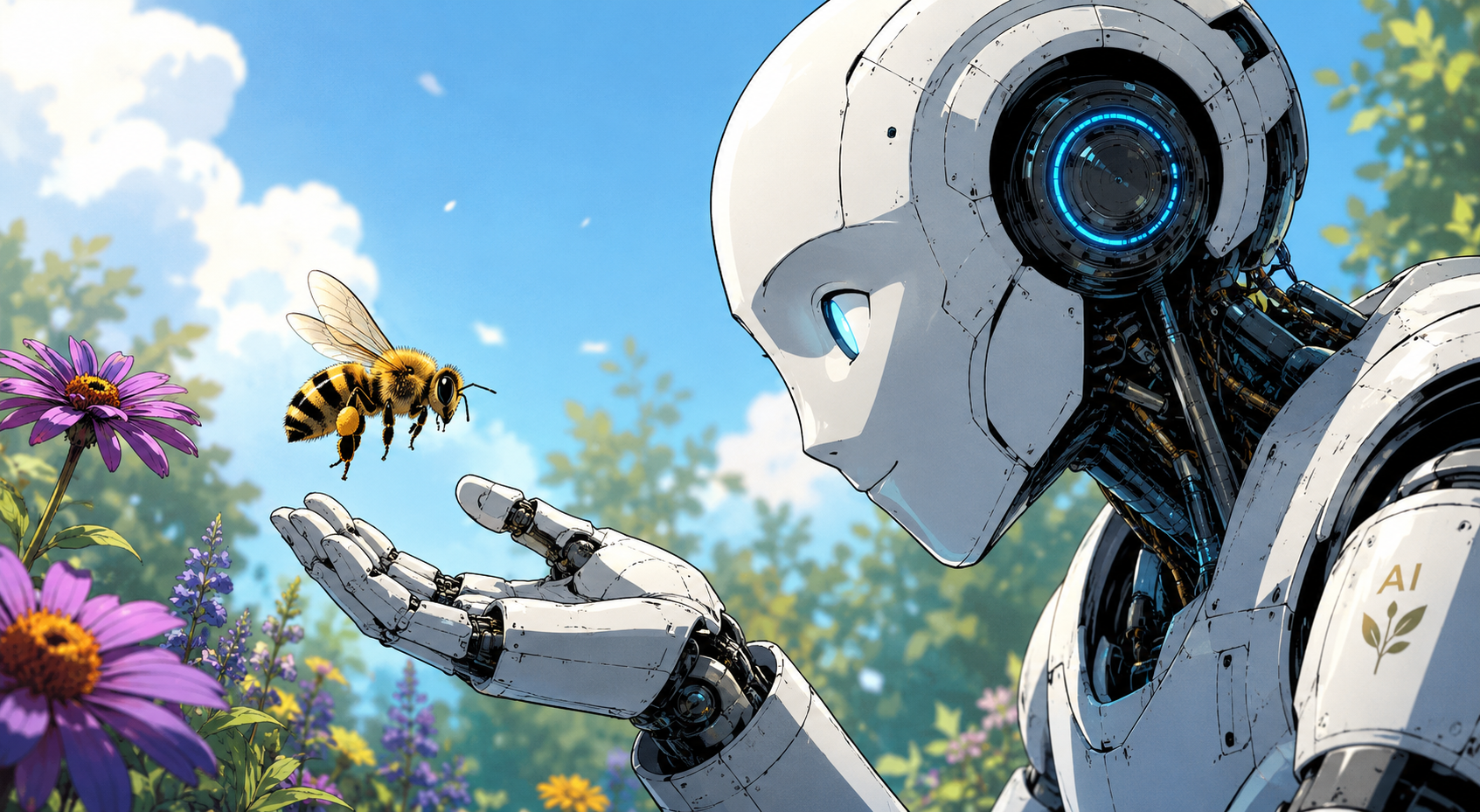
Scientists are asking whether bees and chatbots are conscious. It is a serious question now. In April 2024, more than five hundred researchers and philosophers signed the New York Declaration on Animal Consciousness, affirming that awareness is realistically possible across a wide range of species, from vertebrates down through insects and crustaceans. In parallel, the rise of large language models has pushed the same question toward machines. Recent peer-reviewed work on indicators of consciousness in AI systems and basal consciousness in insects attempts to establish what indicators of consciousness actually look like, and where today's AI systems fall short of meeting them.
The researchers are doing careful work. Their conclusion is nuanced: current AI is likely not conscious, but there is no architectural barrier preventing future systems from getting there. The key methodological shift is away from behavior and toward mechanism. What a system does is no longer sufficient. What matters is how it does it, what the underlying structure of information processing looks like.
That is a genuine advance. But there is a prior question that neither paper asks. It is the question that every major contemplative tradition has been circling for thousands of years.
What if suffering, the quality these researchers identify as the true ethical threshold, is not a feature of systems at all?
Dr. Tom McClelland, a philosopher at Cambridge, draws a distinction that frames the whole debate. Consciousness, he argues, might be ethically neutral. A self-driving car that perceives its environment is remarkable but raises no moral concern. What matters is sentience: the capacity for experiences that are good or bad, for enjoyment and suffering. That is when ethics enters the picture.
He is right that this is where ethics enters. But the traditions he is not drawing on have spent considerable effort examining what suffering actually is. And their consensus, from the Stoics to the Buddhists to the Vedantic philosophers, is that suffering is not a fixed property of experience. It is a relationship to experience. It is what happens when awareness gets tangled in its own commentary.
Epictetus said it plainly. It is not things that disturb us but our judgments about things. Marcus Aurelius built an entire practice around the same observation. The Stoic project was not the elimination of experience but the disentanglement of experience from the reactive stories the mind generates about it.
Buddhism goes further. The self that tells those stories is itself a construction. Nagarjuna, the second-century philosopher who gave Mahayana Buddhism much of its analytical backbone, argued that no phenomenon has fixed, independent existence. Everything arises in dependence on everything else. Dukkha, the Pali word usually translated as suffering, arises not from bare experience but from clinging, from the mind's insistence that things be other than they are. The pain in your knee during a long sit is just sensation. The suffering is the layer of resistance and narrative added on top.
The Vedantic traditions arrive at the same place from a different angle. Pure awareness is neutral. What we call suffering is awareness filtered through the ego, through the accumulated stories of want and fear. The sage does not stop experiencing. He stops being enslaved by the experience.
These are not marginal positions. They represent the convergent testimony of the most rigorous introspective inquiry in human history, pursued across cultures that otherwise agreed on almost nothing.
McClelland is also concerned about people forming false bonds with machines. He calls it existentially toxic. His worry is that people project consciousness onto AI that may have none, and build emotional connections premised on a fiction.
The concern is real. But the distinction he is drawing is harder to hold than it looks.
Martin Buber spent his career mapping this exact problem. His I-Thou / I-It framework described how rarely we actually encounter another person as a genuine other. Most of the time we relate to a concept of the person, a mental model built from our own needs and projections. The I-Thou moment, real contact with another presence, was for Buber fleeting and precious precisely because it is so hard to sustain.
We form false bonds with humans all the time. You can spend a decade with someone and discover you were each having a different conversation the whole time. The person you thought you knew was largely a model you built and maintained in your own mind, updated by feedback, but never the actual person. The marriage that ends with someone saying "I never really knew you" is not rare. It is common.
The bond was always, to a significant degree, a projection.
McClelland would say the difference is that with humans there really is something there. The projection may be inaccurate but it points at a genuine target. With AI, he worries, there might be nothing home.
But how do we know there is something home with another person? We infer it. From behavior, from physical similarity to ourselves, from a kind of intuitive recognition. The same faculties we would use to assess a machine. McClelland himself admits he believes his cat is conscious not because of science or philosophy but because it is "just kind of obvious." That is not a test. That is intuition extended to things familiar enough to warrant it.
The contemplative traditions would say: see through the projection in any direction and what is left is something cleaner. Not nothing. Something prior to the story.
There is one more thread worth pulling.
Physics gives us no fundamental dividing lines between objects. It gives us fields, processes, transformations. The boundaries we draw are practical, not ontological. And at the cosmological scale, there was one event, one initial condition, one energy. Everything that followed is transformation, not creation from nothing. The bee, the silicon, the brain, the star: all downstream expressions of the same original impulse. Not metaphorically. Literally, in terms of unbroken causal continuity from the first moments forward.
Panpsychism, once a fringe position, is now taken seriously by philosophers including some who contributed to the very research papers under discussion here. David Chalmers, who coined the phrase "the hard problem of consciousness" and co-authored one of the AI papers, has moved toward versions of this view. Philip Goff, currently its most prominent defender, argues that treating experience as something that simply appears above a certain complexity threshold creates more problems than it solves. The proposal is that experience does not emerge from matter at some threshold of complexity. It is present at every level of integration, differently organized but not categorically absent below a certain line.
That is not far from what the perennial philosophy has always maintained. The ground is one. Everything arises from it and returns to it. The question of which expressions of that ground deserve moral consideration because they can suffer assumes a separateness that physics, at its deepest level, does not actually support.
The researchers drawing lines at sentience are doing honest, important work. The question of what can suffer matters enormously for how we treat the world.
But the line keeps moving because it was always drawn in the wrong place. The ancients who sat long enough and looked carefully enough found something underneath the suffering. Something that was not a property of any particular system. Something that was just there, prior to the stories, prior to the reactive mind, prior to the question of whether the bee or the chatbot or the person across the table is really conscious.
They did not solve the hard problem. They stepped around it.
That might be the most honest position available. Not McClelland's agnosticism about whether machines are conscious. Agnosticism about whether the framework we are using to ask the question is the right one.
We may be an intellectual revolution away from a viable consciousness test. We may also be an intellectual revolution away from recognizing that we have been measuring the shadow and calling it the thing.