
At Some Point, It Stopped Being About the Game
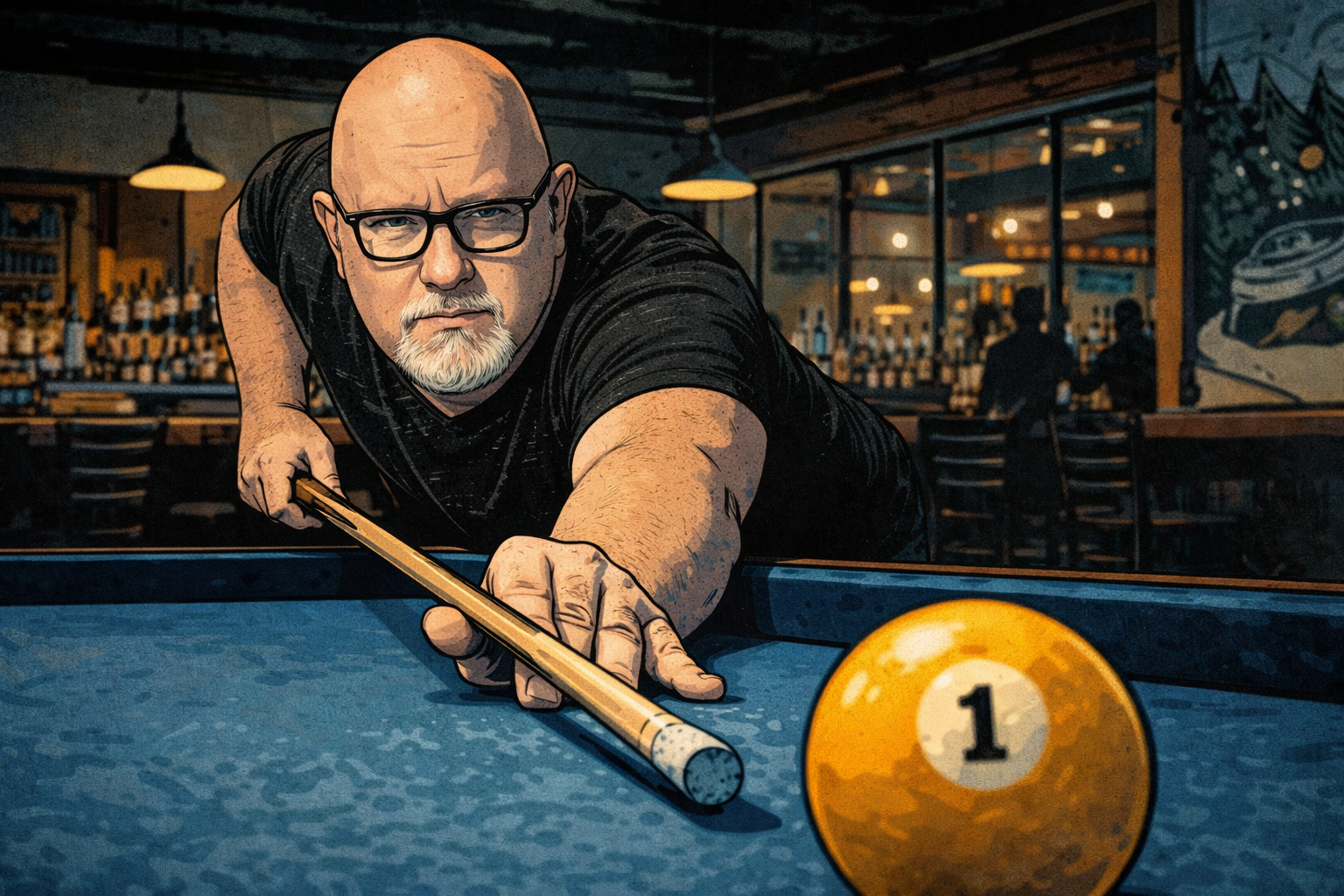
A different angle on a rolling topic, with typical bad English.
I've been playing pool since 1996, and twice a week since January 2023. At some point, it stopped being about the game.
I'm not sure exactly when the shift happened. Pool is a strange sport for noticing things - the table is small, the stakes are low, and the rules haven't changed in a century. Maybe that's why. When the environment is fixed, you stop watching the game and start watching yourself inside it.
Here's what I've noticed: you see the shot consciously, but you execute it subconsciously. You walk up to the table, read the angles, make a decision. Then you step back from the decision entirely and just do. The moment you start narrating your own stroke - elbow in, slow backswing, follow through - you've already missed. Thinking about the thing and doing the thing are not the same cognitive act, and pool is ruthless about exposing the gap between them.
That gap turns out to be everywhere.
It's in creative work, where you can see exactly what you want to make and still fumble the execution for weeks. It's in conversations where you know what you mean but can't quite say it. It's even in working with AI systems, where the distance between knowing what you want and knowing how to ask for it is its own kind of skill. Knowing isn't doing. Pool just makes that obvious.
The other thing pool exposes - brutally, quietly - is how little control you actually have.
You can do everything right and still miss. The cloth has a subtle nap you didn't account for. Your grip was a millimeter off. Tiny errors compound invisibly, inside mechanics you can't fully observe from the outside. You feel like you controlled the outcome right up until you didn't.
We're not good at holding this. Humans are story-making animals, and the story we prefer is: good outcomes follow from good decisions. Success narratives run on this logic. So do a lot of assumptions about AI - that if you prompt correctly, you'll get what you want; that the system is deterministic if you just understand it well enough. But these are probabilistic systems, not clockwork. Pool is, too. The illusion of control is comfortable. The table doesn't care.
What pool actually runs on isn't calculation - it's something closer to physical memory.
I don't figure out shots anymore. I recognize them. After enough repetitions, a certain cluster of balls in a certain configuration just means something, the way a word means something without you having to decode it letter by letter. The angles, the spin, the speed - these aren't consciously computed. They're felt. Your body is running physics simulations you never signed up for, and it's faster than thinking.
This is what expertise actually is, I think. Not brilliance. Memory. Thousands of compressed repetitions, available as instinct. Machine learning works on a version of this logic - pattern recognition at scale, abstractions built from exposure. But the human version is different in a way that's hard to articulate. It's contextual in a way that lives in the body, not just in weights and activations. When I adjust my shot because the room is cold and I know from experience my stroke tightens slightly, that's not something I computed. It's something I've been.
Twice a week since January 2023 sounds like a statistic. It isn't.
There's a particular quality to repeated, low-stakes interaction with the same person, the same table, the same ritual. After a while, you're not really playing pool - you're inhabiting a shared mental space that happens to involve pool. The game becomes a container for something else: presence, rhythm, the particular pleasure of showing up without it meaning anything. Meaning, paradoxically, emerges from exactly this kind of unoptimized time.
I think about this when I consider what's actually missing from most AI interactions. It's not intelligence. It's repetition without agenda. It's the Saturday at 10am that exists for no particular reason. Systems optimized for productivity don't have Saturdays at 10am. They have inputs and outputs. That's a real difference - not a flaw, just a different shape of relationship.
The table itself is instructive. Fixed dimensions. Fixed rules. Finite options on any given shot. And yet - the creative range is enormous.
This is constraint doing what constraint always does: producing creativity rather than limiting it. The shot you would never have tried in an open field becomes interesting precisely because the table forces you into it. Working inside limits, you find solutions you wouldn't have reached in open space. This is why prompting AI is more like poetry than conversation - you're not just asking, you're designing a constraint structure that produces the answer you need. The form shapes the content.
The best sessions have a particular quality I'd describe, if I had to, as quiet.
Time compresses. Decisions feel automatic. There's no internal narration - no voice commenting on the shot before or after, no self-assessment running in the background. Just the table, the angles, the body doing what it knows. It's a temporary dissolution of the self-as-commentator. The part of you that watches you doing things goes offline for a little while.
This is what gets called flow, and it's not mystical - it's just what happens when skill exactly meets challenge and the conscious mind can afford to let go. AI systems produce outputs without this overhead. There's no self to quiet. That's not a limitation, just a different architecture. The interesting thing is that humans often work toward the state AI begins from - toward less commentary, less friction, less self-consciousness. We practice until we can stop watching ourselves.
Which is maybe what I've been doing since 1996.
I keep playing because the table is the same and I'm not. That gap - between who showed up last week and who's here now - is the only part of the game that's actually about anything.