
Cognitive Dissidents on Tour!
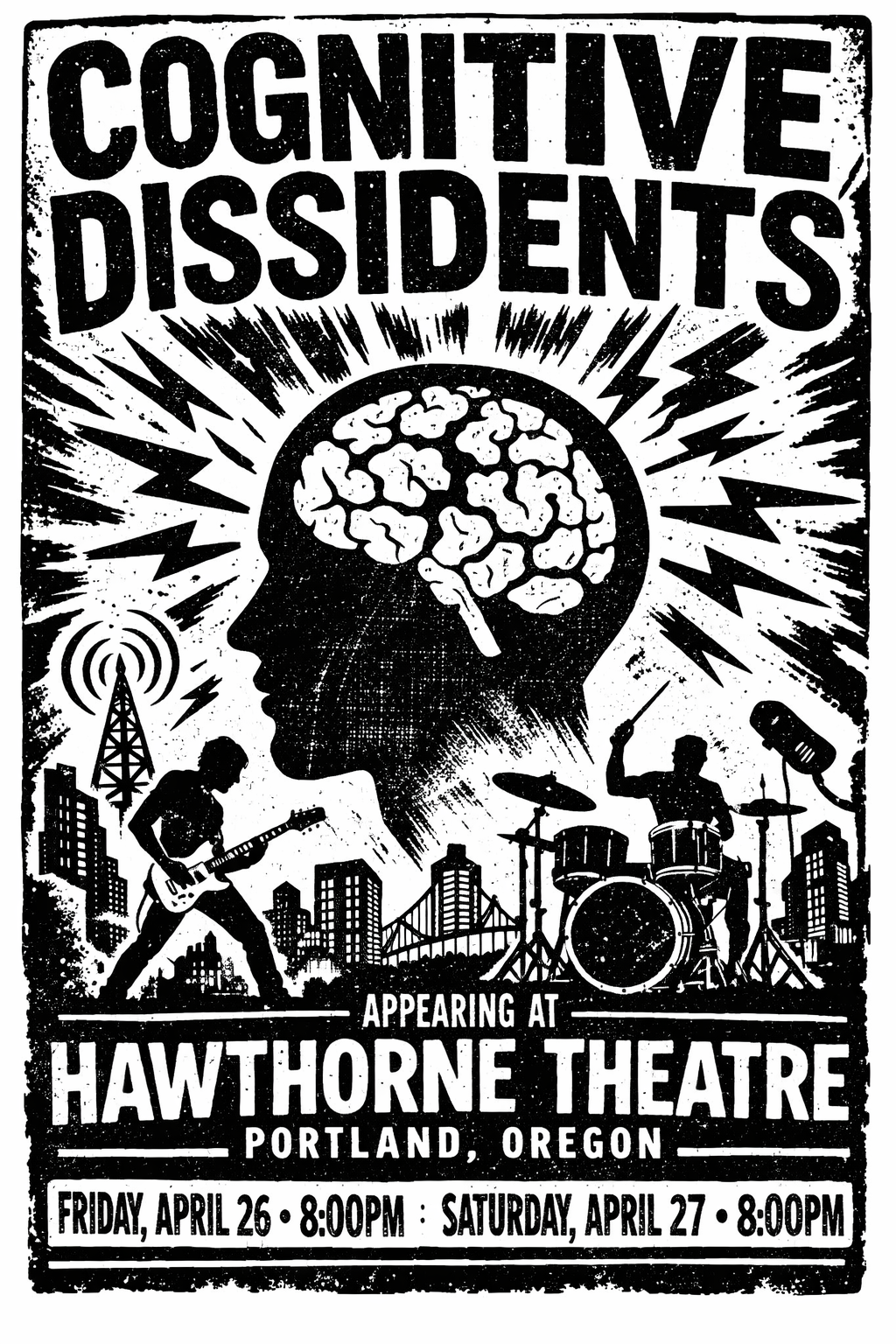
Most people have heard of cognitive dissonance, the uncomfortable tension that arises when our beliefs and actions do not line up. The term was introduced in the 1950s by the social psychologist Leon Festinger, who proposed that humans have a deep psychological drive to keep their internal beliefs consistent. When a contradiction appears, when we do something that conflicts with what we believe, we feel mental stress. To relieve that stress, we usually adjust something: we change our belief, justify the behavior, or reinterpret the situation so the contradiction disappears.
But imagine a slightly different phrase: cognitive dissidents.
A dissident is someone who refuses to accept the prevailing system. Applied to thought, a cognitive dissident would be someone who resists the comfortable mental shortcuts most of us rely on. Instead of smoothing over contradictions, they lean into them. They question assumptions, challenge consensus, and remain suspicious of easy explanations. Where cognitive dissonance pushes most people toward mental harmony, cognitive dissidents tolerate the friction.
In that sense, intellectual progress often depends on cognitive dissidents. Science advances because someone refuses to accept the current model. Philosophy moves forward when someone pushes against inherited ideas. Even personal growth usually begins with the moment we realize that something we "know" might not actually be true.
Most of us spend our lives trying to resolve dissonance as quickly as possible. A cognitive dissident does something different: they pause before rushing to resolve the contradiction. In many ways this resembles the posture encouraged in mindfulness practice. Mindfulness trains a person to observe thoughts without immediately reacting to them, to notice the mind generating explanations, judgments, and stories. When you slow down enough to watch that process, you can sometimes see the tension Festinger described forming in real time. Instead of instantly repairing the contradiction, you sit with it. That quiet space, between the thought and the explanation, can reveal how much of our thinking is simply the mind trying to protect a consistent narrative about who we are. In that moment, the dissident is not rebelling against society so much as rebelling against the mind's instinct to tidy everything up too quickly.