
Every Name Was New Once
Those of you who read "The Paths Words Travel" know how I got into etymology. I was naming fictional characters and wanted names that felt like they belonged to their worlds, so I started looking up where names came from. Once I started, it was hard to stop. Names led to words, words led to languages, and languages led to the ideas underneath them.
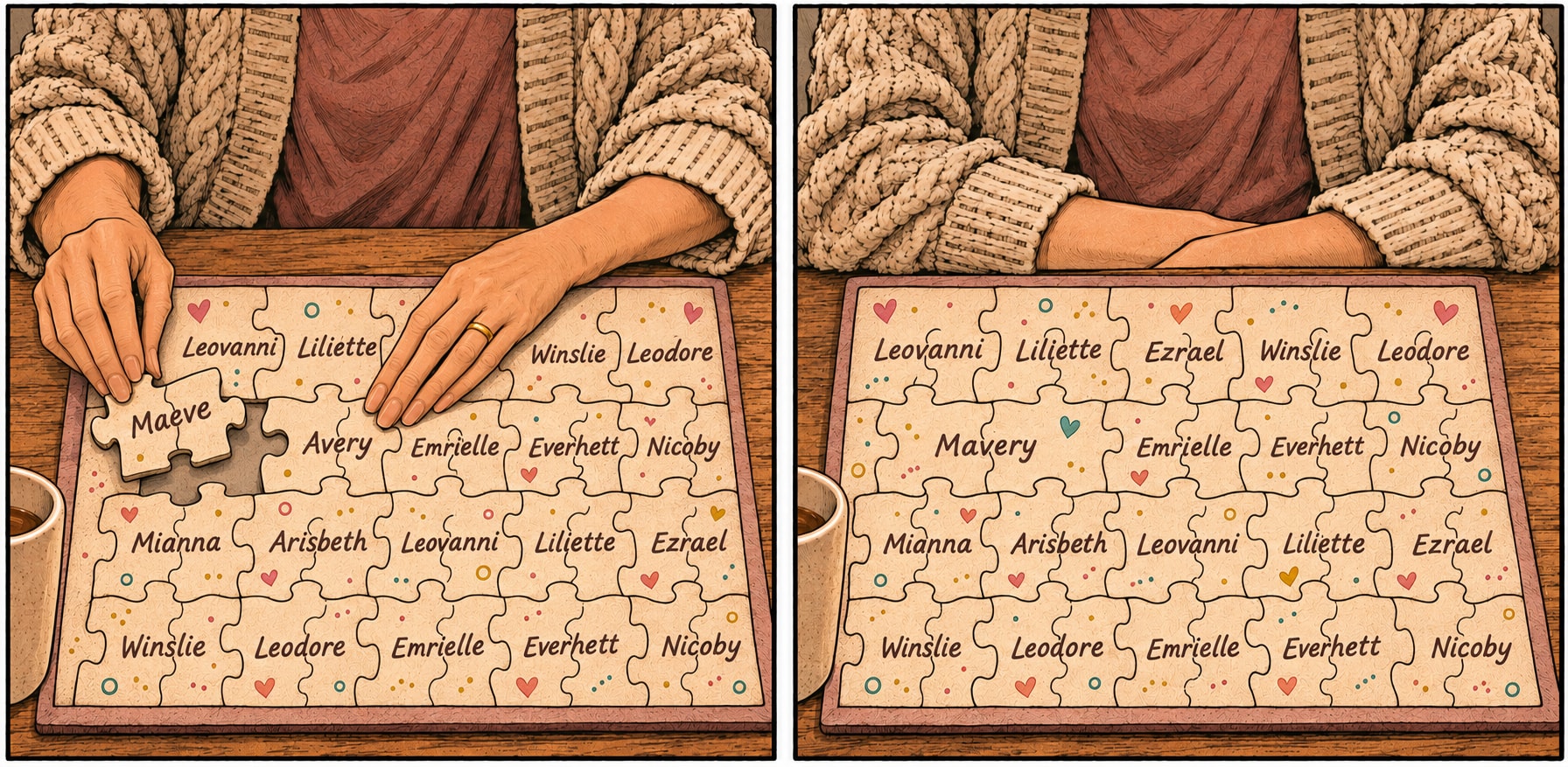
So when I came across a baby-naming trend called namemaxxing, I paid attention. Parents take pieces of two names they love and blend them into something new. Maeve and Avery become Mavery. Nameberry, which coined the term, puts it at the top of its 2027 trend list, with examples like Leovanni, Liliette, Ezrael and Winslie.
My first reaction was to recoil. Part of that is the word itself. "Maxxing" started on incel message boards as "looksmaxxing," the pursuit of peak attractiveness, and it has since spread to everything people want to optimize: sleep, fitness, productivity. Dictionary.com made it the word of the year for 2026. Attaching it to a baby's name felt like treating a child as one more thing to optimize, a name engineered for uniqueness instead of handed down.
Then I remembered my own argument. Words aren't fixed. They widen, narrow and pick up new meanings as they move. Names are words, and they follow the same rules.
Take John. It started as the Hebrew Yohanan, "Yahweh is gracious." Hellenized Jews carried it into Greek as Ioannes, which is how it appears in the New Testament. Latin made it Iohannes. In France it wore down to Jehan, and later Jean. John Calvin still spelled his name Jehan Cauvin in the sixteenth century, and Joan of Arc spelled hers Jehanne. The name came into England through Anglo-French as Johan, and by the middle of the twelfth century English speakers were writing it Jon or Jan.
Then it took off. John the Baptist and John the Evangelist made it one of the most common Christian names, and by the early 1300s it rivaled William in England. From about 1550 until the middle of the twentieth century, either John or William was the top name in England and English-speaking North America. John stayed the most popular name for American baby boys until 1924.
Along the way it kept splitting. Spain made it Juan, Italy Giovanni, Portugal João. Germany made it Johann, which shortened to Hans. Russia made it Ivan. Ireland made it Seán, Scotland made it Ian, and Wales made it Ieuan, which became Evan. The Welsh Bible used the form Ioan, which is part of why Jones is such a common Welsh surname. The feminine side branched too: Jehanne became Jeanne in French, and English ended up with Joan and Jane.
Then there's Jack. Medieval English speakers made pet names by adding "-kin," so William became Wilkin and Adam became Adkin. John became Jankin, then Jackin, then Jack. Scholars still argue about the exact steps, but the nickname got so common that "jack" came to mean any ordinary man. In England and Wales, Jack was the most popular name for baby boys every year from 1995 to 2005. A nickname for John ended up more popular than John. None of it was planned. It happened one mouth at a time.
Blending names isn't new, either. In 1713 Jonathan Swift wrote a poem for Esther Vanhomrigh, a young woman he had tutored. He called her Vanessa, taking "Van" from her surname and "Essa" from a pet form of Esther. The poem wasn't published until 1726, after her death. In 1807 a naturalist borrowed the name for a genus of butterflies. Today Vanessa doesn't sound invented at all.
Marilyn is the same story on a bigger scale. It's a blend of Mary and Lynn that came into use in the 1920s and peaked from the 1930s through the 1950s. One of the oldest and most revered names in the Western world got spliced onto a short English name, and the result sounded natural enough that a generation of parents chose it.
If Mavery makes me wince and Marilyn doesn't, the difference isn't in the method. It's in the mileage. Marilyn has had a century to wear smooth. Vanessa has had three. John has had more than two thousand years, and it's still changing.
That's what etymology keeps teaching me. Every name I ever traced back was new once. Somebody had to say it for the first time, and somebody else probably thought it sounded made up. When I named my characters, I went looking for roots so the names would feel like they had grown in their worlds instead of being dropped in from outside.
Namemaxxing parents are doing something close to that. They aren't pulling syllables out of the air. Nameberry describes it as blending two beloved names into something that still carries the essence of both. That's not so different from what Swift did. He made a name out of a person.
I still don't love the word. "Maxxing" carries its origins with it, the way words do, and I'd rather a child's name didn't sound like a performance metric. But the practice underneath the label is old, and it's human. Names have always been built out of other names, and this is one more path they're traveling.
Mavery belongs to its world. Its world just happens to be ours.