
My Perspective on How a Life is Built
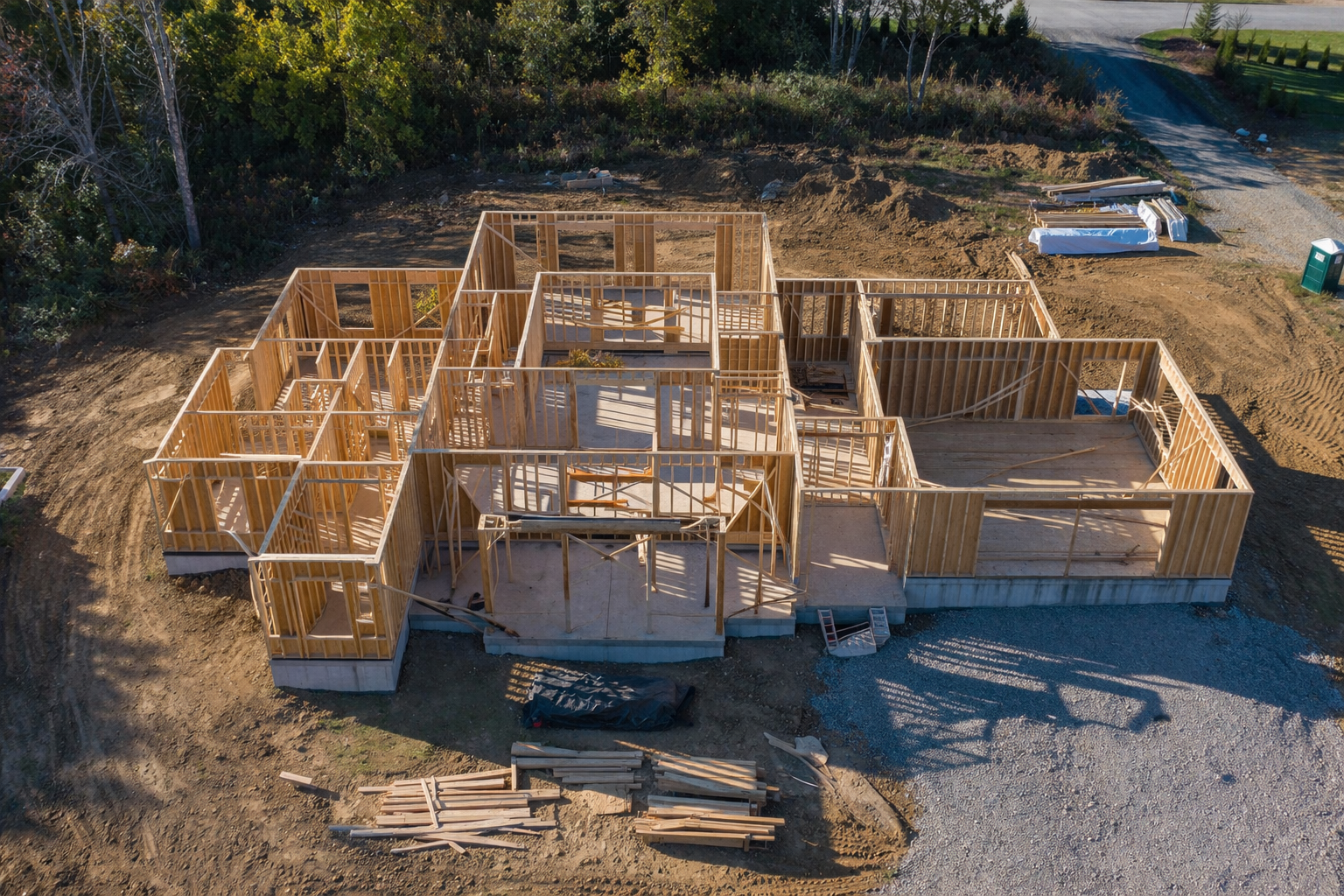
There is a pattern you can feel before you can name it. It shows up quietly, not as a rule but as a rhythm. Looking back, it starts to look like life reorganizes itself every several years, not dramatically, but enough that your relationship to yourself shifts. The ground does not move, exactly. But you notice you are standing in a different place.
This is not something I learned from a theory first. It is something I noticed from the inside, the way you notice a season changing not because someone told you to look, but because the light is different and the air has a different weight. Only later did I realize that parts of it had been mapped before, in different ways, by people who were trying to understand the same thing.
The simplest way I can frame it is this. The first half of life is foundation. The second half is building. The foundation tends to follow a shared rhythm. The building depends on what you actually have to work with.
The Foundation
In early life, the rhythm is surprisingly consistent.
Around eight, something stabilizes. You recognize yourself as a continuous person, not just a collection of moments, but someone who persists through time. Memory starts to feel like yours. You begin to understand that there is a you that showed up yesterday and will show up tomorrow. Jean Piaget described this shift in The Psychology of the Child as children moving into more structured, concrete reasoning. From the inside, it feels less like an intellectual development and more like the first time you can see the outline of yourself.
By sixteen, there is a stronger sense of agency. Choices feel like yours, even when they are limited. Identity starts to form in a way that feels personal rather than inherited. Erik Erikson mapped this as the tension between identity and confusion in Childhood and Society and Identity and the Life Cycle. This is also when the gap between who you are and who your parents are starts to open up. For some people that gap is liberating. For others it is terrifying. Often it is both at once.
Around twenty four, perspective deepens. You can look back on your past as a story, not just what happened but what it meant. Relationships, direction, and interpretation start to matter more than raw experience. You begin to ask not just what you are doing but why, and whether it is actually yours.
By the early thirties, there is often a quiet shift. Youth is no longer your identity, even if you still feel young. There is a subtle boundary crossed, a sense that you are now building something rather than just becoming something. Daniel Levinson came closest to describing the structure of this in The Seasons of a Man's Life, with alternating periods of stability and transition that often fall into six to eight year spans.
What Gets Laid Down
But the foundation is not only psychological.
Alongside the interior shifts, something else is being constructed, or not constructed, during the first half of life. Habits. Practices. The behavioral and material infrastructure that the second half will either draw on or go without.
Some of this is inherited directly. If you grew up in a house where people exercised, where money was managed with some intentionality, where conflict was navigated rather than avoided, those patterns tend to follow you. Not because you chose them, but because they were the house you lived in. You learned them before you had the awareness to evaluate them.
Some of it is a response to what was missing. People who grew up with financial instability sometimes become disciplined savers. People who grew up in chaotic households sometimes build unusually stable ones. The foundation can be built in reaction as much as in inheritance. That is its own kind of architecture, shaped by absence as much as presence.
And some of it is built through deliberate choice, though that choice is never made in a vacuum. The person who starts running at twenty two, or who begins a meditation practice, or who decides early to invest in friendships rather than just accumulate acquaintances, is laying something down that will matter later. I can say this from the inside. The practices I built in my earlier years, some inherited, some chosen, some discovered by accident, are not incidental to who I am now. They are structural.
What makes this complicated is that the foundation is never fully equal. Two people can arrive at fifty with similar psychological development and radically different material realities. Health, economic stability, the presence or absence of a reliable support network, these are not just circumstances. They are load-bearing. The building you can construct depends in part on things that were never entirely in your hands.
The Inflection Point
Then comes the shift that changes the nature of the project.
Somewhere between forty and the mid forties, the pattern changes. For some people it shows up as disruption, a sudden awareness that the life they have been building is not quite the life they meant to build. For others it arrives as clarity, a sense of momentum and purpose that feels cleaner than anything in the years before. Often it is some unstable mixture of both.
What had been a forward momentum begins to turn inward. Questions shift from achievement to meaning. The external markers that organized the first half start to feel insufficient.
Levinson described this as a midlife transition, something necessary rather than pathological. Carl Jung framed it more deeply as individuation in Modern Man in Search of a Soul, a movement away from external validation toward internal alignment. Both were pointing at the same thing from different angles: this is where the building project becomes conscious. You are no longer just living forward. You are starting to ask what you are actually constructing and whether it is worth the materials.
Erikson described a tension at this stage between generativity and stagnation, whether you are creating, contributing, extending yourself into the world, or closing in on yourself. That framing has always struck me as honest. The forties are often when the difference between those two trajectories becomes visible.
By the late forties into the early fifties, another awareness begins to take shape. Physical limits are no longer abstract. Mortality is no longer theoretical. It is not a constant presence, but it is present in a way it was not before, a new variable in every calculation.
Where the Shared Rhythm Ends
Up to this point, the rhythm feels shared. Not identical across every life, but recognizable. Biology, culture, and developmental timing all push in similar directions. There is enough of a common structure that the stages can be named.
After this point, the pattern starts to break apart.
This is where life becomes less universal and more specific, more dependent on the particular foundation that was laid and the particular building that has been constructed.
Levinson's work has real limits here. His research drew largely from middle class professional men, which narrows its reach considerably. The idea of a shared sequence is harder to defend when you factor in significant differences in health, economic stability, the presence or absence of close relationships, and the accumulated weight of a life's specific circumstances.
Erikson continued to propose later stages, including integrity versus despair, but even these assume a kind of shared arc. What actually shows up in later life is far more variable.
This is where longitudinal research like George Vaillant's Aging Well becomes more useful than stage theory. His findings from the Harvard Study of Adult Development suggest that what shapes later life is not a universal sequence but a combination of specific factors: health, relationships, coping style, the actual texture of the life you have lived. The foundation matters more than the timeline.
The Foundation Is Not Fixed
There is a common assumption woven into most developmental thinking: that early life determines everything. That once the foundation is set, the rest follows from it. That the habits, patterns, and structures of the first half are essentially locked in.
That turns out to be incomplete.
Research into adult neuroplasticity suggests that meaningful psychological change remains possible well into later life. Joseph LeDoux, in Anxious, explores how emotional memory and deeply ingrained patterns can be reworked through processes like reconsolidation. The structure is not as permanent as it looks from the outside.
Contemplative traditions have held this position far longer than neuroscience has. The idea that the self can be observed, understood, and genuinely reshaped is not a modern discovery. It is ancient, and it has been tested by a great many people over a very long time. I have been practicing in that territory for more than forty years, and I can tell you it is not theoretical.
Foundation repair is real. People go back in the second half and reinforce things, correct things, sometimes replace things that were never right to begin with. A significant relationship, a crisis that cracks something open, a sustained practice, these can all do structural work. The first half is not sealed.
What You Are Building
So the model, such as it is, comes down to this.
The first half of life lays a foundation. That foundation follows a recognizable rhythm, shaped by biology, development, and the particular circumstances you were born into and grew up inside. Some of what gets laid down was handed to you. Some of it you built in reaction to what was missing. Some of it you chose, with whatever awareness you had at the time.
The second half builds on that foundation. What gets constructed depends on the material you have, the awareness you bring, and the willingness to keep working even when the early blueprints turn out to be wrong.
Some of what you have to work with was in your control. A lot of it was not. The rest is what you are still able to change.
That is not a theory. It is just what I have noticed, looking back at the rhythm of it, and forward at what is still being built.