
It Took the Wheel
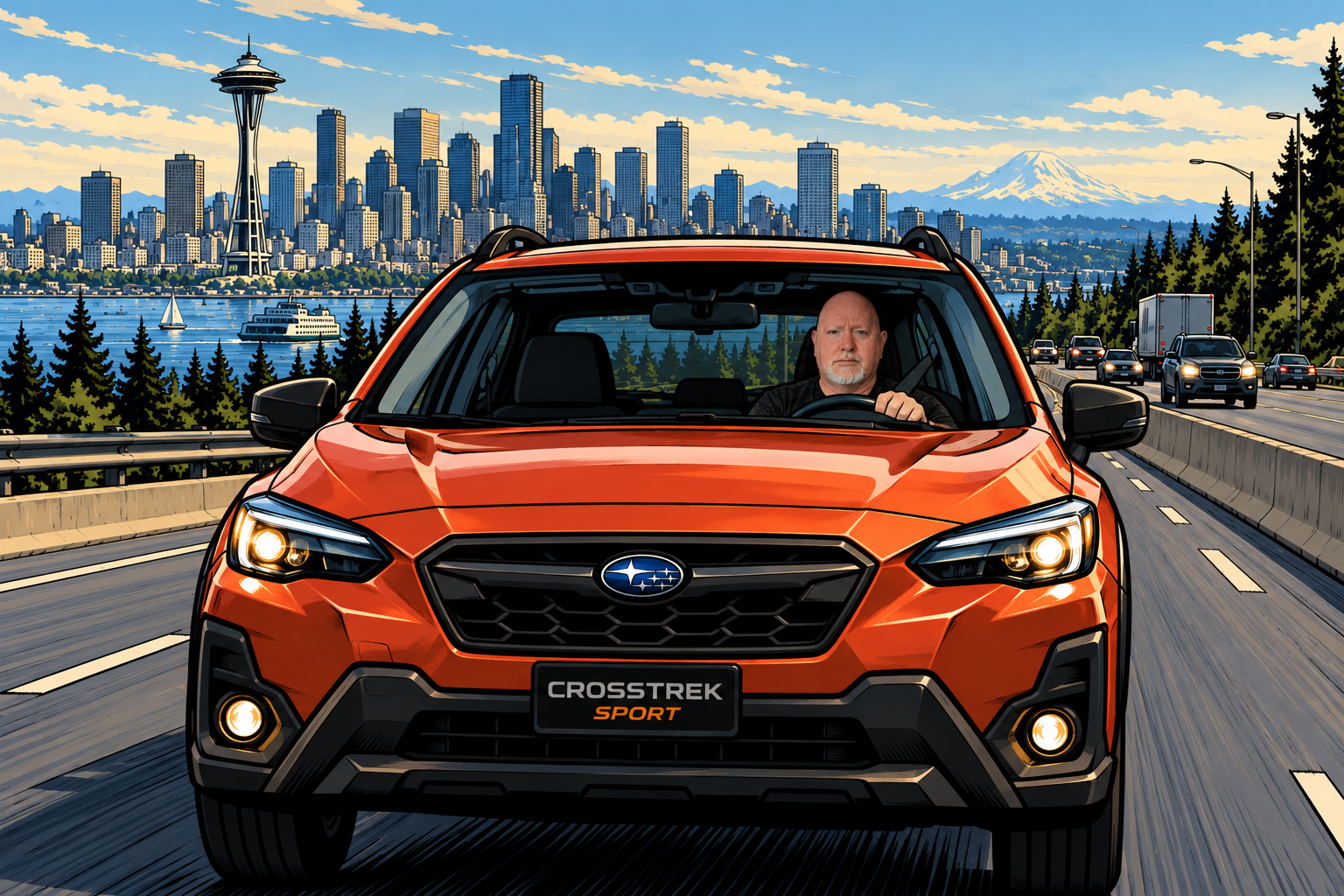
I left Portland at five in the morning, which on a Friday is the one window when I-5 north is nearly empty. It was just me and the truckers under a gray sky that never quite decided to rain. It stayed overcast most of the way up. I reached down and set the cruise control the way I have set it in every car I have ever owned, expecting the same dumb bargain: pick a speed, hold it, pray nobody brakes suddenly. That is not what happened. The car started thinking.
It saw the traffic ahead of me before I did. When a car drifted into my lane a quarter mile up, the Crosstrek eased off the accelerator on its own, held a polite distance, and gathered the speed back up when the road cleared, smoothly, the way a careful person would. I had expected a thermostat. I had been handed something closer to a chauffeur.
Then I turned on the lane centering, and that is where it stopped being a novelty and started being a little uncanny. I kept my hands on the wheel, the way you are supposed to, and as the highway bent I felt the car guiding itself toward the center of the lane. Not fighting me. Correcting me. It was finding the middle of the lane more precisely than I was, and I have been driving a long time. On a few open stretches, with no one around, I let my hands hover just off the wheel and watched it take the curves on its own, clean and unbothered.
After a while I noticed how little I was actually doing. It is 180 miles from Portland to Seattle, and over almost all of them it felt as though the only real decision left to me was which lane to be in. When I flicked the turn signal to move over, the car handed the steering back and waited, patient, for as long as the blinker stayed on. The moment I clicked it off, it found the new lane, settled into the center, and took over again. I chose the lane. It did the driving.
For all that, I want to be clear about what this is. This is not a self-driving car. It is what the engineers call Level 2 driver assistance, and I am still the one responsible for everything that happens. There are no lasers on the roof, no spinning lidar, nothing exotic. It is two cameras mounted behind the rearview mirror, reading the painted lines and the shapes of cars, feeding a piece of software that decides what to do. That plainness is the part I keep turning over. Two cameras and some code already do this. If this is the floor, I find myself very curious about the ceiling.
That curiosity did not mean I trusted it. I spent the drive up testing it, second-guessing it, keeping my hands tense on the wheel, waiting for a mistake it never quite made. The drive back today felt different. The clouds had burned off, and I pulled onto the road around noon on a Saturday into full sun and full traffic. The empty gray highway of Friday morning was gone, replaced by the merging and bunching and sudden slowing of a busy road. I expected the system to struggle with it. It handled the crowded, sunlit Saturday exactly as well as it had handled the empty, overcast Friday, which is to say better than I expected both times.
That help mattered more on the way home, because of what the retreat had done to me. It was the standing and walking all over that got me, over an hour of it, and the milling around the way you do at these things. I had been favoring my left knee the whole time, which meant my right leg took the load. By the end, my right ankle had swelled up and started to ache. The small, constant labor of driving was work my body did not especially want to do: the throttle, the corrections, the holding of a lane for three hours. The car took that work. I did not have to be grateful for a miracle. I only had to be grateful for a little relief on a day I needed some, which is a smaller thing and a truer one.
That little relief is what stayed with me after the drive. Not all of this technology is going to remake our lives overnight. The headlines want it to be a revolution or an apocalypse, one or the other, arriving next Tuesday. But a great deal of AI is going to show up the way this did, discreetly, inside something you already own, making an ordinary task easier than it was. People are afraid of it, and I do not think they are wrong to be. Change is frightening, real change most of all, and the essays promising that AI will end humanity inside a decade are engineered to frighten. I understand the fear. I feel the edge of it myself.
I do not think you answer that fear with a bigger prophecy. You show people one small thing that helped. I am an optimist about all of this, because when I weigh the benefits against the costs, the benefits keep coming out ahead.
The last stretch of the drive gave me one more reason for that hope. Coming back into Portland, I found I-5 shut down for several miles and the 405 backed up for miles. The highway the car had made so easy simply ended, and I diverted onto surface streets, ankle and all, to pick my way home through stoplights and turns and the ordinary mess of a city. The car had helped with the steering and speed for 163 of the 180 miles. The seventeen it left me were the closure, the detour, the improvising.
But even that improvising came with help. Google Maps drew the line home through those last seventeen miles, routing me around the shutdown and choosing the turns. It was doing its own version of the work the car had been doing, reading a flood of live data to find the best path through it. So the handoff at the edge of the freeway was not from the machine back to me. It was from one AI to another, from the one that steers to the one that finds the way, with me in the middle, helped home by two systems I had not really thought of as artificial intelligence.
That is the honest shape of where we are. The future did not announce itself. It did not arrive the way I was told it would. It steered most of the miles, found the rest, and asked almost nothing of me but my attention. That is a smaller thing than the prophets promise, on either side. It is also already here, discreetly, in the car and in the phone on the seat beside me.