
Killing Two Birds, and Other Things We Say Without Thinking
Language is full of landmines for the literal-minded. We say these things dozens of times a day, never once picturing what we're actually describing. But slow down for a second and really see the words, and suddenly English becomes a very strange place to live.
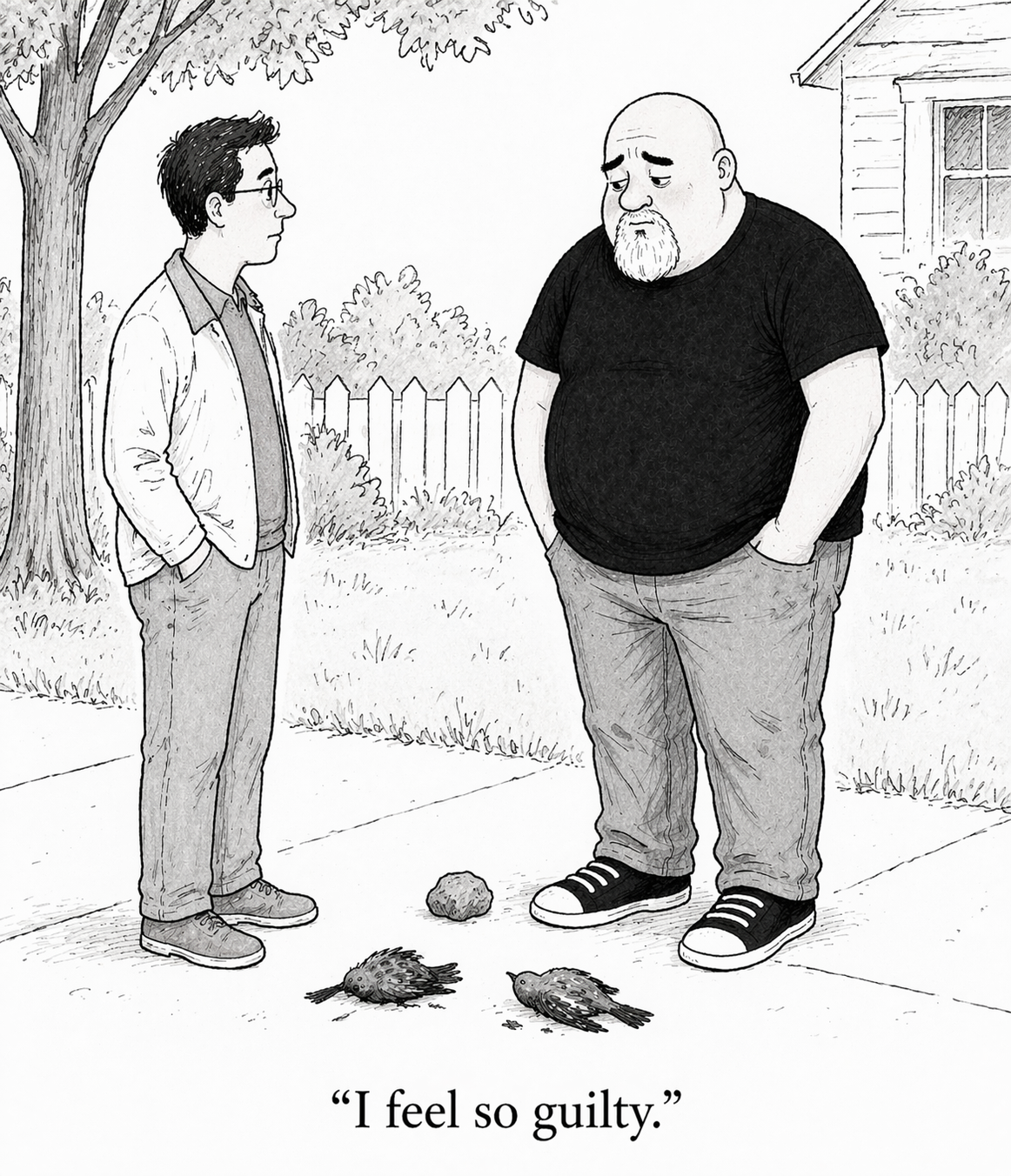
Take yesterday. I found myself telling someone I was "killing birds" referencing running errands, and saying "there's another bird" as I crossed things off my list.
That moment got me thinking about where these phrases come from, and what they'd look like if we meant them literally.
There are two groups of people who tend to experience idioms most intensely, and for surprisingly similar reasons.
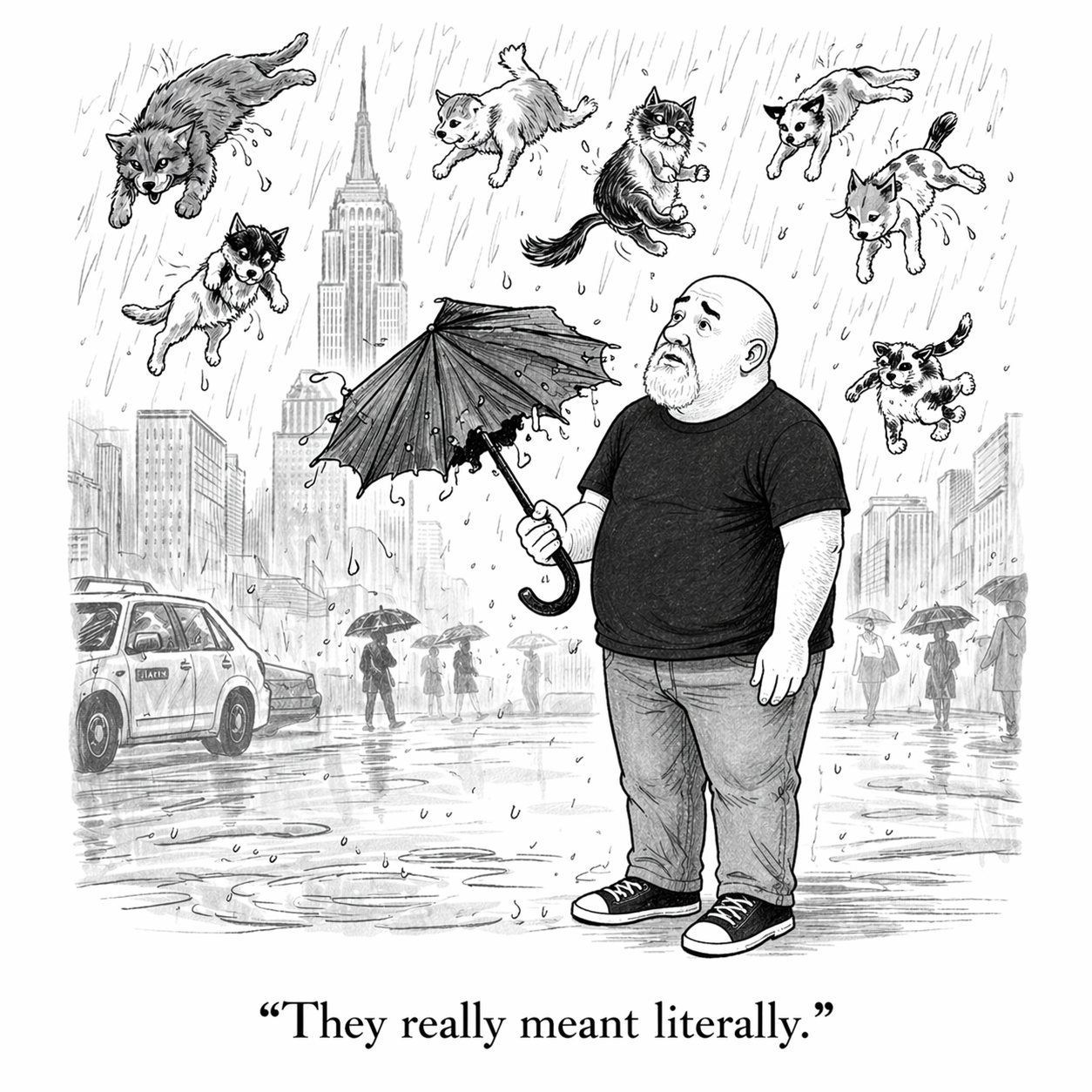
People with autism often process language with a strong preference for the literal. An idiom lands as a statement of fact first, and the figurative meaning, if it comes at all, has to be learned as a separate piece of information. "It's raining cats and dogs" can genuinely stop someone in their tracks. Not as a joke. As a sincere moment of confusion about what is happening outside. The neurological wiring that makes metaphor feel automatic and transparent to most speakers is exactly the wiring that idioms exploit, and for someone who doesn't have that shortcut, each phrase has to be catalogued individually.
What happens next is the part I find genuinely delightful. Once the idiom is learned, it often gets deployed with tremendous enthusiasm and not always perfect aim. There's something freeing about having cracked the code. The phrase gets used frequently, sometimes in situations where it almost fits, sometimes where it really doesn't, and occasionally where the application is so creative it makes you question whether they've understood it better than you have. The overuse isn't a deficit. It's the pleasure of finally being in on the joke.
Killing Two Birds with One Stone
The image is almost impressive. One perfectly thrown stone, two birds, total efficiency. The phrase shows up in English as early as the 1600s, though some trace variants of the idea back to ancient Greek. The literal scenario is plausible, actually, which might be why it stuck. A clean metaphor for efficiency will always find an audience.
Blowing Smoke
This one has a genuinely fascinating, if possibly apocryphal, origin story. The popular account traces it to 18th century medicine, when practitioners would literally blow tobacco smoke into a patient's rectum as a resuscitation technique, particularly for drowning victims. Tobacco enema kits were reportedly standard equipment along the Thames. The theory goes that the phrase "blowing smoke up someone's ass" meant giving them something useless dressed up as cure. Whether or not the history is entirely accurate, it became a genuine medical practice long enough to enter the language, and the phrase survived to mean exactly that: flattery with no substance behind it.
Breaking the Ice
Before the railroads, before the canals, trade routes in cold climates depended on ships. When a harbor or river froze over, smaller "icebreaker" vessels were sent ahead to break a path for merchant ships. The first contact, the hard physical work of clearing the way, gave us the social metaphor. Now we use it for small talk at parties, which feels like a downgrade.
Spilling the Beans
One theory points to ancient Greece, where secret ballots were cast using beans. White beans for yes, black beans for no. Knock over the jar, and the secret vote was out. The image of someone literally tipping over a jar of beans and ruining everything is both comic and accurate to how secrets usually escape.
Hitting the Sack
Before modern mattresses, many people slept on sacks stuffed with straw, hay, or corn husks. "Hitting the sack" meant exactly what it sounds like: throwing yourself down onto the thing you slept on. The phrase retained its meaning even as the object disappeared. We kept the verb and the sack, lost the straw.
Kick the Bucket
Several competing origins here. One theory involves the wooden beam (called a "bucket" from the Old French buquet, meaning a balance or trebuchet) used in slaughterhouses to hang animals by their heels. The animal's final spasms would cause it to kick the bucket beneath it. Another theory connects it to suicide by hanging, the bucket being the thing kicked away. Either way, it's bleak imagery dressed up in casual language we use to announce someone's death at the dinner table.
Bite the Bullet
Before anesthesia was reliable or available, surgeons in the field needed patients to stay still during procedures. Giving them something to clench between their teeth, often a leather strap or a bullet, served two purposes: it kept them from crying out and gave them something to bear down on. The bullet detail may be more literary than literal, but the practice of giving patients something to bite was real. "Biting the bullet" came to mean enduring something painful without complaint.
Let the Cat Out of the Bag
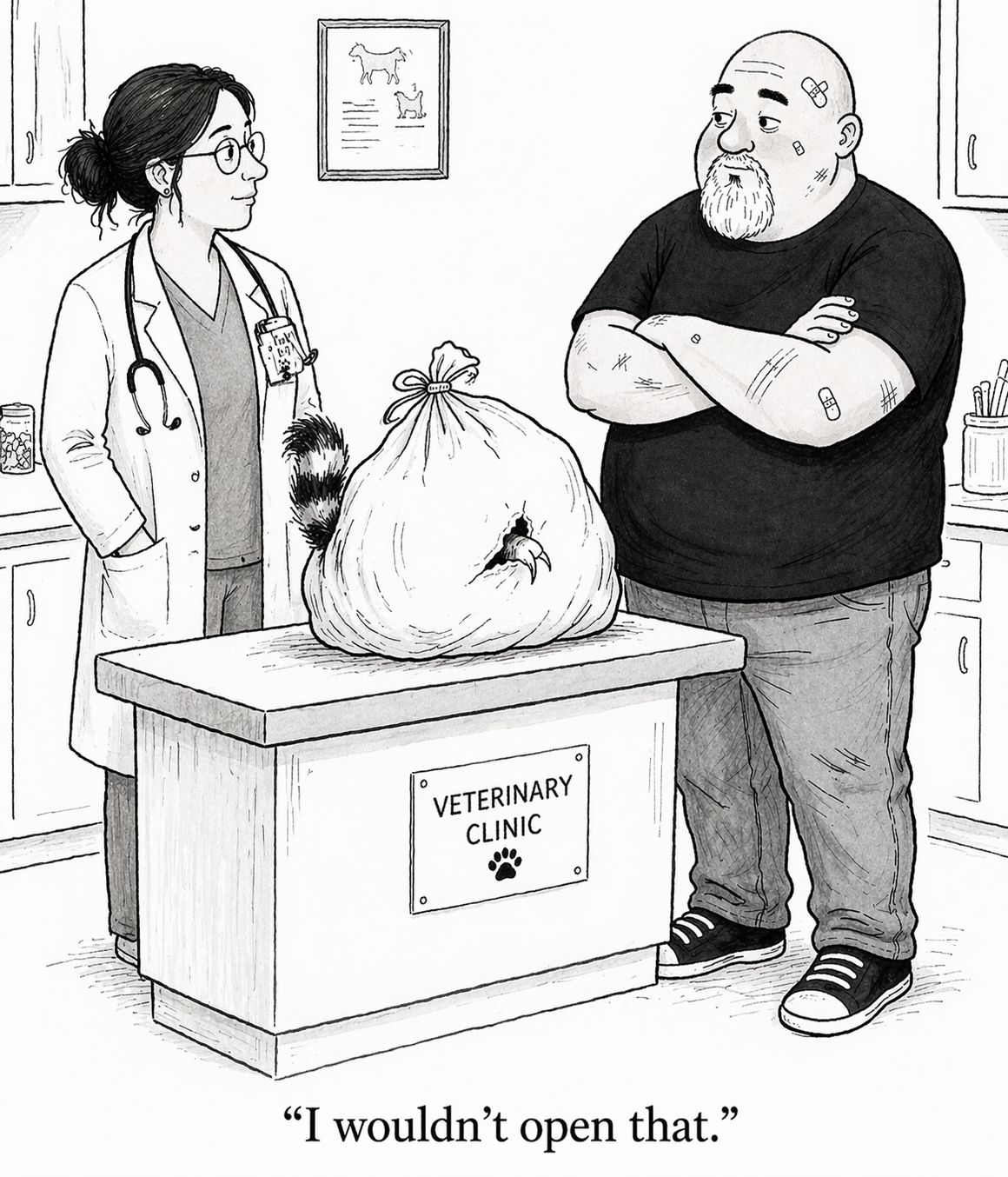
The most vivid theory connects this to a market scam. Piglets were sold in bags at medieval markets, and an unscrupulous vendor might substitute a cat for the more valuable pig. If the buyer opened the bag before leaving, the cat came out, the fraud was exposed, and "the jig was up" (another one). The pig in a poke is the companion idiom, meaning you bought something without inspecting it. These two may have traveled together from the same market.
Mad as a Hatter
Not a Lewis Carroll invention, though he made it famous. Hatters in the 18th and 19th centuries used mercury nitrate in the felt-curing process. Prolonged exposure caused mercury poisoning, which produced tremors, mood instability, hallucinations, and erratic behavior. The workers were not metaphorically mad. They were being slowly poisoned by their trade, and everyone around them could see it. Carroll's Mad Hatter was a cultural reference, not a fantasy.
Riding Shotgun
This one is almost literal. On stagecoaches carrying valuables across rough or bandit-prone territory, the driver needed someone beside him with a shotgun to guard against robbery. "Riding shotgun" meant occupying that armed guard's seat. The term reappeared in American Western films and slid into casual use for whoever claimed the front passenger seat. The threat level dropped considerably.
Steal Someone's Thunder
This one belongs to English playwright John Dennis, and the story is almost too good to be true. In the early 1700s, Dennis invented a new theatrical device to simulate the sound of thunder for one of his plays. The play flopped and closed. Shortly after, he attended a production of Macbeth at the same theater and heard his thunder machine being used without his permission. He reportedly stood up and shouted that they had stolen his thunder. The phrase stuck, outlasting Dennis, the play, and the machine.
Skeletons in the Closet
This phrase carries some genuine medical history. Before modern anatomy education, medical schools struggled to legally obtain cadavers. Grave robbing was common, and doctors sometimes kept illegally obtained skeletons hidden, literally in closets and storage rooms, to avoid discovery. The literal concealment of something shameful and dead became the general metaphor. The closet was apparently a more popular hiding spot than you'd think.
Cut to the Chase
A clean one to end on. Silent film and early sound film relied heavily on chase sequences, because physical action translated to audiences even without dialogue. The chase was the payoff. When editors or directors wanted to skip past the slower material to get to the exciting part, they'd say "cut to the chase." It moved from film production into general use to mean: get to the point, skip the setup, the audience is waiting.
People learning English as a second or third language go through a version of the same experience described above, with the added layer that idioms carry cultural assumptions invisible to anyone who didn't grow up inside them. "The ball is in your court" means nothing useful if you don't have a mental image of a tennis or basketball court as a space of individual responsibility. "Break a leg" as encouragement before a performance requires you to know that theater people consider it bad luck to say "good luck," which requires you to know that theater people have a whole system of superstitions, which is a lot of cultural scaffolding for what looks like a simple phrase.
The confusion tends to produce one of two responses. Either the learner avoids idioms entirely, playing it safe with direct language, or, once a few idioms click, they begin using them everywhere, sometimes correctly, sometimes confidently misapplied, and occasionally combined in ways that create something entirely new. "We'll burn that bridge when we come to it." "Don't count your bridges before they hatch." These hybrid constructions, technically called malapropisms or mixed idioms, are often funnier than either original phrase. The intent is fluency. The result is something more interesting.
Both groups, autistic speakers and language learners, end up doing something the rest of us stopped doing a long time ago: they actually hear the words. The idioms that became invisible through repetition get a second look, and sometimes that second look reveals just how absurd the whole enterprise is. We've been saying these things for centuries, blissfully unaware that we're describing a cat in a bag or a doctor's very strange idea of medicine.
There are hundreds more where these came from, and honestly the rabbit hole goes deep. The ones that survive tend to be vivid, a little violent, and grounded in something real: a practice, a material, a job that doesn't exist anymore. Language preserves the fossils of the world that made it.