
Legal Slop
I find AI genuinely useful in many contexts. People can paste their lab results into a chat window and get a plain English explanation instead of spiraling through WebMD at midnight. Someone with a good idea and no budget can build a website that looks like they hired an agency. A person who can't afford a $200 headshot session can generate a professional photo that opens doors that used to stay closed. These are not trivial things. Access to capability that was previously gated by cost and expertise is genuinely good, and I think the people who dismiss it haven't spent enough time on the wrong side of that gate.
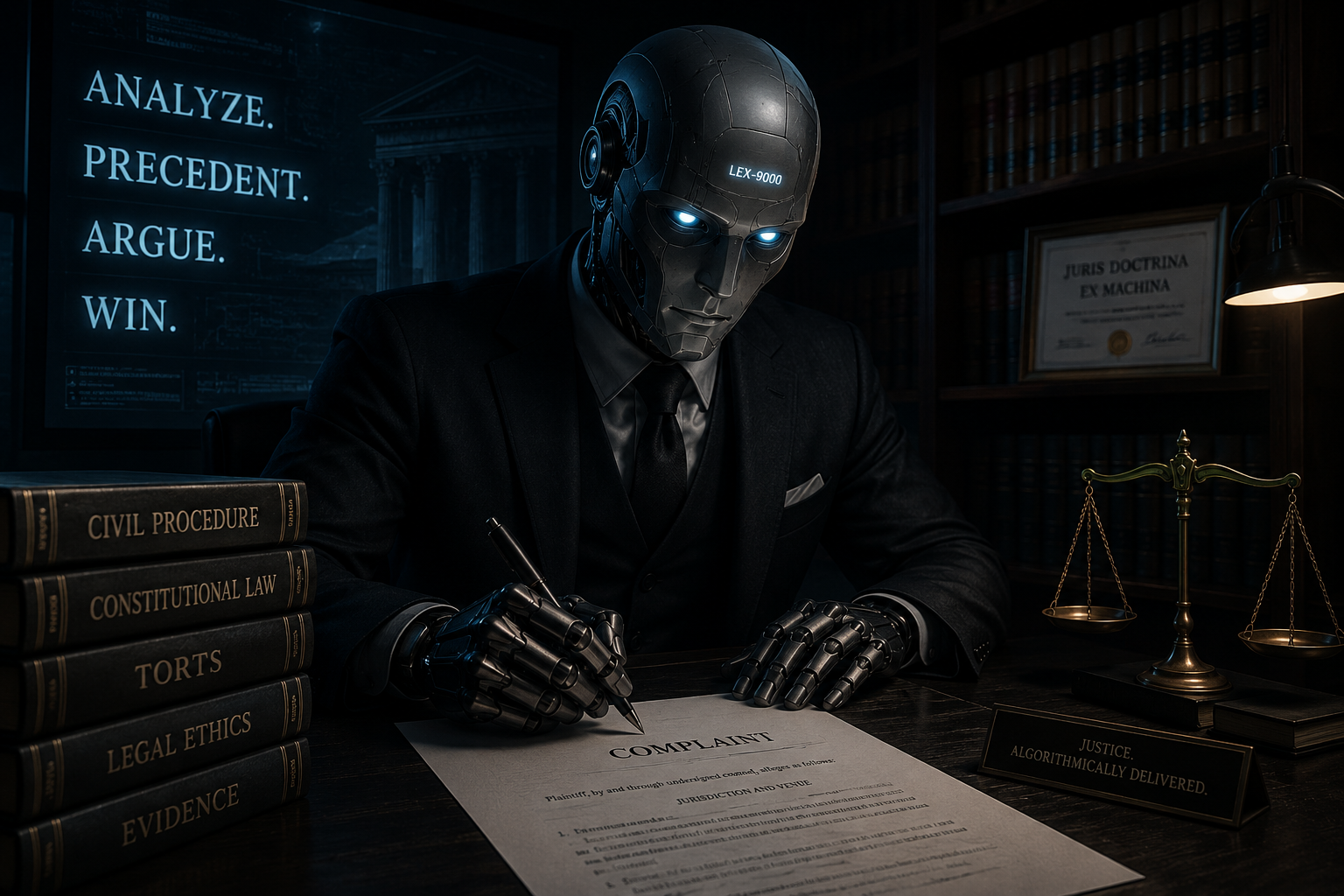
But useful tools get abused. Anyone who has spent time on YouTube lately knows what AI slop looks like at scale. The legal system is developing its own version. Call it legal slop. And it's considerably more damaging than a bad thumbnail.
I recently became aware of a complaint filed here in Oregon. It alleged everything: constitutional violations, fraud, conspiracy, negligence, intentional infliction of emotional distress, and a handful of claims I had to look up. The prose was clean. The citations were real. The formatting was correct. One hundred and eighty pages. By every surface measure, it looked like a lawsuit.
It wasn't, really. It was a grievance in a suit and tie.
A lawyer doesn't just write the complaint. About half the time, a lawyer tells the client they don't have a case. That conversation never happens with AI. The AI will write the most compelling version of whatever you hand it. It has no stake in the outcome, no bar license, no relationship with the court, no ability to say this is going nowhere and you're going to waste a year of your life.
What we've democratized is access to legal language. We have not democratized judgment. Nobody has figured out how to do that, and AI doesn't come close.
This isn't entirely surprising if you've been watching what frictionless technology does to cognition over time. I've written before about what I call the judgment ceiling, the point at which a person's ability to evaluate, critique, or refine output stops, not because they lack intelligence, but because they never had the conditions to develop that capacity. The same design philosophy that optimized our devices for cognitive ease, for System 1 thinking, for the path of least resistance, also shaped who eventually picks up an AI tool and what they do with it. The frictionless complaint is the logical extension of the frictionless scroll. When the dominant environment of your life is designed to remove resistance, and a tool appears that will convert your grievance into a formatted legal document without asking hard questions, the path from feeling wronged to filing a lawsuit becomes as easy as posting an angry comment. The friction that used to exist at every step of that path was doing work we didn't fully appreciate until it was gone.
The human cost runs in both directions, and both sides deserve attention.
On one side is the filer. I want to be careful here, because it's easy to dismiss these cases as nuisance litigation and move on. But many of the people generating legal slop are not cynical actors gaming the system. In my experience, a significant number appear to be in genuine distress. They have grievances that feel real and overwhelming to them. They have likely exhausted other options, or believe they have. The AI didn't create their pain. It just handed them a tool with no instruction manual and no warning label, one that feels like access to justice but functions more like a pressure valve that redirects suffering into the court system.
That's not a good outcome for them either. A 180-page complaint isn't going to get them what they need. It's going to get them a dismissal, possibly with sanctions, and whatever comes after that for a person who was already struggling.
On the other side is the defendant. This part of the conversation gets almost no attention, and it should. When a coherent-looking lawsuit lands naming you as a respondent, you cannot ignore it. Default judgment is real. You have to respond, or hire someone to respond, or spend weeks trying to figure out which one. You absorb the anxiety, the cost, the time, and the reputational shadow of being a named party in litigation, regardless of merit. The AI that generated the complaint has no awareness of you at all. You are simply a field in a form.
The court system sits between these two people, under-resourced and increasingly unable to perform the triage function it was never explicitly designed to perform but always implicitly relied on lawyers to handle upstream.
The solutions are not complicated in concept, even if they are in execution. They don't require new technology. They require institutional adaptation to a new reality.
The first lever is the clerk's window. Court clerks are currently ministerial by design. They receive filings, process them, stamp them, move them along. They are not asked to evaluate merit, and they shouldn't be. But there is a meaningful difference between evaluating merit and recognizing that a document fails basic threshold coherence. Oregon's own public-facing court guidance reflects the line already in place: court staff can provide general procedural information, but cannot give legal advice. A 180-page complaint alleging thirty overlapping causes of action against six defendants is not a close call. Clerks could be trained and empowered to flag filings for early judicial review without making legal determinations themselves. That's a different job than the one they currently have, but not an unreasonable one.
The second lever is the in forma pauperis process. Fee waivers exist for good reason. Access to the courts should not be exclusively available to people who can afford filing fees. Oregon already allows people who cannot afford fees to request a waiver or deferral. But the waiver was designed as a financial accommodation, not a bypass. Attaching a triage step to the IFP process, a brief self-help center consultation, a plain language review of the claim, something that introduces a human conversation before the document clears the window, could restore some of the filtering function that used to happen upstream with counsel, without eliminating access for people with legitimate claims and no resources.
The third lever is judicial screening. Many federal courts already have mechanisms for dismissing frivolous claims sua sponte, on the court's own motion, without waiting for the defendant to respond. That power exists. It is unevenly applied and largely absent at the state court level, where most of this volume is landing. Standardizing and expanding early screening dismissal for pro se filings would give judges a tool calibrated to the current reality rather than the one courts were designed for.
None of these solutions are about punishing people for representing themselves. The right to do so is fundamental. What they're about is rebuilding the friction that used to exist in the system, friction that was doing necessary work, but rebuilding it more justly than the original version, which was just money.
None of this is going to be resolved quickly. It never is with new technology. The pattern is consistent across every significant technological shift: the capability arrives before the institutions designed to absorb it have adapted, and the gap between the two is where the damage accumulates. We are currently in that gap with AI and the legal system, and the filing volumes suggest we are still in the early innings.
The tools will get more capable. The documents will get more convincing. The volume will increase. Courts that are already strained will get more so before the institutional responses catch up, assuming they do.
What's different this time is that we can see it coming. We don't have to wait for a decade of damage before acknowledging the pattern. The clerks, the judges, the bar associations, the court administrators who are watching their dockets fill with legal slop right now know exactly what is happening. The question is whether that recognition translates into adaptation, or whether we do what we usually do with new technology and wait for the problem to become undeniable before we decide to take it seriously.
The courts were built for a different world. That world is gone.
Addendum
Shortly after I posted this, I came across something worth noting. Anthropic has been offering discounted access to Claude for nonprofits and working with access-to-justice organizations, including the Justice Technology Association and Free Law Project, to make legal help more affordable and available. There are also broader efforts aimed at frontline workers, including public defenders and social-service providers. This is worth acknowledging because it cuts both ways. The same technology producing legal slop is also being deliberately deployed to help people who genuinely need it and have no other options. And crucially, in those contexts the judgment layer is preserved. A legal aid attorney using AI is still an attorney. The filter is still there. That's exactly the distinction this essay is trying to draw.