
Midjourney's Golden Light
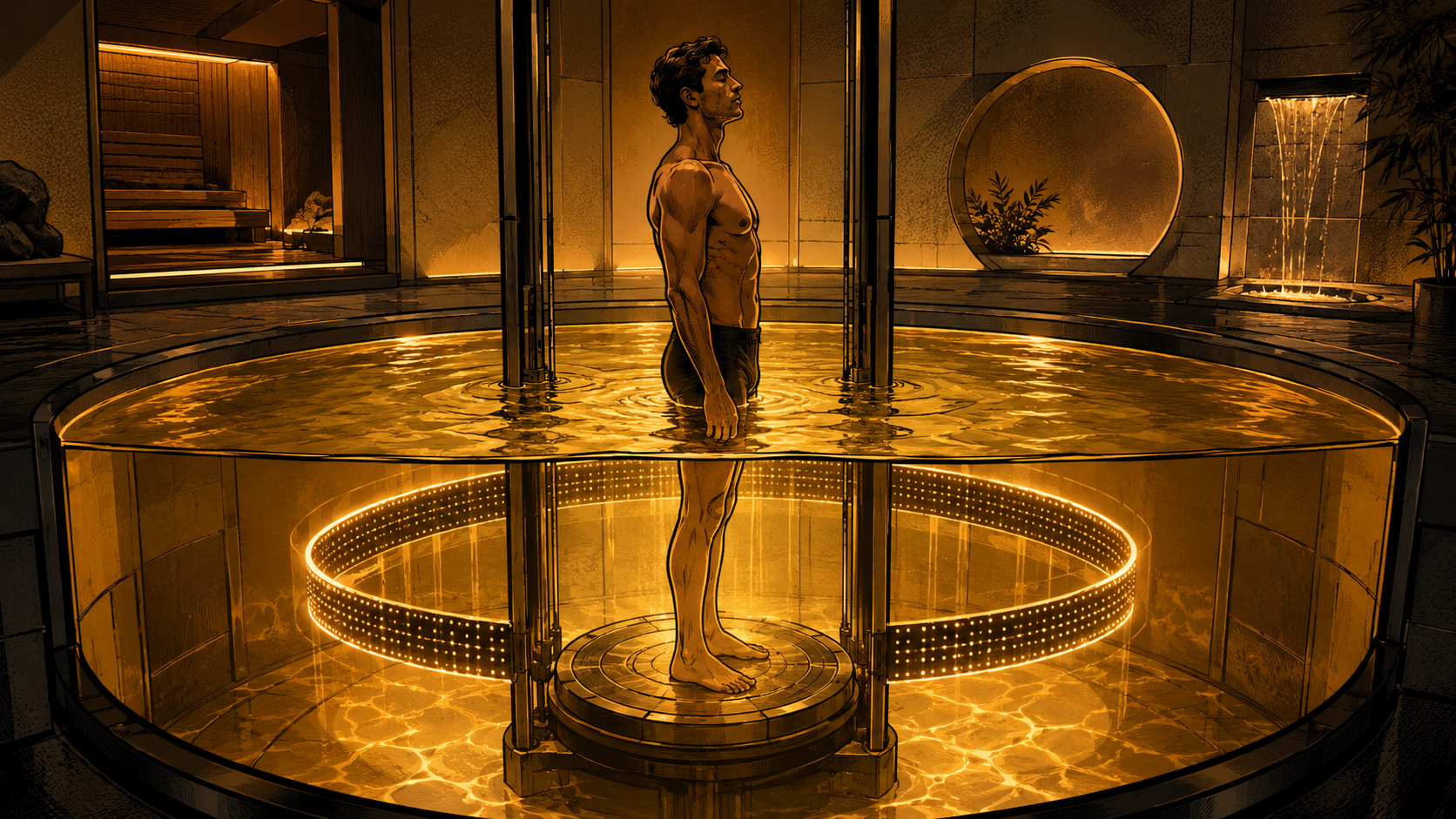
For the past few years, the name Midjourney has meant one thing: jaw-dropping, AI-generated images. If you wanted a neon cathedral, a cinematic avatar, or some impossible dreamscape with perfect lighting, they were your go-to.
But the AI giant just announced a pivot that sounds straight out of a high-budget sci-fi novel. They are stepping away from the screen, moving into hardware, and opening 24/7 luxury medical spas centered around a revolutionary full-body health scanner.
Yes, you read that correctly. The company that populated your social feed with AI avatars wants you to strip down and step into a pool of golden light.
The scanner itself is a genuine piece of engineering. Built in partnership with ultrasound manufacturer Butterfly Network, Midjourney's Ultrasonic CT works nothing like a traditional MRI. You step onto a platform and descend slowly into warm water. A ring of roughly half a million microscopic sensors, each the size of a grain of sand, fires ultrasonic waves through your body from every angle simultaneously, listening to the echoes the way dolphins use echolocation. More than two petaflops of processing power crunch the returning data in real time, assembling a radiation-free, 3D map of your internal anatomy in under 60 seconds.
The setting is deliberate. Midjourney's flagship location, slated for San Francisco by the end of 2027, will surround the scanning pods with hot tubs, saunas, and cold plunges. The company has been explicit about the logic: people don't line up for medical procedures, but they do go to spas. Getting a longitudinal dataset of your organ health and vascular architecture is, in their framing, just a casual byproduct of your afternoon wind-down. "The scans are a side-effect," they wrote. The experience is the product.
The ambition behind all of this is staggering. Midjourney wants 50,000 scanners deployed worldwide by 2031, running at a combined capacity of one billion full-body scans every month. They believe that level of early detection could prevent 30% of global deaths and cut healthcare costs in half. No peer-reviewed data accompanies either figure. They are goals, offered as vision.
Which is where the questions start.
The first is medical. Whole-body screening of healthy, asymptomatic people is not a new idea, and medicine has already worked through it. In the early 2000s, full-body CT scanning had a similar moment, the same logic of catching things early, the same promise of prevention at scale. It faded not because the technology failed but because of what it found. Radiologists have a word for it: incidentaloma. An incidental finding, something the scan picks up that wasn't what anyone was looking for, and may not matter at all. A shadow on a kidney. A nodule on a lung. Statistically unremarkable, clinically ambiguous, but once seen, impossible to ignore. The downstream workup, the follow-up scans, the biopsies, the specialist appointments, generates its own costs, its own anxiety, its own risk. Overdiagnosis, the identification and treatment of conditions that would never have caused harm, can expose people to the risks of treatment without giving them a corresponding benefit. The medical community didn't abandon broad screening because it was incurious. It pulled back because the math was harder than it looked.
Midjourney is proposing to run that experiment again, at spa scale, with AI doing the labeling, and without starting as an FDA-cleared diagnostic product. They have threaded this needle carefully: by offering body composition maps rather than diagnoses, they avoid beginning with the full diagnostic approval burden. But that just relocates the problem. If the scan finds something that looks concerning, the person who just climbed out of a warm pool now has to navigate that alone, without a clinician who ordered the scan, without a referral pathway, without the clinical context that makes an ambiguous finding interpretable. The spa removed the anxiety of the medical setting. It didn't remove the anxiety of the result.
The second question is arithmetic. Midjourney's business model requires one billion scans a month by 2031. That means finding a billion people willing to be scanned, and then keeping them coming back every 30 days. Monthly. The medical justification for monthly full-body scanning of healthy people does not exist. So the volume has to come from somewhere else, from people who want the data, who find the experience enjoyable, who treat it the way they treat a gym membership. Which means the population Midjourney is actually targeting is not the global population dying from preventable disease. It is the wellness-consumer demographic that already has access to primary care, already has reasonable health outcomes, and is now being offered a subscription to detailed biological self-knowledge as a lifestyle product.
That demographic is not a billion people. And it is not the billion people the 30% mortality claim implies.
There is a third question, and it may be the most important one.
Midjourney has no outside investors. It describes itself as a community-backed research lab, funded by the people who use its products. That structure is unusual enough to be worth sitting with. It means no venture capital demanding an exit, no board pushing for a liquidity event. It also means the company's long-term revenue logic is entirely its own, and largely opaque.
So ask the question the announcement doesn't answer: what happens to the data?
Not the diagnoses. There are no diagnoses, Midjourney has been careful about that. What happens to the body composition maps. The organ dimensions. The vascular architecture. The longitudinal record of how your insides change month over month, year over year, across a billion people.
That may not be medical data in the familiar clinical-record sense, depending on how the service is ultimately structured. It may not carry the same legal weight as a diagnosis created inside a doctor-patient relationship. It is, in their own framing, wellness information. A side effect of a spa visit.
But it is also something that has never existed before. A proprietary, continuously updated, internally consistent biological database of human bodies at a scale no hospital system, no government, no research institution has ever assembled. The training implications alone are staggering. Any AI model trying to understand human physiology, predict disease progression, simulate biological aging, or assess actuarial risk would find that database extraordinarily valuable. Not as medical records. As something adjacent to medical records that carries less regulatory friction.
Midjourney built its first business by ingesting creative work at scale and turning it into a generative model. It is currently fighting lawsuits from Disney, Universal, and Warner Bros. over that approach. The legal argument against them is essentially that the inputs had value the company didn't pay for. It is worth asking whether the architecture here is similar, with the direction reversed. Last time, Midjourney harvested the output of human creativity. This time, it may be positioning itself to harvest the output of human biology.
None of this requires bad intent. It may not even be the plan. But a company with no investors, a product that doesn't begin as a diagnostic medical service, a spa experience designed to make the scanning feel incidental, and a stated goal of imaging a billion people monthly is also, structurally, a company building the most valuable biological dataset in human history. As a side effect.
The golden light is warm. The water is comfortable. The 60 seconds pass quickly. And somewhere in a compute cluster, your insides join the library.