
Name an Invention With No Ancestor
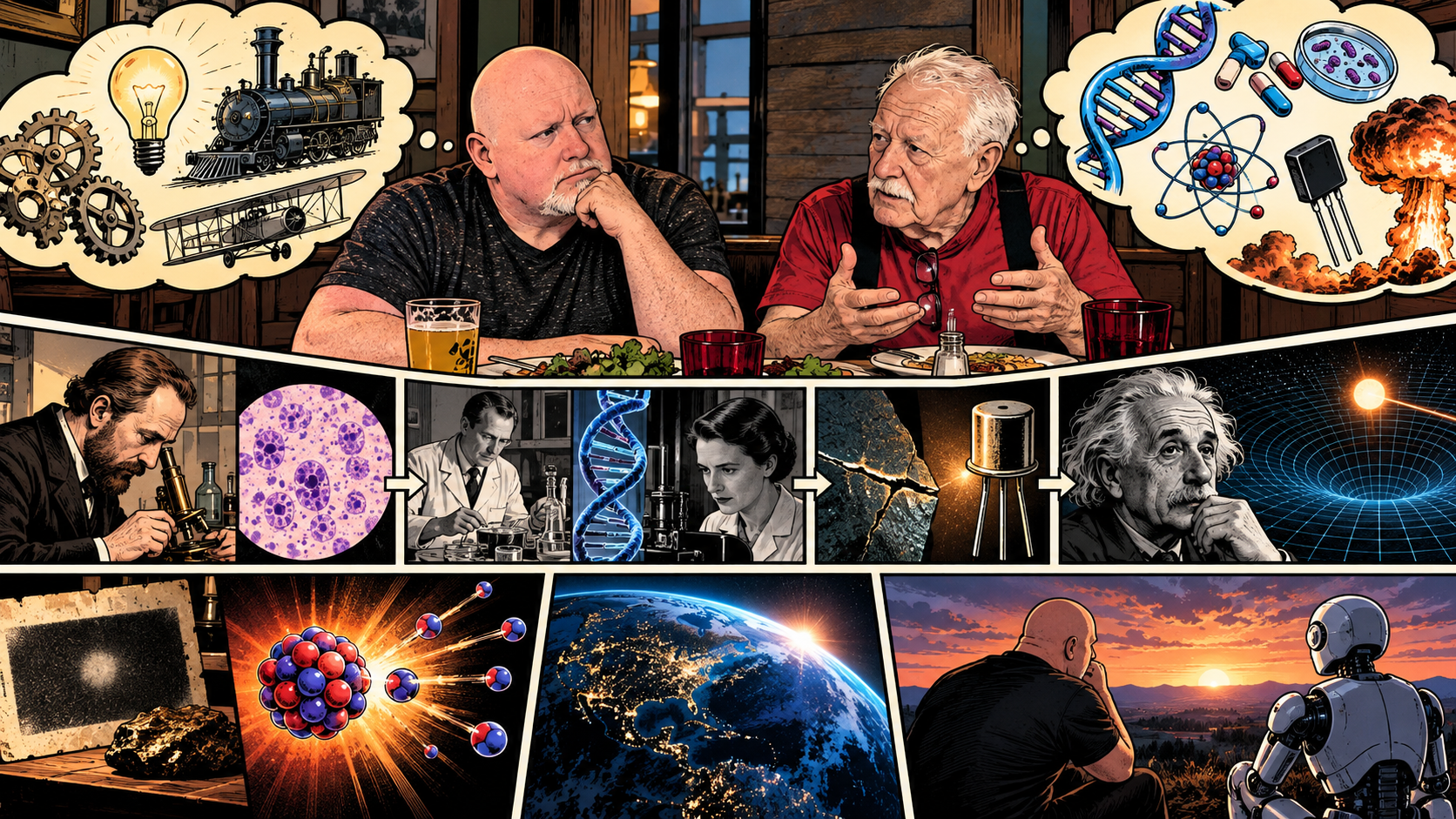
The dinner table is a bad place to settle a philosophical argument, and yet it is exactly where the question came up for me. My dad and I were talking about invention, and I made a claim that I thought was obvious: there really haven't been any original scientific inventions since the Industrial Revolution. Not in the romantic sense. Nobody sat down in a quiet room, dreamed up a wholly new thing, tested it, and discovered that reality had been waiting for the answer all along.
He didn't like that. He started listing counterexamples: DNA, antibiotics, nuclear technology, the transistor, and a fair amount of biology. So I did what I do with every argument I can't settle at the table: I went and looked each one up.
And every one of them had the same shape. Before the breakthrough there was a prior discovery, and before that an accident, an odd observation, or an unanswered anomaly someone could not stop thinking about. Nobody produced a correct theory out of nothing and then watched reality confirm it. Reality spoke first. The theory was the answer.
I haven't been able to let go of that since. And the longer I sit with it, the more I think it matters for the question that has nothing to do with my dad's dinner table: whether machines can be original.
What would count?
First, what I am not saying. I am not saying nothing new ever happens, or that people are not creative. Obviously they are. The transistor was new. PCR was new. The world after them looked different from the world before.
What I am questioning is a specific picture of invention, the romantic one. In that picture, a genius starts from a blank page and produces something with no lineage. Not an improvement on an existing idea. Not a combination of older ones. A genuine point of origin, conceived deliberately, without an earlier problem or observation pulling the thinker toward it.
That is the thing I told my dad I couldn't find. And that's the challenge I'd put to anyone reading this: name one.
DNA, traced back
DNA is a good place to start because it is the example most people reach for, and because it was not invented at all. It was discovered, and the discovery took about eighty-five years.
In 1869, the Swiss researcher Friedrich Miescher was studying proteins in white blood cells and found a substance in the cell nuclei that did not behave like protein. It was rich in phosphorus. He called it nuclein. He did not know what it did; he only knew it was not what he expected.
In 1928, Frederick Griffith was trying to understand why some strains of pneumonia bacteria were virulent and others were harmless. He noticed that dead virulent bacteria could somehow turn harmless live strains deadly. Something was being passed along. He had no idea what.
In 1944, Oswald Avery and his colleagues showed that the "something" was DNA. Then came Erwin Chargaff's ratios, the odd fact that the amounts of certain bases always matched. Then came Rosalind Franklin's X-ray images. Only after all of that did Watson and Crick build their model in 1953.
The double helix was a brilliant piece of reasoning. But it was reasoning about a pile of observations that other people had already made, several of them unexpected. That is the pattern I kept seeing. Not theory first. Anomaly first.
Reality pushes first
Once you see the pattern, it shows up everywhere. The sequence is almost never: idea → invention. It is closer to: reality → anomaly or problem → existing knowledge → recombination → discovery.
Take the transistor. We tell the story as three men at Bell Labs in 1947. But in 1940, Bell Labs engineer Russell Ohl was puzzling over a silicon rod that behaved strangely when light hit it. The rod had a crack, and the impurities on either side of it had separated. That accident was the p-n junction, the foundation of modern chips. The transistor came out of a lab already chasing a practical problem: controlling electrical signals without vacuum tubes, with a strange cracked rod sitting in its recent memory.
Or relativity. Einstein is our patron saint of pure thought, but physics had been stuck on a contradiction for decades. Maxwell's equations said light traveled at a fixed speed. The 1887 Michelson-Morley experiment failed to detect the ether light was supposed to travel through. Lorentz and Poincaré had already worked out much of the math trying to patch the hole. Einstein's genius was real, but he was answering a question reality had been shouting for twenty years.
Nuclear technology starts with a drawer. In 1896, Henri Becquerel was studying whether uranium salts gave off rays after soaking up sunlight. A stretch of cloudy weather stopped his experiment, so he put the salts away on top of a wrapped photographic plate. When he developed the plate anyway, it was fogged. The uranium did not need the sun at all. That was radioactivity. Four decades later, in 1938, Otto Hahn and Fritz Strassmann bombarded uranium with neutrons and found barium in the results, which made no sense to them. Lise Meitner and Otto Frisch worked out what it meant: the uranium atom had split. Fission began as a chemistry result nobody could explain.
Even Kary Mullis, whose idea for PCR famously arrived during a night drive in 1983, was assembling parts that already existed. DNA polymerase had been isolated in the 1950s. The heat-tolerant bacterium whose enzyme would later make PCR practical had been found in a Yellowstone hot spring in the 1960s. The flash of insight was a flash of connection.
As Louis Pasteur put it in 1854: "chance favors only the prepared mind." I used to hear that as a line about luck. Now I hear it as a description of how discovery actually works. The accident opens the door. Knowledge is what lets someone notice that it is a door.
But what about genius?
The strongest pushback, the one I kept giving myself, is the genius. Gauss. Gödel. John von Neumann. Minds so far beyond everyone around them that surely they made something from nothing.
But look at what they actually did. Gödel's incompleteness theorems, published in 1931, are as startling as mathematics gets. They were also a direct response to David Hilbert's program to put all of mathematics on a complete and consistent foundation. Hilbert asked the question. Gödel proved it had no answer that Hilbert would like.
That's what I keep coming back to. A brilliant answer still requires a question. Take away the problem, the contradiction, the tradition, the vocabulary, and what exactly would a genius work on? Genius shortens the distance between a problem and its solution. It does not seem to eliminate the need for a problem.
A cow named Veronika
If you want to see invention at its most basic, meet Veronika. She is a pet Swiss Brown cow in a small village in southern Austria. Years ago, her owner noticed her picking up fallen branches and using them to scratch herself. Later the family gave her sticks and rakes, and she got better at it.
In January 2026, researchers from the University of Veterinary Medicine in Vienna published a study in Current Biology describing what she does. Given a deck brush, she uses the bristle end for her tough back and switches to the smooth handle for her softer belly. It is the first documented tool use in cattle.
Nobody taught Veronika to invent a back scratcher. A branch was lying there. She picked it up, maybe for no reason at all. It scratched. She did it again. Then she refined it.
accident → observed result → deliberate repetition → refinement
The deliberate part, the part we'd call invention, comes after the accident reveals a possibility. I suspect that's true of most of human history too. It's just that our branches are cracked silicon rods and moldy petri dishes.
Two people, one idea
Here's something that should bother anyone who believes in the lone originator. Big discoveries keep happening twice.
Newton and Leibniz developed calculus independently. In 1922, sociologists William Ogburn and Dorothy Thomas compiled a list of 148 inventions and discoveries made independently by more than one person. Robert Merton later argued that these "multiples" are the normal pattern of science, not the exception.
If ideas came from nowhere, from the private spark of one mind, why would two minds keep landing on the same one at the same time? The simpler explanation is that the conditions ripened. The problems, tools, and prior results reached a point where the next step was waiting. Calculus had ancestors going back to Archimedes, and Fermat and Isaac Barrow had come close. Someone was going to formalize it. Two people did.
The same logic applies across whole civilizations. Pyramids went up in Egypt and Mesoamerica. That's not evidence of pure originality. It's evidence that people facing similar problems, with similar materials and the same gravity, arrived at similar answers.
Even being wrong feeds the process. Johannes Kepler spent years convinced the planets' orbits fit inside nested geometric solids. He was wrong. When he tried to force Mars into perfect circles, Tycho Brahe's data refused by a tiny margin. That stubborn discrepancy drove him to ellipses. Alexander Fleming's contaminated petri dish in 1928 was a ruined experiment before it was penicillin.
misunderstanding → failed expectation → anomaly → new explanation
The wrong idea helps produce the right one.
The honest objection
I owe my dad a concession here, and I owe the argument one too.
If every invention has some ancestor, then my thesis can never lose. Show me any breakthrough and I'll find a precursor. That isn't a discovery about invention. It might just be a fact about time. Everything happens after something.
So here's the version I actually believe. Recombination is universal. What varies is the size of the leap. Most inventors make short jumps between ideas that were already close together. A few, like Mullis connecting a polymerase to a chain reaction on a dark highway, jump across a gap that nobody else could see. That distance is real, and it deserves the word "genius."
But a long leap is still a leap from somewhere. The originality isn't in the materials. It's in the connection, and in noticing that reality has pushed back in a way worth paying attention to. Put more simply: there are no true points of origin, only recombinations triggered by reality pushing back.
The AI turn
This is where the dinner table argument stops being a history lesson.
The most common dismissal of AI is that it cannot be original. It only recombines what it was trained on. It remixes. The well-known version calls large language models "stochastic parrots," systems that stitch together patterns without understanding them.
Maybe so. But if everything above is right, then recombination was never the thing that separated us from machines. Recombination is what Newton did. It's what Watson and Crick did. It's what Mullis did on that highway. "It only recombines" describes human invention too. As a way of ruling AI out, it proves too much.
So if there is a real difference, it has to be somewhere else. I think it's in the other half of the formula: reality pushing back.
Every story in this essay begins with someone physically present when the world did something unexpected. Miescher's strange phosphorus. Ohl's cracked rod. Fleming's ruined dish. Tycho's stubborn eight arcminutes of Mars. A language model has read about all of those moments. It has never been in the room for one. It has the prepared mind in abundance, more reading than any human could do in a thousand lifetimes. What it mostly lacks is the accident, and the itch that makes someone refuse to let a small anomaly go.
That's not a permanent limit. It's a question of what these systems are connected to. The researchers who studied Veronika made a point that stuck with me: her rich, unusual life as a pet likely let a capacity emerge that ordinary cattle never get the chance to show. The same may be true of machines. Wire them into instruments, experiments, and the stubborn mess of the physical world, and they may start noticing their own cracked rods.
Which means the honest question was never "can AI be original?" None of us are, in the romantic sense. The better question is whether AI can be surprised, and whether it can tell when a surprise matters.
Back to the table
I'm not sure that argument with my dad had a winner. He was defending something worth defending: that the people who gave us DNA and the transistor did something extraordinary. I agree. I just think the extraordinary part is different from what we were taught.
So I'll leave you with the challenge I couldn't meet at dinner. Name an invention with no ancestor. Not something revolutionary. Something whose creator wasn't answering an observation, solving a problem, fixing something that already existed, combining older ideas, or exploiting an accident.
If you can't find one, maybe invention was never the creation of ideas. Maybe it is the act of recognizing what circumstances have finally made visible.
The Veronika story itself is reported in a Current Biology study on cattle tool use, and the public version was summarized by Scientific American.