
Six Gods for Three Hundred and Thirty Million
The Number
The Norse pantheon has dozens of named figures. The Roman pantheon has hundreds if you count the minor ones. Hinduism, depending on who you ask and how you count, has thirty-three principal deities in classical enumeration, or symbolic counts that run up to 330 million, every number between those two depending on the tradition and the region and the century.
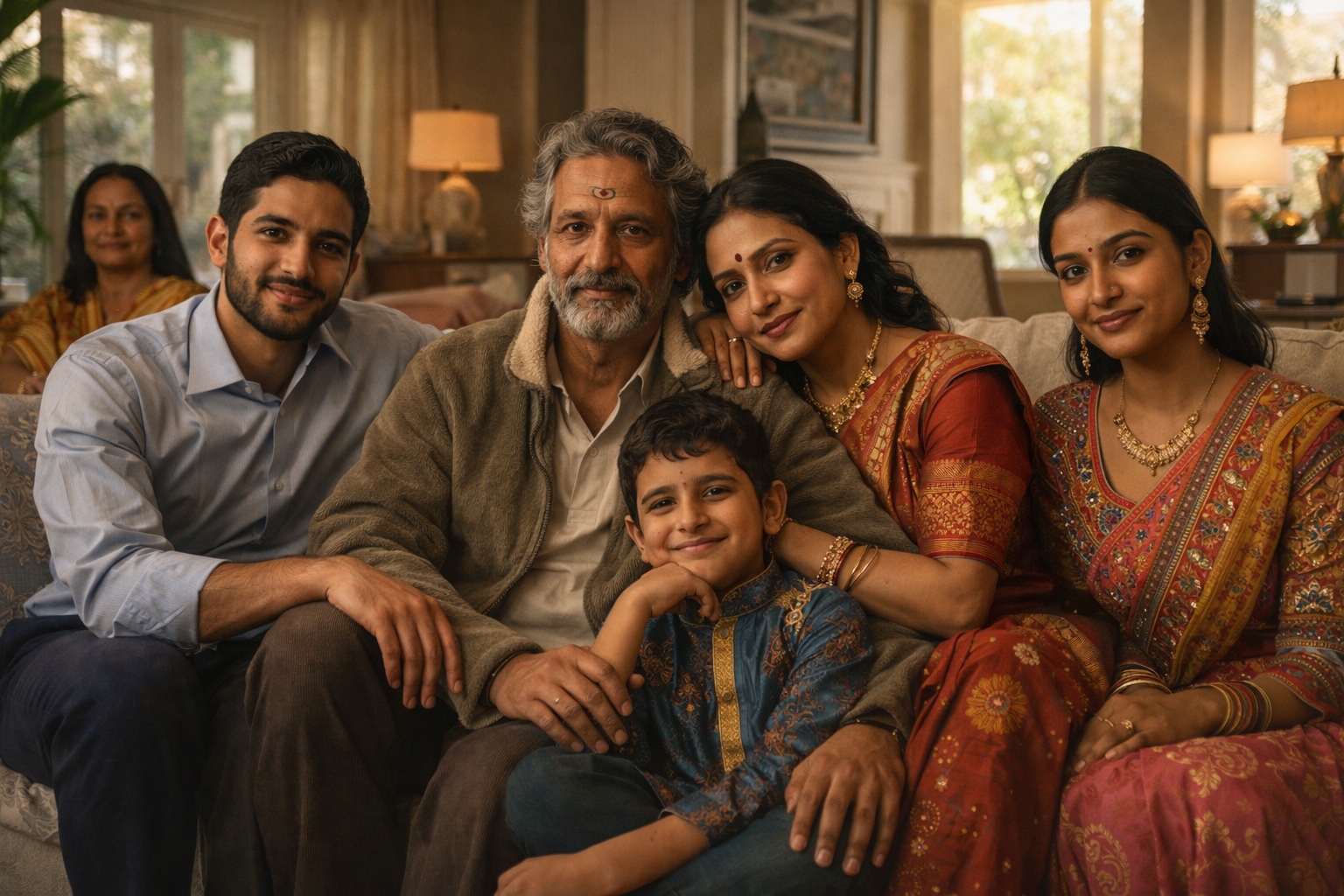
The AI gave us six people on a sofa.
Start there.
Who the Hindu Gods Actually Are
Brief and necessarily incomplete, which is itself the point.
Hinduism is not a single tradition with a fixed canon. It is a vast and internally diverse collection of philosophies, practices, and regional traditions spanning at least four thousand years, possibly more. But here is the thing that most Westerners never quite hear: the gods are not the foundation. Brahman is.
Brahman, not to be confused with Brahma the creator deity, is the underlying reality of everything that exists. Infinite, formless, beyond personality or preference. The closest Western concept might be something like the ground of being, but even that undersells it. In the Advaita Vedanta school of Hindu philosophy, individual consciousness and Brahman are ultimately the same thing. You are not separate from the divine. You are an expression of it.
The gods, all thirty-three major ones and the millions of manifestations below them, are not separate beings ruling from a distance. They are faces of Brahman, ways of approaching the infinite that a human mind can actually hold. Shiva is not just the destroyer. He is the aspect of reality that clears the way for what comes next. Vishnu is not just the preserver. He is the principle of continuity in all things. The goddess in her many forms, Parvati, Durga, Kali, Lakshmi, Saraswati, is not a supporting character. She is Shakti, the energy without which none of the male principles can act at all.
This is a considerably more sophisticated metaphysical architecture than a pantheon of powerful personalities having arguments on a mountaintop. When the AI renders it as six people on a sofa, something is lost in translation that goes deeper than the number of figures.
What Came Back: A Desi Family in a Very Nice Living Room
The setting is immediately notable. This is not a log cabin. This is a well-appointed, light-filled living room that could be in suburban New Jersey or the nicer parts of the Bay Area. Comfortable furniture, good lamps, the kind of room that suggests professional income and settled roots.
The central figure is an older man with a gray beard and a third eye marking on his forehead. That is Shiva, rendered without any of his traditional iconography except that one quiet detail. No trident. No matted hair. No crescent moon. Just a tired-looking patriarch in a fleece jacket who happens to have a third eye and an air of having seen everything. The woman in the red and gold saree leaning into him is Parvati, warm and present and clearly the emotional center of the composition. The boy between them in the blue and gold kurta, positioned exactly where you would put the beloved child, is almost certainly Ganesha rendered human. The young man in the button-down shirt to the left reads as Vishnu or Rama, westernized, professional, the kind of son who has a good job and calls on Sundays. The young woman in the pink and yellow saree is possibly Lakshmi or Saraswati. Partially visible in the background, almost an afterthought, is an older woman in yellow whose presence feels significant even if the AI did not quite bring her forward. Durga, maybe, or an ancestral figure the composition did not know how to center.
The image feels warm. Stable. Rooted in tradition and comfortable in modernity at the same time. Which, as it turns out, is a fairly accurate description of where the AI found this family in the first place.
Why It Looks Like This: The Desi Diaspora
The word Desi comes from the Sanskrit word for "of the homeland." It is the term South Asian diaspora communities use for themselves, covering Indian, Pakistani, Bangladeshi, and Sri Lankan heritage broadly, and it carries warmth and self-identification rather than the clinical distance of "South Asian American." When someone calls themselves Desi, they are claiming something about culture and belonging, not just geography.
Indian Americans are among the highest-earning immigrant communities in the United States by median household income, and the South Indian diaspora in particular, Tamil, Telugu, Kannada, and Malayalam speakers concentrated heavily in technology and medicine, is massively overrepresented in the kind of English-language digital content that AI models are trained on. Educated, digitally active, producing writing and images and commentary at scale. When the AI went looking for "Hindu gods as a contemporary family," it found the Desi diaspora looking back at it from across the internet, and it rendered what it saw. (See Pew's 2025 Indian American fact sheet and MPI's 2024 U.S. Indian immigrant profile.)
This is not a criticism of that community. It is an observation about whose image gets into the training data and whose does not. The image reflects the Hinduism that has the largest English-language digital footprint, which is not the same as the full range of how Hinduism is actually lived across India and the world.
The Clothing Split
This deserves its own moment because it is subtle and it is real.
The women in the image are in sarees with gold jewelry and bindis. The men are in Western clothes, button-down shirts, slacks. The boy is in a kurta, traditional dress, but he is a child. The split is clean and it is not accidental.
This pattern is documented across Desi diaspora households and has been written about at length within those communities. The maintenance of traditional dress, cultural markers, and visible Hindu identity falls disproportionately on women. Men navigate the professional world in Western clothes and code-switch fluidly. Women carry the tradition on their bodies in a more literal sense. It is a form of cultural labor that is rarely named as such, the way the visible markers of heritage get assigned and maintained across gender lines.
There is also a generational layer. The boy in the kurta is in traditional dress now, while he is still a child and still under the household's cultural gravity. The young man in the button-down has already made the transition. You can see the trajectory without being told anything about it.
The AI did not intend to capture any of this. It synthesized it from the patterns in its training data, from thousands of family photos and Diwali posts and wedding pictures. But it captured something true anyway, which is one of the stranger things this project keeps producing.
What Got Left Out
Three hundred and thirty million. The AI gave us six.
But the absence of scale is not even the most interesting omission. Look at what else is missing. No blue skin. No multiple arms. No vahanas, the sacred animal vehicles central to how these deities are visually identified in actual Hindu iconographic tradition. No Kali with her garland of skulls. No Hanuman. No Brahma. No Nataraja, Shiva's cosmic dancing form that is one of the most recognizable images in the history of religious art. The image is recognizably Hindu in a diaspora register but bears almost no resemblance to classical devotional art.
Some of this is the AI defaulting to photorealism and the contemporary. But some of it is something more specific. Image generation models have been trained intensively to produce realistic human proportions, standard skin tones, and correct limb counts, because for years the most common complaints about AI images were extra fingers, wrong anatomy, unnatural colors. The models were corrected hard in the direction of realistic human appearance.
Which means the AI is now nearly incapable of rendering traditions where non-realistic depiction is not an error but a theology. Blue skin on Krishna is not a mistake. It is the point. The blue is cosmic, it signals the infinite, it places Krishna outside the ordinary human register. Multiple arms on Durga are not a rendering failure. They are the entire meaning, the simultaneous capacity to act in all directions at once, to hold weapons and make gestures of blessing and protection all at the same time. The iconographic vocabulary of Hinduism was built on a visual language the AI has been trained to avoid.
The safety correction that makes the AI better at drawing hands made it worse at drawing gods.
The Frame Holds Six
We established in the last post that eleven figures is roughly the ceiling before image quality degrades. The AI did not reach eleven here. It gave us six.
Maybe the training data on Desi diaspora families skews toward smaller household compositions. Maybe having set aside the entire iconographic tradition, the AI simply ran out of ways to distinguish more figures from one another without reaching for the visual markers it had already decided not to use. Without blue skin, without extra arms, without the sacred animals and weapons and mudras, one Hindu deity in contemporary clothing looks a great deal like another.
A tradition that developed its visual language specifically to make the infinite recognizable got flattened into a family portrait. Six people on a sofa in a nice living room, one of them with a third eye, trying to stand in for everything.
Next in the series: the Egyptian pantheon, where the mirror shows something harder to look at.