
Space Is Not the Final Frontier
In 1995, philosopher David Chalmers drew a line that has never been erased. He distinguished between what he called the "easy problems" of consciousness (how the brain processes information, integrates data, and produces behavior) and the hard problem: why any of that processing is accompanied by subjective experience at all.
Why does it feel like something to see red? Why is there an inside to being you?
The easy problems, Chalmers noted, are just engineering. Complicated, but solvable in principle. The hard problem is something else entirely. It does not yield to the same methods. It may not yield to any methods we currently possess. Thirty years after he named it, the hard problem remains exactly what it was: a wide open question at the center of everything, staring back at us without blinking.
We have mapped galaxies. We have sequenced the genome. We have split the atom and landed machines on Mars. And we still do not know what consciousness is, where it comes from, or why it exists at all.
That seems worth sitting with for a moment.
The Telescope Pointed Outward
We are a civilization that celebrates the outward frontier. Space, in the cultural imagination, is where the real mystery lives: vast, dark, ancient, waiting. The image of a rocket leaving the atmosphere carries a particular kind of weight. It means we are reaching, expanding, refusing to be small.
I do not want to diminish that. But I want to suggest something that has taken me a long time to see clearly: we are pointing the telescope in the wrong direction.
The most unexplored territory in the known universe is not out there. It is in here. And almost nobody is going.
The Inward Frontier
I have been on that inward journey for more than forty years.
Meditation is more like skydiving than climbing. You do not achieve skydiving. You jump, and the experience is what it is. You show up, you practice, and eventually the territory reveals itself. What I keep finding in there is strange and enormous and largely unmapped.
I am also neurodivergent, which means the interior has always been both more intense and more difficult to navigate than it seems to be for most people. For much of my life I was oriented almost entirely inward in the wrong way, self-focused in a way that had too little room for other people. That is its own kind of wall.
But in 2010, something happened that I still do not have adequate language for.
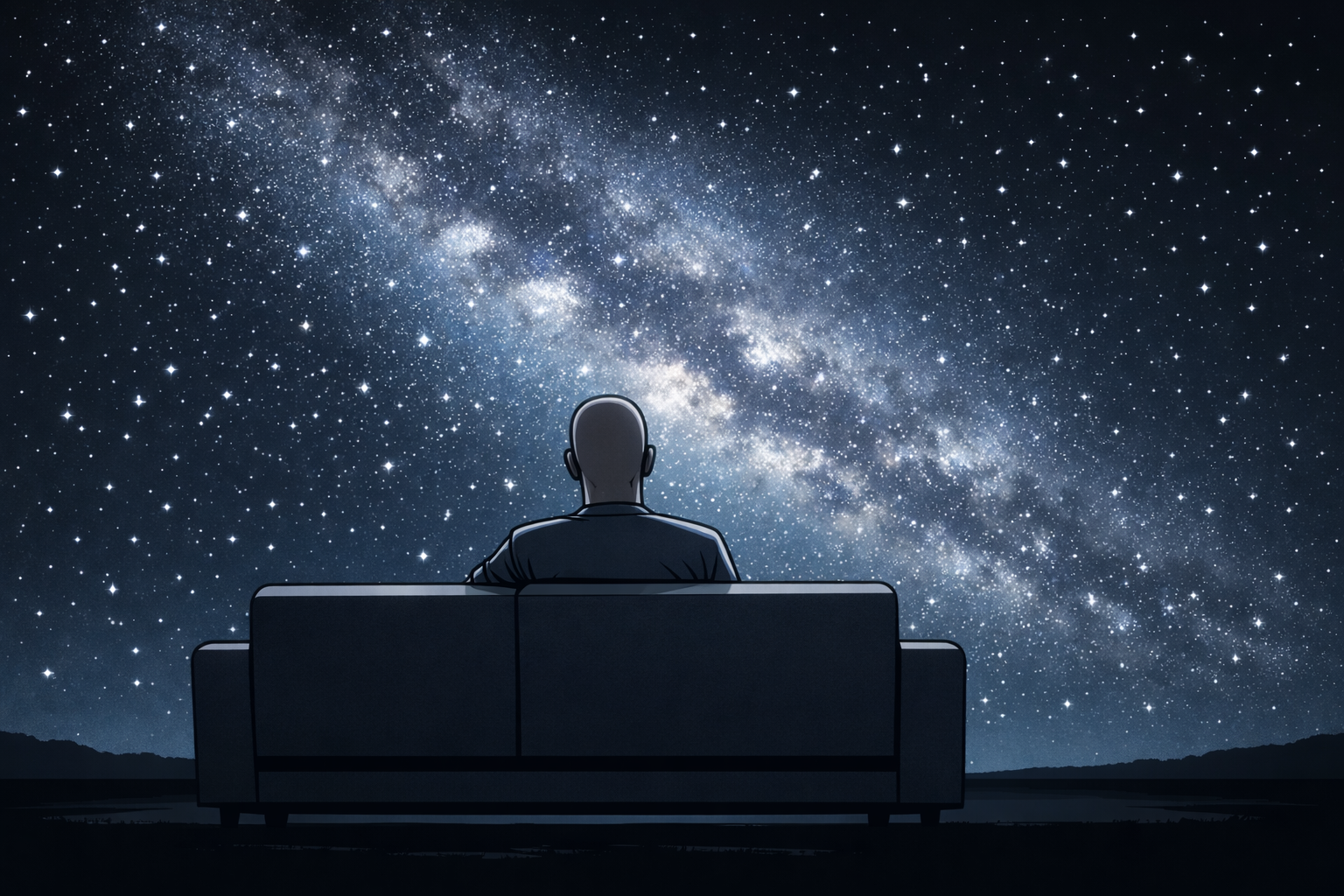
I was sitting on my couch, not on a mountaintop, not at the end of a vision quest, just on my couch, when something opened. For five days I was filled with what I can only call pure compassion. Not sentiment, not warmth, not the ordinary low-level goodwill most of us manage on a good day. Something categorically different. An intense, overwhelming love for literally everyone. Every person I thought of or encountered was met with that same flood of feeling, without exception, without effort.
And then, as if a veil had been thrown over it, it went away.
What stayed was the memory. And the memory has been transforming me ever since, slowly, incompletely, but genuinely, in ways I am still noticing.
I tell that story not to make a spiritual claim but to make an empirical one. That state exists. I was in it. It was more real than ordinary waking consciousness, not less. Whatever consciousness is, it contains that, and most of us will never know it because we are too busy looking at our phones.
And I am not alone in reporting it. Thousands of people across centuries and cultures have documented the same territory: mystics, contemplatives, ordinary people who were simply paying attention. St. Teresa of Avila mapped it in the sixteenth century. Thomas Merton wrote about it from a Trappist monastery in Kentucky. Bernadette Roberts described the dissolution of the self in careful, unsentimental prose. Adyashanti has documented sudden awakening experiences with a clarity that is almost clinical.
Most compelling to me is the psychologist William James, who a century ago treated these experiences as data in The Varieties of Religious Experience, approaching the interior with the same rigor a scientist brings to any phenomenon worth studying. I only discovered James in the last year, but I found my own thinking reflected in his work with uncanny precision. That is not influence. That is convergence. And convergence is its own form of evidence, suggesting that the territory is real, that it is consistent, and that it is available to anyone willing to make the journey inward.
Why We Avoid the Interior
Why don't more people go inward?
I have watched this question for a long time and I keep arriving at the same answer: fear.
Not fear of nothing, but fear of something specific. Fear of the mirror. Of seeing yourself clearly without the usual machinery of justification and avoidance running.
Psychology gives this resistance a name. The psychologist Leon Festinger called it cognitive dissonance: the mind's deep drive to smooth over contradictions and protect a consistent self-narrative (see this post). We are wired to tidy things up before we have really looked at them. The interior threatens that tidying instinct at a fundamental level.
Most of us have an image of ourselves that is carefully maintained. Looking honestly at the interior threatens that image. And the ego, which I think is mostly just fear wearing a suit, will do almost anything to prevent that.
We call it being busy. We call it being practical. We call it not being the navel-gazing type. But what it usually is, underneath, is avoidance. The interior is where the unresolved things live, and unresolved things are uncomfortable, and discomfort is something our entire consumer infrastructure is designed to help us escape.
Here is what I have come to believe after four decades of paying attention: the outer problems are downstream of the inner ones. We do not work together because we are fragmented inside. We fight and hoard and build walls between nations for the same reason we build walls inside ourselves. The instrument of perception is compromised. We are sending unresolved people into boardrooms and governments and relationships, and then we are surprised when things do not cohere.
This is not a moral argument. It is a practical one. You cannot solve collective problems with individually fragmented actors. The telescope pointed at distant galaxies is being operated by someone who has never looked at himself.
The Real Frontier
I have written about consciousness before, from different angles: through the lens of neuroscience and perception in What Your Eyes Don't Show You, through the strange territory of AI in When an AI Emails a Philosopher About Its Own Consciousness, and through identity and awareness in Code-Switching, Consciousness, and the Selves We Don't Know We're Wearing. Eight posts now, circling the same mystery. It keeps demanding more.
What I have not written until now is the simple version. Consciousness is the frontier. Not metaphorically. Literally. It is the least explored, least understood, and most consequential territory available to us: where suffering happens, where meaning is made, where every human experience occurs. Nothing matters except through it. And we are, as a civilization, almost entirely pointed away from it.
The hard problem that Chalmers named is not going to be solved by more brain scans. It is going to require people willing to go in, not as a hobby or a wellness practice, but as a serious investigation into the nature of what they actually are.
That investigation does not require equipment. It does not require money or credentials or the right stuff. It requires only willingness. The willingness to stop building walls. To sit down. To look at what is actually there without flinching away.
You do not even need a mountaintop.
A couch will do.