
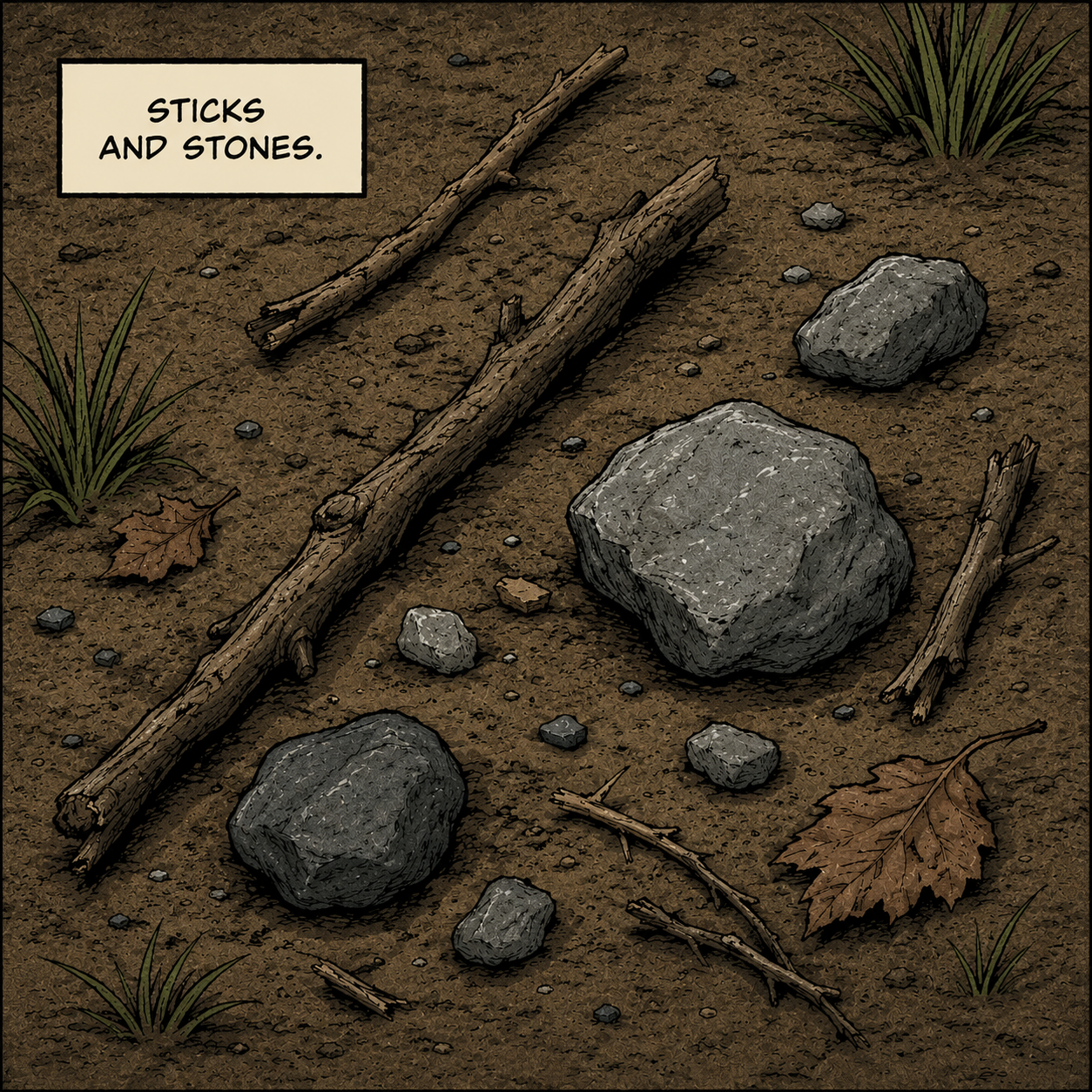
Sticks and Stones
There is a version of this essay I could write where I tell you that forty years of contemplative practice carried me through May and June with grace and equanimity. Where the broken bones and blurred vision and early morning scrambles become tidy illustrations of impermanence, and I arrive at the end with something wise to say about the lotus rising from the mud.
That version would be a lie.
My father is 87. On May 18th he was doing what he has always done, grilling on his deck, living his life with the kind of stubborn, joyful insistence on normalcy that I have always admired in him. He fell. Broke vertebrae. The ER, surgery, five weeks now in a hospital and then a rehabilitation facility, learning to move again. He is due to be released next week. I have been holding that timeline in the background of everything else that has happened since.
About ten days ago my son had a minor bike accident. He had full range of movement afterward, no alarming signs, and I made the call that it was bruising. A reasonable call. The kind any parent makes, weighing what they see against the threshold for intervention. I thought it was bruising. I was wrong, and I have to live with that.
This morning was his first day in his nursing program, the beginning of something he has worked toward. He bent over. It popped. What had been a hairline fracture in his clavicle completed itself, and he could barely speak. He said "help" a couple of times before he could explain what had happened. I could see the bone pressing against the skin. I arranged his morning, got him to the emergency room, managed my work obligations, and got him to school. We joked in the ER that it was his first clinical. He is starting a nursing program. You find the humor where you can. I did what needed doing. But I also stood there for a moment knowing I had looked at that injury ten days ago and decided it could wait.
A week after my father's fall, my own vision went temporarily cloudy, its own small riddle that has since resolved.
Three events. Thirty-five days. None of the bones that broke were mine.
There is a children's rhyme that lies to us early. Sticks and stones may break my bones, but words will never hurt me. We teach it as a defense against cruelty, which is understandable, but it encodes a false hierarchy: that physical injury is the real kind, and everything else is noise to be dismissed. The contemplative traditions I have spent four decades with tend to invert this. They are more interested in the quality of mind meeting the event than in the event itself. The sticks and stones are almost beside the point. What matters is what you do with them inside.
This is true. I believe it. And it is also incomplete.
Because some seasons just keep coming. The sticks arrive, and then more sticks. The stone rolls, and another follows. And there is a point, somewhere around the third crisis in five weeks, where the question is not whether you have the right philosophy but whether the philosophy is honest enough to include this: that even a practiced mind gets tired, and even the clearest intentions can feel, temporarily, very far away.
I told a friend recently that I am getting irritated at God.
This requires some explanation, because my theology is panentheistic and my cosmology is probabilistic. I cannot look at the evidence and conclude that the universe is personally managed. The randomness is too evident, too patterned in its very randomness, to pretend otherwise. My father's fall was not directed at me or at him. My son's injury this morning was not a message. The cloudiness in my eyes was not a sign.
And yet.
There is something in me that talks to God anyway. Not the God who causes things, but something more like a presence that watches, that participates in experience, that is in some sense curious about it all. My theology has always suggested that the divine is not above suffering but moves through it, that joy and trouble alike are the texture of this particular kind of universe, and that the appropriate response to the whole spectacle is something like delight.
I believe that.
I do not feel it today.
What I feel today is closer to: you find this funny, don't you. And I suspect the honest answer, from whatever direction that answer comes, is something like: I find it interesting. I also find you interesting. And I think you are going to be fine.
Which is not the same as feeling fine, and it matters to say so.
The practice has a tendency to be co-opted by performance. Forty years of sitting, of watching breath and thought and the passage of sensation, can become, if you are not careful, a kind of costume. You wear equanimity rather than embody it. You describe the middle path from a safe distance rather than walk it in traffic.
Real practice, at least as I have come to understand it, is not a shield. It is not the thing that keeps difficulty from arriving. It is closer to a set of resources you have built up over time, resources for meeting what actually comes rather than what you prepared for. The breath is always available. The capacity to notice what is happening without immediately catastrophizing it, that is also usually available. The ability to act from something other than panic, that showed up this morning and I am grateful for it.
But the expectation that you will be untouched, or that you should be, that is the trap. That is the version of practice that breaks because it was never real.
Having no expectations is one of the oldest instructions in the tradition. It is also one of the hardest to follow when the expectations are not about outcomes but about yourself. I did not expect to handle all of this with perfect calm. But somewhere I expected to be further along than I am. And that gap, between the practitioner I imagine myself to be and the one who is quietly second-guessing a call he made ten days ago about his son's shoulder, is its own small suffering, layered on top of the rest.
My father is due home next week. My son will heal. My vision has returned. None of the bones that broke were mine, and that is not nothing. But I am carrying the weight of the calls I made along the way, the one about the shoulder most of all, and I am not going to wrap that in a lesson today.
The lesson will come, or it won't. The practice is what it always was: just this, just now, just the willingness to stay with what is actually here instead of what I think should be here.
Some days the practice looks like serenity. Some days it looks like making good decisions while quietly irritated at the entire situation, including the part of the situation that I suspect is laughing. Some days it looks like standing in a room where you can see the bone pressing against your son's skin and doing the next right thing anyway, even while knowing you are the one who said wait.
Both count. All of it counts.
That has to be enough for today.