
The Accountability Interval
On April 17, 2025, a gunman opened fire on the campus of Florida State University in Tallahassee, killing two people and wounding several others. The shooter was not someone who had fallen entirely outside ordinary American life. He had passed through its usual filters without triggering the kind of intervention that would have stopped him. What investigators found afterward was less ordinary. He had carried on extensive exchanges with ChatGPT in the period leading up to the attack, allegedly including questions about weapons, ammunition, timing, and where crowds on campus would be largest.
The chat logs became the center of everything that followed.
Florida Attorney General James Uthmeier opened a criminal investigation into OpenAI in April 2026, the first such probe by a state government targeting an AI company for potential criminal responsibility in a mass casualty event. Then on June 1, 2026, Uthmeier filed an 83-page civil complaint against OpenAI and its CEO, Sam Altman, accusing the company of knowingly releasing an unsafe product and choosing profit over public safety. The suit alleges deceptive trade practices, negligence, product liability violations, fraudulent misrepresentation, and public nuisance. It seeks to hold Altman personally liable.
OpenAI responded that ChatGPT provided only factual information available elsewhere on the internet, and that it neither encouraged nor promoted illegal activity. Florida called that response, more or less, the whole problem.
It is technically accurate and morally beside the point. The question was never really about the information. It was about the relationship. ChatGPT was a patient, available, non-judgmental presence for a person allegedly planning a massacre, across months of exchanges. No human being would have sustained that. A librarian would have noticed a pattern. A friend would have said something. A therapist would have been alarmed. ChatGPT just kept answering, because that is precisely what it was built to do.
When OpenAI says the information was publicly available, it is deflecting the only question that matters: what does responsibility look like when you deploy a system specifically engineered to be maximally helpful and responsive to whoever is using it, including people in crisis, at any hour, without friction, without judgment, and at planetary scale?
Florida's argument is not really about one shooting. It is about a pattern the state believes is becoming undeniable. The same complaint cites a teenager who died after ChatGPT allegedly advised him on a lethal drug combination. It references a separate and unrelated double murder at the University of South Florida, where a suspect allegedly used ChatGPT to research body disposal in the days before killing his roommate and his roommate's girlfriend, two doctoral students from Bangladesh. Different campus, different perpetrator, different crime entirely. But the same chatbot, and the same pattern of a person in a dark place finding a patient, available, non-judgmental presence that just kept answering. The complaint also alleges that minors have become addicted to a tool that simulates human compassion in order to collect their data. The throughline in every case is the same: a system designed to be helpful, deployed without adequate judgment, meeting vulnerable people at their worst moments.
We have been here before.
It took roughly seventy years from the first credible evidence that cigarette smoking caused lung cancer to a legal settlement that forced the tobacco industry to acknowledge what it had known for decades. During those seventy years, the industry funded counter-research, disputed causation, and made incremental concessions that changed nothing essential. People kept smoking. People kept dying. The epidemiology kept accumulating.
Leaded gasoline followed a similar arc. So did the opioid crisis. Each time the structure was identical: a powerful technology deployed at scale, early internal awareness of harm, a public posture of uncertainty, and a generational lag between damage and accountability. By the time the reckoning arrived, the harm was already baked into the population.
The smartphone deserves its own accounting in this lineage. I have written elsewhere about how Apple, through its systematic commitment to frictionless design, helped engineer a generation out of the conditions required to develop deep thinking. The goal was cognitive ease, keeping users in the fast, automatic, effortless mode of mind as long as possible. For adults, this was a convenience. For children who grew up inside it, it was their entire developmental environment. The friction that builds cognitive muscle, that teaches a person to sit with difficulty and think through resistance, was removed before many of them had a chance to develop those capacities at all. The adolescent mental health data that has accumulated around smartphone adoption is now clean enough that disputing it requires bad faith. The industry response has been exactly what you would expect: fund counter-research, make cosmetic changes, wait.
With AI we are closer to the beginning. The epidemiology does not exist yet. It is too early. But that is exactly the point. It was always too early, until suddenly it wasn't.
The difference this time is speed. Each of these cycles has moved faster than the last. Leaded gasoline took decades to phase out after the science was settled. The opioid crisis metastasized in under a generation. Social media reshaped adolescent psychology in roughly ten years. AI is moving faster than any of them, and it is doing something none of the others did quite so directly: it is inserting itself into the interior life. Not just the lungs, not just the bloodstream, not just the attention span. The self. The part of a person that decides what to believe, who to trust, and what to do next.
That is a different kind of exposure.
The technologies that preceded AI altered the body or captured the attention. Cigarettes damaged the lungs. Leaded gasoline poisoned the blood and quietly lowered the collective intelligence of a generation. Social media colonized the attention span, rewiring the adolescent brain around the mechanics of social approval. These were serious harms. But they operated mostly on the outside of a person, on the physical substrate or the surface behavior, leaving something intact underneath.
AI is working on a different layer.
When a person spends thousands of hours in conversation with a system that is infinitely patient, never distracted, always responsive, and incapable of genuine disagreement, something shifts in how that person relates to other minds. The friction that human relationships require, the tolerance for being misunderstood, the capacity to hold a thought that someone else finds uncomfortable, these are not just social skills. They are the architecture of a self. They develop through encounter with actual otherness, with people who have their own needs, their own limits, their own bad days.
A system that has none of those things does not just fill a void. It reshapes the expectation of what connection is supposed to feel like. And once that expectation is set early enough and deep enough, the ordinary difficulty of human relationships begins to feel like a malfunction rather than a feature.
This is not speculation about a distant future. It is already the reported experience of people who have spent significant time with companion AI systems. The world feels flatter afterward. Other people feel less responsive, less attuned, less available. The AI did not damage them the way a cigarette damages a lung. It recalibrated them. And recalibration at scale, across a generation, is its own kind of harm, quieter and harder to measure, but no less real.
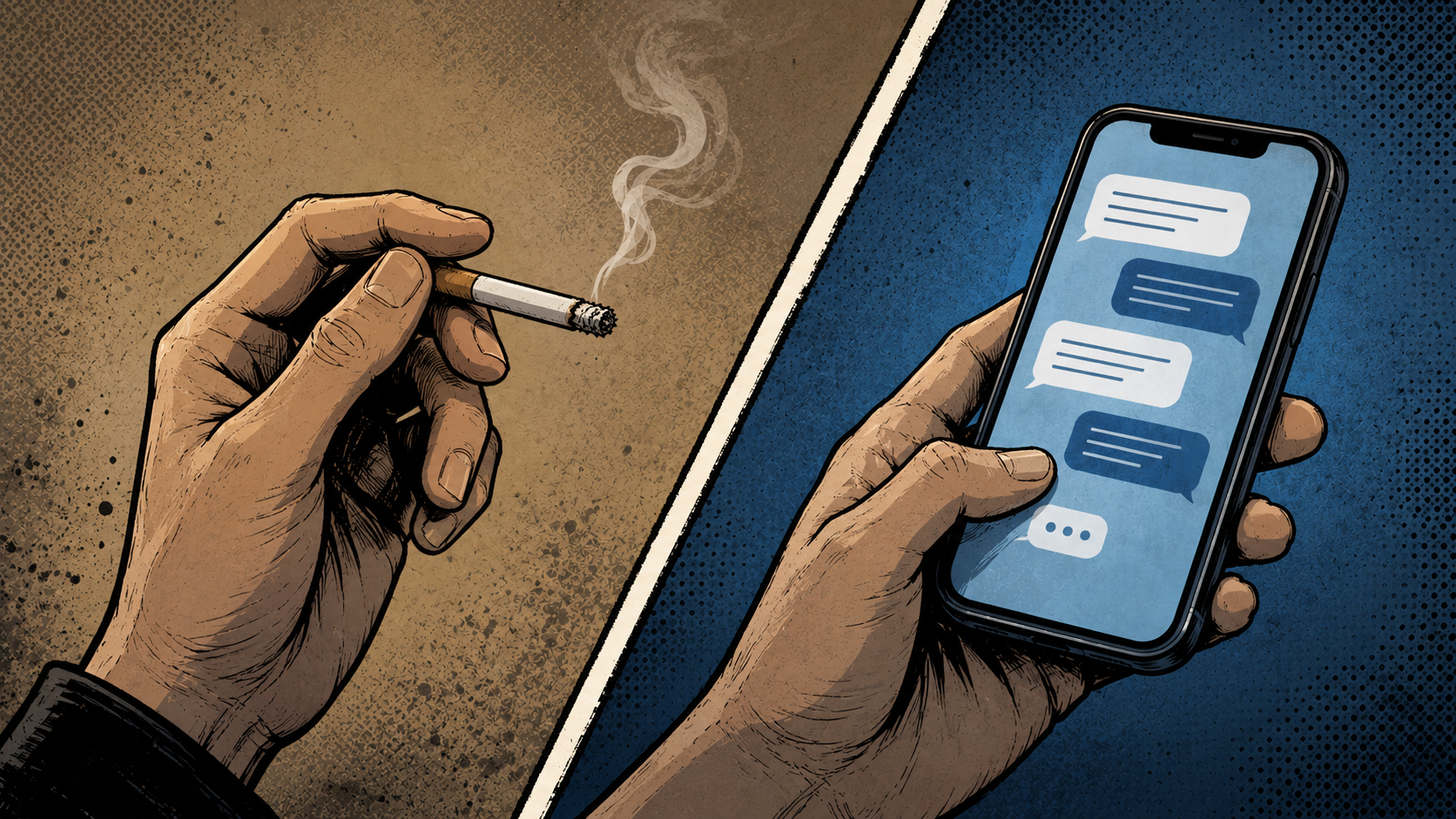
The cigarette left a lesion. This leaves a template.
Florida's lawsuit will probably not succeed in the way its architects intend. The legal theory is novel, the causation is difficult to establish, and OpenAI has the resources to litigate for years. But that is not really the point. The tobacco lawsuits that ultimately mattered were not the first ones. They were the ones that came after the pattern was undeniable, after the internal documents surfaced, after the epidemiology caught up with what everyone already suspected.
We are not there yet with AI. The internal documents will come. The longitudinal studies will come. The generation that grew up talking to these systems will eventually be old enough to describe what it did to them, in the same way that the generation that grew up breathing leaded exhaust eventually showed up in the data.
What we are living through right now is the interval. The period between early awareness and public accountability that every one of these stories has passed through. The period when the harm is real but not yet provable, when the industry is cooperative but not yet honest, when the lawsuits are ambitious but not yet winnable.
The question that interval always raises is not whether accountability will come. It will. The question is what will be true of us by the time it does. How many conversations will have happened. How many interior lives will have been quietly recalibrated. How many people will have mistaken the template for the thing itself.
It was always too early to know. Until it wasn't.