
The Accuser Without a Face
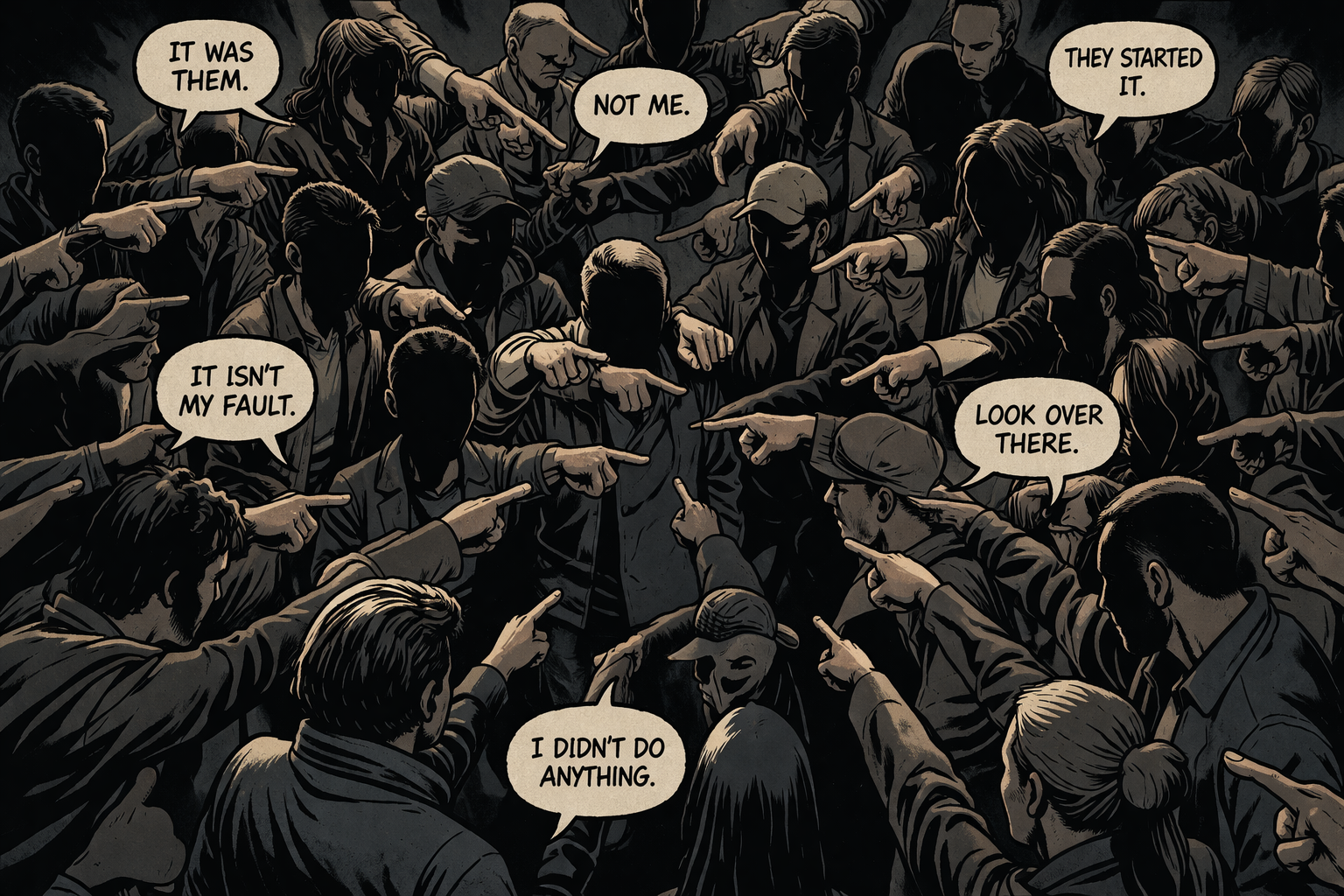
There is a long-standing idea in religious and philosophical thought that evil is not simply an individual failing but something that emerges between people, something structural, contagious, and difficult to locate. The work of Rene Girard sharpens that intuition into a mechanism: human communities, he argued, stabilize themselves by projecting their internal tensions onto a chosen victim. Violence is displaced, unified, and then ritualized. The scapegoat carries what the group cannot bear to see in itself. As Girard wrote in Violence and the Sacred (1972), "the sacrificial process prevents the spread of violence by keeping vengeance in check" - not by eliminating the underlying tension, but by redirecting it outward.
In that framework, the devil is not just a supernatural being. He is the ultimate scapegoat: an abstraction large enough to absorb the moral weight of an entire species. A symbolic container for what we refuse to own.
This explains something subtle but persistent in human language. When people do harm, they often describe it as intrusion rather than choice. Something got into me. I wasn't myself. The grammar itself distances the actor from the act. Philosopher Harry Frankfurt, writing on the structure of the will, observed that what we disavow in moments of harmful action often reveals the most about how agency is organized and delegated in the self. The devil, in this sense, is not just believed in. He is used. A conceptual technology that allows responsibility to slide sideways.
But there is a deeper inversion available here.
It may be that the invention of the devil is not merely a psychological defense, but an inadvertent diagnosis. Not that we created a myth to explain evil, but that in doing so, we described something real - just not where we thought it was.
Across history, human systems have produced patterns of behavior that no single individual fully intends and yet many participate in. Hannah Arendt's account of Adolf Eichmann, in Eichmann in Jerusalem (1963), introduced the phrase "the banality of evil" to describe exactly this phenomenon: atrocity unfolding through bureaucratic compliance rather than exceptional cruelty, responsibility diffused across a chain of ordinary actors until it seems to belong to no one. Slavery did not require every participant to be uniquely monstrous. Ecological destruction continues through countless ordinary decisions, none of which feel decisive on their own. Institutions grind people down without any one person experiencing themselves as the agent of harm.
This is what makes these systems so difficult to confront: they are distributed. No central driver. No singular will. Everyone implicated, no one fully responsible.
That pattern begins to look familiar.
If one were to describe a force that operates through accusation, fragmentation, and the displacement of responsibility - something that emerges from collective behavior rather than individual intent - it would not look entirely different from the traditional figure of the devil.
There is a theological resonance here that rewards close attention. The Hebrew term ha-satan (הַשָּׂטָן), appearing in Job and Zechariah, designates not a rebel deity but a prosecutorial function: "the accuser" or "the adversary," a figure whose role within the divine court is to present charges against human beings. Elaine Pagels, in The Origin of Satan (1995), traces how this forensic figure was gradually transformed into a cosmic enemy, a shift that conveniently exteriorized what had previously been understood as an internal or relational problem. The defining characteristic was not horns or fire, but accusation itself: the act of pointing outward, of locating the problem elsewhere.
If the devil is the accuser, then one of the most "devilish" things we do may not be violence alone, but the reflex to attribute that violence to something outside ourselves. The accusation becomes the mechanism of evasion. The more insistently we locate evil elsewhere, the less we have to examine how it operates through us.
From this angle, the scapegoat mechanism and the concept of the devil begin to converge. The devil is not only the one we blame; he is the structure that allows blame to function as a release valve, preserving social cohesion without requiring genuine self-recognition.
And yet, this framing risks oversimplification if taken too far.
The same collective human organism that produces systemic harm also produces its interruption. Abolition movements emerged within societies that normalized slavery. During World War II, individuals and networks risked their lives to conceal and protect those targeted for extermination. Contemplative traditions across cultures have spent centuries developing practices specifically aimed at observing and loosening the automatic patterns that lead to harm. The Buddhist concept of pratityasamutpada (dependent origination) holds that harm arises not from a fixed inner nature but from conditions, which means those conditions can, in principle, be changed.
Girard himself noted that the Judeo-Christian narrative contains a self-subverting element: the consistent presentation of the victim as innocent progressively exposes the scapegoat mechanism for what it is. Once the crowd's logic is visible, it can no longer function with the same unconscious ease. As Girard wrote in The Scapegoat (1986), "the Gospels show us the founding mechanism of human culture in the very act of destroying its effectiveness." Awareness disrupts the cycle.
So a more precise formulation emerges.
Humanity is not the devil. Humanity contains the full range of what the devil was meant to represent, and created the concept, in part, to avoid integrating that knowledge.
The myth persists because it is useful. It simplifies moral complexity into a figure. It allows for condemnation without introspection. But it also encodes, in symbolic form, an observation about distributed responsibility that remains difficult to articulate directly.
From a contemplative perspective, this lands less as an abstract claim and more as a practical one.
If the tendency toward harm is not confined to individuals but arises in patterns - automatic, relational, often invisible - then the work is not simply to identify and oppose "evil" externally. The 13th-century Christian mystic Meister Eckhart suggested that the deepest spiritual error is to locate the sacred, or its absence, at a comfortable distance from the self. The same principle applies here. It is to notice how quickly the mind moves to accusation, how readily it divides the world into actors and intrusions, and how easily responsibility is displaced.
The interruption does not begin at the scale of systems, though it eventually must reach there. It begins at the level where the mechanism is most accessible: the moment of reaction, the formation of judgment, the subtle relief of locating the problem outside oneself.
Seen this way, the figure of the devil becomes less an entity to reject and more a mirror to reinterpret.
Not something that exists independently of us, but something that becomes visible when we look closely enough at how we avoid seeing ourselves.