
The Anger Is the Point
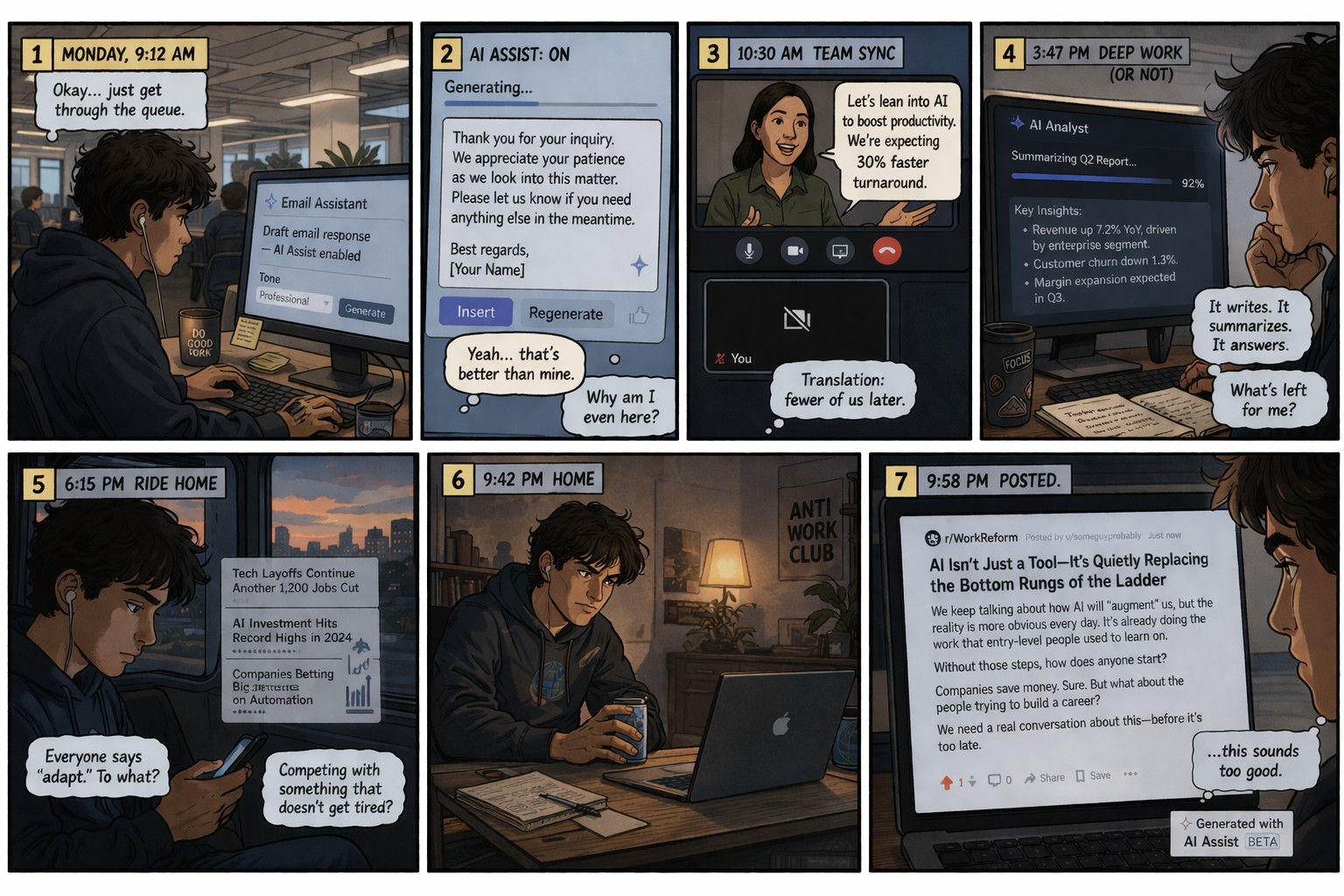
A new Gallup survey dropped this week with a finding that sounds contradictory until you think about it for a minute: Gen Z is using AI at steady, high rates and getting angrier about it at the same time. Half of 14- to 29-year-olds use generative AI at least weekly. Excitement about it has dropped 14 points in a single year. Anger has risen 9 points. Even daily users are less hopeful than they were twelve months ago.
My first reaction was: of course. We've been here before.
Since the Industrial Revolution, new technologies have followed a fairly consistent pattern: initial fear, rapid adoption driven by usefulness, gradual development of rules and norms, and eventual normalization. What's different with AI is not the pattern itself, but how compressed and psychologically intense it feels. Gen Z's current stance, heavy use combined with rising skepticism, fits into that broader history, but with some important differences.
Early industrial machinery triggered one of the most extreme reactions. Workers didn't just worry about losing jobs. They physically destroyed machines during the Luddite movement. The fear was immediate and tangible: livelihoods disappearing overnight. Despite that resistance, adoption continued because it was economically inevitable. Over time, societies adapted through labor laws, unions, and new kinds of work. The key difference with AI is that industrial workers had little choice. Gen Z is choosing to use AI while simultaneously distrusting it, a tension I explored in The AI Divide Is Real, But the Tools Are Part of the Problem.
With electricity, the fear shifted from economic survival to physical safety. People worried about fires, electrocution, and the invisible nature of electrical force. Adoption was slower because it required infrastructure, but once standards and regulations were established, trust followed. AI doesn't benefit from that same pathway. Its risks are not physical or easily observable. They are cognitive, economic, and long-term, which makes them harder to regulate and harder for people to feel resolved about.
The rise of automobiles introduced another kind of fear: visible danger. Early cars caused accidents, disrupted cities, and were seen as chaotic. Yet adoption accelerated quickly once vehicles like the Ford Model T made them affordable. Society responded by creating traffic laws, licensing systems, and insurance structures. In contrast, AI's risks are less visible. There is no equivalent of a car crash that clearly demonstrates harm. Instead, concerns revolve around job displacement, misinformation, and the erosion of skills, effects that are diffuse and harder to pin down.
Television offers a closer psychological parallel. Critics worried it would degrade attention spans, reduce reading, and negatively shape culture. Those concerns sound very similar to today's worries about AI harming learning and critical thinking. The difference is that television was passive. It influenced what people consumed, but it did not replace the act of thinking itself. AI, by contrast, can generate ideas, write, and reason, which creates a deeper concern: not just that people will think less, but that they may lose confidence in their own thinking.
The internet marked a major shift by giving people access to vast amounts of information. It was adopted rapidly, but skepticism persisted around privacy, credibility, and misinformation. AI builds directly on that foundation but goes a step further. Instead of simply accessing information, it produces it. That changes the trust dynamic. With the internet, the question was whether a source was reliable. With AI, the question becomes whether the output itself is grounded in reality at all, which I approached from a different angle in When an AI Emails a Philosopher About Its Own Consciousness.
Smartphones intensified concerns around attention, addiction, and constant connectivity. Adoption was nearly universal despite widespread awareness of negative effects. Gen Z, having grown up with smartphones, is already familiar with the trade-offs of powerful technology. That experience likely contributes to their more cautious stance toward AI. They have already seen how a technology can be both indispensable and problematic at the same time, something I wrote about in We Taught the World to Read. Then We Forgot Why It Mattered.
The core difference with AI is that it targets cognition rather than just behavior or labor. Previous technologies replaced muscle, extended reach, or altered habits. AI operates closer to judgment, creativity, and reasoning, the traits people associate with identity and agency. That makes the skepticism more personal. At the same time, its benefits are immediate and practical, which explains why usage remains high despite growing concern.
Taken together, Gen Z's response is not an outlier but an acceleration of a historical pattern. They are adopting AI quickly, as every generation has done with transformative technology, but their skepticism is arriving earlier and more sharply. That suggests the usual cycle - fear, adoption, regulation, normalization - may unfold faster with AI, but also with more tension around trust than previous technologies experienced.
I can see this playing out in my own house. My 26-year-old uses AI regularly and thoughtfully. My 24-year-old rails against it almost constantly and, as far as I can tell, only uses it by accident. He is a black and white thinker, something I recognize because I'm wired the same way, and he has painted the whole technology with one broad stroke. He is, almost precisely, the person this Gallup survey is describing.
My 26-year-old is less enthusiastic than he was a year ago. And honestly, so am I. I've pulled back on some of my own usage, not out of fear, but as a deliberate choice not to outsource my thinking. I use it now mostly for enhancement, supplementing areas where I'm genuinely weak rather than substituting for areas where I'm not. The difference matters.
What makes Gen Z's response genuinely different from every previous technology panic is that they are using the thing they're angry about. The Luddites smashed the looms. Gen Z is running the looms, clocking out, and then going home to write angry posts about looms on their phones. That's not contradiction. That's sophistication.
The Gallup data shows this clearly. Daily AI users are less angry and more hopeful than non-users, but they are still more skeptical than they were a year ago. Familiarity is not producing blind trust. It's producing something more useful: informed skepticism. They know what the tool does, they're watching what it costs them, and they're not pretending those two things cancel each other out.
There's one place where that skepticism needs to go further, though. A lot of people using AI are not actually reading their outputs. They're accepting whatever comes back and moving on. That concerns me more than the anger does. The entry threshold for AI is almost zero. The judgment ceiling, the level of discernment required to actually use it well, is anything but. I read and verify everything, especially in my legal work, and I'd argue that's not optional. The tool is only as good as the judgment applied to it.
That matters because this generation will have political power before long. And when they do, the combination of high usage and hard-won skepticism is exactly the input that produces thoughtful regulation. Not censorship born from fear of something people don't understand. Not the wild west we have now, where the technology is outrunning any coherent framework for governing it. Something in between, grounded in actual experience.
Every generation shapes the technology that shaped it. Gen Z grew up with smartphones and watched that go sideways without guardrails. They're not going to make the same mistake twice if they can help it. The anger in the Gallup numbers isn't a problem to be managed. It's a resource, if anyone is paying attention.