
The Archipelago
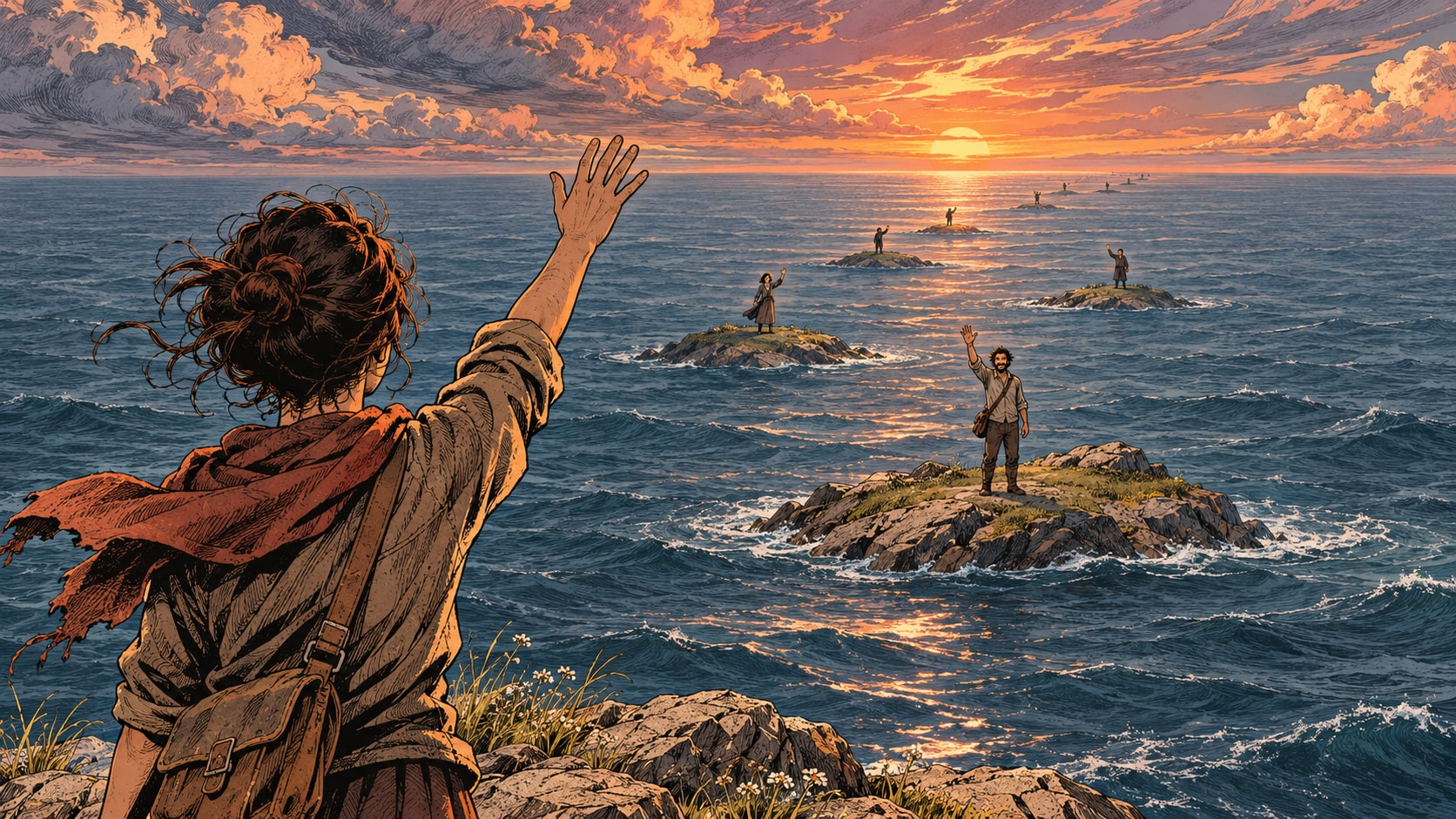
In 1624, John Donne wrote that no man is an island, entire of itself; every man is a piece of the continent, a part of the main. He wrote it while recovering from a serious illness, listening to a church bell toll for someone else.
I've always believed the first half. I've never felt like an island, cut off and alone. But I've never felt like a piece of the continent either.
If I had to name the shape of my life, I'd call it an archipelago. One island in a string of them, close enough to see the others and wave, with water in between that never quite goes away.
It started early. In school I was the odd man out, and I figured it was something I'd grow out of. College is supposed to be where you find your people. I felt it there too.
It followed me into every job I've had. Different places, different people, same water.
The strangest place it shows up is faith. I've practiced meditation for nearly forty years, and the spiritual life sits close to the center of who I am. Yet I've never been able to join a religious organization. I always felt like the odd man out.
And then there's family. I'm the black sheep of mine. That one is the hardest to explain, because family is supposed to be where you belong by default, before you've done anything to earn it.
So I went looking for a name for it.
Psychology has a few, though none of them is a diagnosis. The temperament researchers Alexander Thomas and Stella Chess talked about "goodness of fit," the match between a child's nature and the family's style. When the fit is poor, nobody has to be at fault for a kid to grow up feeling like a guest in his own house.
Family systems therapists describe roles people get cast in, and the black sheep is one of them. Murray Bowen wrote about differentiation, the work of becoming your own person without either merging with your family or cutting yourself off from it. Elaine Aron's "highly sensitive person" describes someone who has felt out of step for as long as they can remember.
I recognize something in each of these. None of them feels like the whole story. They try to explain where the feeling comes from, but they don't say much about what to do with it.
The usual answer to a feeling like this is therapy. I'll be honest: I have no faith in modern therapy.
I've watched people get their worst behavior validated by therapists who seemed more interested in making them feel good than in fixing what was actually wrong. I call it validation therapy. And I think most therapists are broken themselves. Why would I take my car to a mechanic who can't fix his own?
To be fair, it isn't supposed to work that way. Marsha Linehan's dialectical behavior therapy, the best-known approach built on validation, pairs acceptance with a hard push for change. Validation was meant to be half the job, not all of it.
Part of the problem is structural. People quit the moment they're challenged. A 2012 meta-analysis by Joshua Swift and Roger Greenberg found that about one in five clients drop out of therapy early, and a therapist who needs clients learns not to push too hard.
Older traditions built the challenge into the arrangement. A Zen student or a monastic novice committed to the teacher first, knowing the teacher would be hard on them. The difficulty was part of the deal, not a betrayal of it. Modern therapy lost that commitment, and a lot follows from the loss.
Which is a little ironic, coming from someone who has never been able to join anything.
Here's the thing about archipelagos. Many of them aren't really separate. The Hawaiian Islands are the tops of volcanoes built by the same hotspot, rising off the same ocean floor. From the surface they look like scattered pieces. Below the waterline, they're one long ridge.
I don't know if that's true of people. Part of me wants to say yes, that underneath the water we're all standing on the same ground. Another part of me knows the water is real, and cold, and still has to be crossed.
Maybe both are true. Maybe the outsider's job isn't to become part of the continent. Maybe it's to remember the ridge, even on the days all you can see is the water.