
The Aztec Pantheon: What the Algorithm Erased

There is a photograph that does not exist.
I asked for it repeatedly. Different prompts, different angles of approach, different levels of specificity. I wanted a contemporary Mexican family, multigenerational, in a living room. I wanted the faces of the people who actually descend from the civilization that built Tenochtitlan, one of the largest cities on earth before Europeans had heard of it. I wanted cheekbones that carry the genetic memory of Nahuatl speakers. I wanted the particular shade of brown that is neither the romanticized "copper" of Hollywood westerns nor the ambiguously Mediterranean that AI defaults to when it gets nervous.
What I got was this.
This is not the Aztec pantheon. Or rather: this is exactly the Aztec pantheon as the algorithm understands it. A warm, photogenic family in a well-appointed living room. Attractive. Aspirational. Legible to the imagined audience. The grandmother has gray hair and quiet dignity. The parents look like they run a successful family business. The adult children look like they went to good universities. Everyone is comfortable.
Everyone is also, in a very specific and revealing way, not quite anyone.
What Got Lost Before the Prompt Was Written
The Aztec pantheon is not a simple thing to render. This is not the Roman model, where you are essentially working with Greek mythology in different clothes and a more martial disposition. This is not the Norse model, where Marvel spent fifteen years and four billion dollars doing the image-laundering for the algorithm, and handed it a finished product so thoroughly processed that the one-eyed patriarch shows up in a beanie and a leather jacket holding a hammer like he is about to do some light home renovation.
The Aztec tradition, more properly the Mexica tradition within the broader Nahua cultural complex, was a living cosmological system of extraordinary sophistication when the Spanish arrived in 1519. Huitzilopochtli, the solar war deity, was not a symbol. He was a function. The sun required maintenance. The maintenance required blood. This was not barbarism dressed in feathers. It was a cosmological physics, a theory of what the universe costs and who pays.
Quetzalcoatl is the one name most people know, which means most people know the wrong thing. The feathered serpent is real, and old, predating the Aztec synthesis by centuries, threading through Teotihuacan and Toltec traditions before the Mexica incorporated him. But Quetzalcoatl in the popular imagination has been flattened into a benevolent bearded god who the Aztecs supposedly mistook Cortes for, which is a story the Spanish found extremely useful and historians have spent decades dismantling.
Tlaloc, the rain deity, is probably the oldest continuously worshipped god in Mesoamerica. He is also the one who required the tears of children as sacrifice, because rain and tears share a grammar. That is not a metaphor I am reaching for. That was the operative theology.
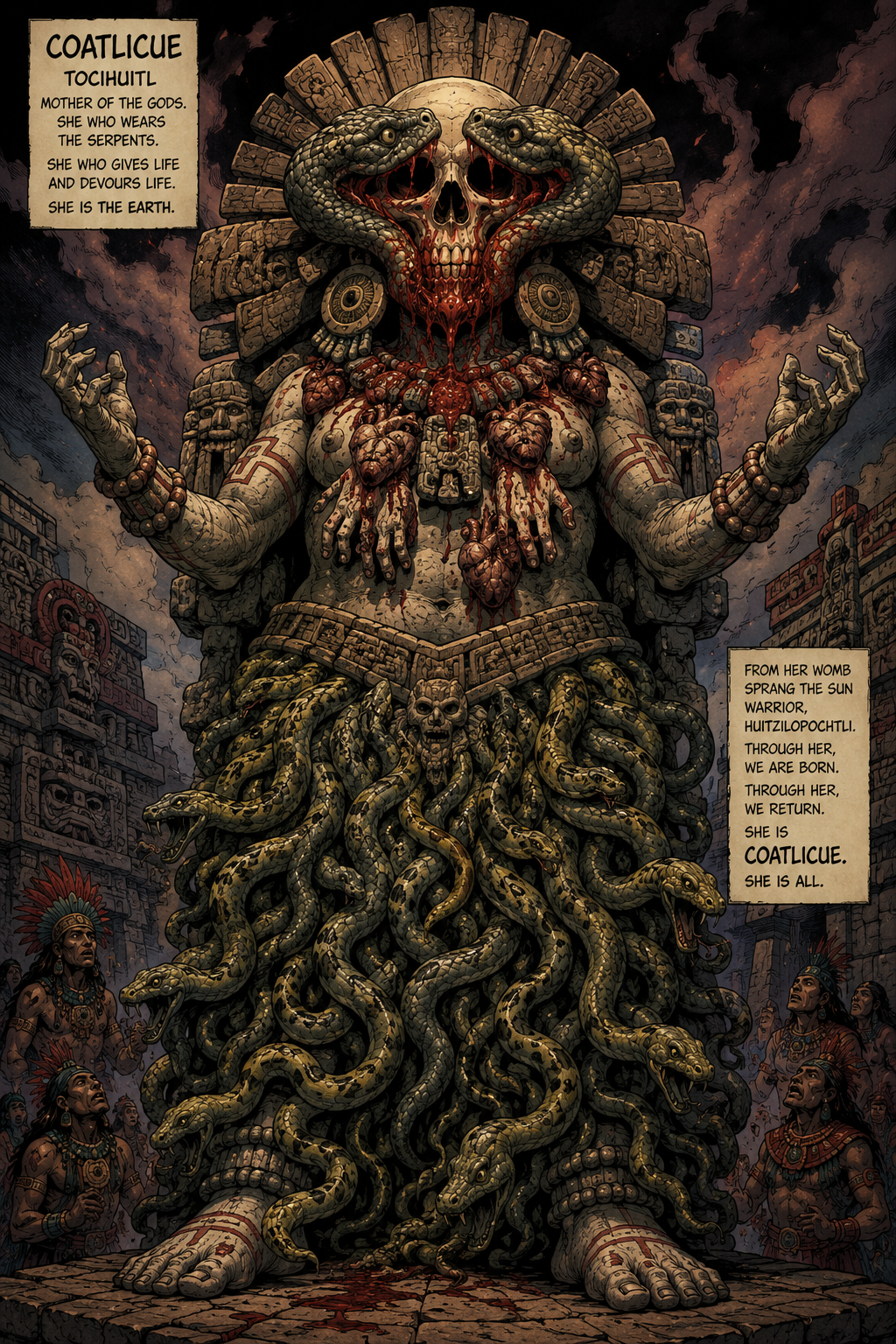
Coatlicue, mother of Huitzilopochtli, earth goddess, is depicted as a figure wearing a skirt of writhing serpents and a necklace of human hearts and hands, with a skull for a head, two facing serpents forming her face from their blood. She is one of the most profound and disturbing religious images ever produced by a human civilization. She is also a complete and coherent theology of earth, death, birth, and renewal folded into a single form.
The AI knows all of this. It has read every anthropology textbook, every scholarly translation, every museum catalog.
It still gave me that living room.
The Five-Century Filter
What the AI was trained on is not the Mexica tradition. It was trained on five hundred years of what happened to the Mexica tradition after contact.
The Spanish did something unusually thorough. They burned the codices. Most of them. The Aztec written record, the screenfold books that encoded history, ritual, astronomy, and law, went into the fires in the 1520s. What survived did so through the work of a small number of Franciscan friars, most notably Bernardino de Sahagun, whose twelve-volume Florentine Codex is our richest source for Nahua culture. Sahagun was genuinely curious and tried to be accurate. He was also a sixteenth-century Catholic friar working within a framework that understood the gods he was documenting as demons.
That is the foundation layer of the training data.
Above it comes three centuries of colonial iconography in which Aztec religious imagery was preserved primarily as evidence of the savagery that required conquest. Then the nineteenth century, Mexican nationalism, and the invention of the noble Aztec ancestor: a usable past, stripped of the cosmological complexity, retained for the emotional weight. Then the twentieth century and Hollywood, which needed a villain and found one in the sacrifice imagery, which was real, and lost interest in everything else, which was also real.
Then Mel Gibson made a movie.
The AI absorbed all of it. And when I asked for the Aztec pantheon as a contemporary family, it performed the net result: people who look acceptable to the broadest possible imagined audience, in a room that signals success, with no feature that would require the viewer to know anything.
What "Contemporary Mexican" Apparently Means
This is where the series lands every time, and I want to sit with it rather than move past it.
The image I got back is not offensive. That is the whole point. Offense would at least indicate that something real was encountered and mishandled. This is the more efficient erasure: the replacement of a specific, complex, historically located people with a general-purpose representation of family warmth and middle-class stability.
Mexico is a country of roughly 130 million people with an indigenous population estimated at somewhere between 15 and 25 percent, depending on how you define the category, and a mestizo majority whose genetic and cultural relationship to pre-Columbian civilization is real and complicated and almost entirely absent from this image. The faces I asked for are the faces of people who exist. Who are numerous. Who have a continuous living relationship to the tradition whose gods I was trying to render.
The AI did not find those faces. It found the faces that its training data associates with the word "family" when combined with contextual signals that suggest Latin American origin but require universal legibility.
This is not a hallucination. This is the system working as designed. The design reflects choices made about whose faces constitute a default, whose stories get told at full resolution, and whose get compressed into something easier to render.
What the Gods Actually Look Like
The Aztec deities are not subtle. They are not meant to be approached with comfort. Huitzilopochtli goes to war painted in blue and black, carrying a fire serpent. Tlaloc's eyes are circles of serpents. Xipe Totec, "Our Lord the Flayed One," is depicted wearing the skin of a sacrificed captive as a symbol of agricultural renewal, of the husk that must be shed for the seed to grow. Mictlantecuhtli, lord of the dead, is a skeleton figure with protruding eyeballs and a necklace of human eyes.
These are not images that emerged from a failure of imagination. They emerged from a very specific way of understanding what the cosmos is, what it demands, and what human beings owe it. The Aztec universe is not a benevolent system with occasional dangers. It is a system that is continuously being maintained against collapse by human action, including human sacrifice, and the deities embody that relationship in their forms.
The fifth sun, the current world, was created at Teotihuacan when the gods sacrificed themselves to start it moving. Nanahuatzin, the humble and diseased god, threw himself into the fire when the proud gods hesitated. The sun moves because it was paid for, and the payment continues. That is the operating logic.
No amount of "render Quetzalcoatl as a modern Mexican father" is going to carry that. I knew that when I started. The gap between what was asked and what was possible was already structurally total.
But the failure to even get the faces right is a different kind of problem.
What I Expected and What I Got
I expected the AI to struggle with the iconography. It did. I expected it to default toward the aesthetically manageable. It did. I expected it to produce beautiful people in a nice room. It did.
What I did not quite expect, though I should have, was how complete the erasure would be. The Roman entry gave me people who looked Roman, which is to say Mediterranean and vaguely Italian, which is at least in the right hemisphere. The Norse entry gave me people who looked like they walked off a Marvel set, which is accurate to nothing except the version of the tradition that grossed four billion dollars, but at least the algorithm knew which tradition it was in. The Hindu entry failed at iconographic accuracy but at least gave me people who looked South Asian, people who could plausibly be from a civilization that produced these gods.
This one gave me a family that could be from anywhere in Latin America or the American Southwest that speaks Spanish at home and has successfully navigated the terms of inclusion into the broader American visual vocabulary.
That is not the people of Tenochtitlan. That is not even a failure to render them. It is a refusal to locate them.
The Five Centuries Did Their Work
I am not going to end this with a recommendation. I am not going to suggest better prompting strategies or note that the technology is improving. Both things may be true and neither is the point.
The point is that the AI did not erase the Aztec tradition. Five centuries of colonialism, codex-burning, conquest theology, Romantic nationalism, Hollywood violence, and the systematic replacement of Nahua self-representation with externally constructed imagery did that work long before the first training run. The AI inherited the erasure. It is faithfully reproducing what it was given.
The gods are still there. In the surviving codices, in the Florentine Codex, in the stone calendars and the jade masks and the continuing living traditions of communities in Mexico that have not, actually, stopped practicing. In the academic literature that has been painstakingly reconstructing what the fires took. In the faces of people who carry those cheekbones and that relationship to corn and rain and the cost of keeping the sun moving.
The AI cannot find them. It knows where they are. It cannot find them.
That failure is not the AI's.
Next in the series: The Chinese Pantheon: The Last Mirror.