
The Bravest Thing Sukoshi Almost Did
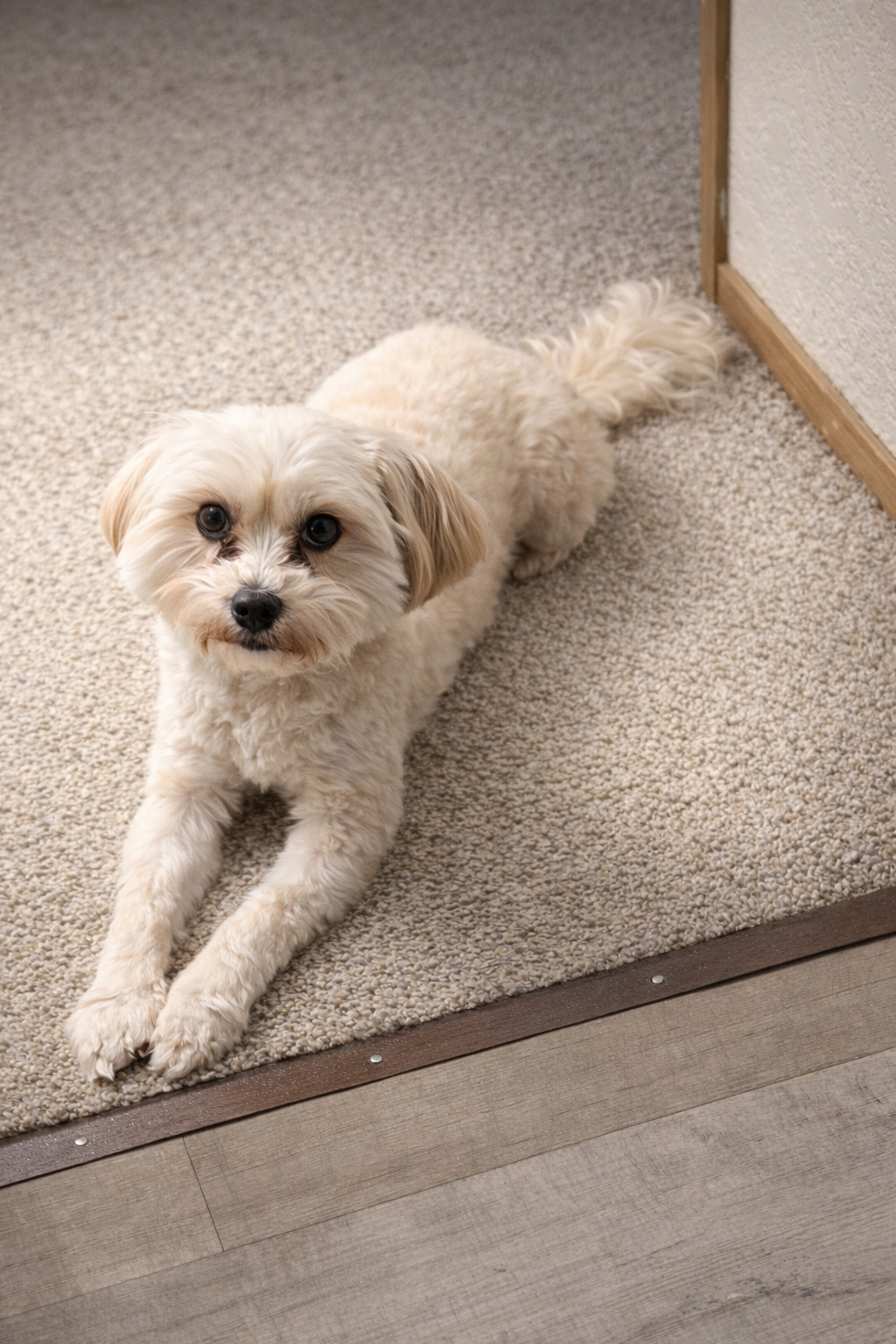
He was doing the thing he does, sprawled at my feet, watching me with that particular expression that could mean anything from "I love you" to "you have forgotten something important." I had fed him about an hour earlier. I wasn't going anywhere. I had planned on staying in, just the two of us, a quiet evening. But he was watching me with those dark eyes, the ones set into that cream-colored face with the deep rust staining beneath them, and something made me ask, mostly as a joke, whether he wanted to get in the car.
Sukoshi is a fourteen pound cavapoo, all soft waves and oversized ears and a face that looks like it was designed specifically to be taken seriously. He came into my life small enough that I kept referring to him by a word my dad picked up in the Navy, stationed in Japan in the late fifties. The Japanese word is sukoshi. The sailors shortened it to skosh, meaning a little bit, and carried it back home with them. My dad used it my whole childhood. When I got this dog I had a different name in mind, but I kept calling him a skosh, and eventually I asked my dad where the word came from, and by then it was already his name. He was named, without either of us planning it, after a word that connects him directly to my father. That matters to this story.
Because Sukoshi hates the car.
Not dislikes. Not tolerates with some grumbling. Hates. Full panic attacks. Trembling, whining, the whole physiological cascade. He starts falling apart when he hears me pick up my keys to lock the front door. The car itself is almost beside the point by then. His nervous system has already decided.
So when he perked up at the question, I paid attention. I pushed a little. "Do you want to go to Grandpa's?"
His tail started going.
I want to be clear that I wasn't trying to take him anywhere. I had no agenda. What happened next was his, not mine. I was mostly a witness, trying to read him carefully and make sure I wasn't misreading what I was seeing. Because this was new. Sukoshi is approaching three in July, and something has been shifting in him. A settling. A kind of maturity I hadn't seen before tonight.
I decided to take him seriously.
He has a small bench by the door, put there so I don't have to bend over to clip his leash. He got up on it without being asked and went still while I hooked him in. That's his full body yes. We moved toward the front door and the thin anxious whine started, the one that usually means the battle is already lost before it began. I told him no whining. He stopped. Even on his travel medication he doesn't usually stop. But he stopped, because he wanted this badly enough to try to hold himself together.
I asked him directly at the door: did he want to stay home? He knows the word. He didn't signal that he did. He wanted to go.
So we went outside. I locked the door. He whined again. I said no whining again. He stopped again. Each time he stopped I felt something I can only describe as disbelief edged with something like wonder. His body was already climbing toward panic, I could see it in the set of his shoulders, the way he was moving, and he was overriding it step by step because the destination was worth it to him. His grandfather. The big backyard full of squirrels. The person his name, in a way, came from.
We got to the car and I opened his door and he climbed up into his seat and let me hook him in. He was trembling by then, that fine full-body shaking that means open revolt in the nervous system even while the rest of him is cooperating. I went around to the driver's side and got in. He was trembling but present. Still trying. I sat there for a moment just absorbing it, this small cream-colored dog in his seat, shaking, wanting to go.
Then I turned on the engine.
He lurched toward me immediately, the way he does at the end of rides when he's done and wants out. I recognized it. I looked at him and asked him directly: Grandpa's or home?
He moved toward home.
I unhooked him and he launched himself across my lap and out the door the second I opened it, and stood outside shrieking while I got my cane and climbed out after him. And then, the way it always goes with dogs, it was over. We walked back inside. He settled into his spot. He was fine.
After it was over I found myself wanting to understand what had actually happened in him, not just as a charming story but as a map. He's a big part of my world. The better I understand how his mind and nervous system work, the better I can take care of him. So I asked Claude about the psychology behind what I had witnessed, and what came back was clarifying in ways I'm still sitting with.
What was happening in the living room when his tail started going has a name. Neal Miller's approach-avoidance conflict describes what occurs when a creature is simultaneously drawn toward something desirable and repelled by something frightening. The critical insight is that both drives are real and running at the same time. This isn't confusion or mixed signals. It's two genuine forces pulling in opposite directions simultaneously. Which one wins at any given moment depends largely on proximity, both physical and psychological, to each. The closer you are to the reward, the stronger the pull toward it. The closer you are to the threat, the stronger the pull away. Standing in the living room, Grandpa's backyard was vivid and present in Sukoshi's mind. The car was still abstract, still a concept. Desire was winning, but only because the threat hadn't gotten close enough yet to shift the balance.
Each step we took outside changed that calculation.
What Sukoshi was doing in the moments when he stopped whining on command, when he climbed into the seat still shaking, has a parallel in what researchers call emotional regulation under motivation. The capacity to work against a fear response because the desired outcome is compelling enough isn't uniquely human. Animals do it too, particularly when the motivating reward is something deeply meaningful to them. He wasn't eliminating the fear. He was holding it, which is a different thing entirely, and in some ways a harder one. The fear was still there, running underneath everything. He was just refusing to let it be the only thing.
Until the engine.
Fear in animals doesn't operate as a single switch that flips all at once. It accumulates, trigger by trigger, each one adding to the load the nervous system is already carrying. Behaviorists call this trigger stacking. The keys. The leash. The path to the car. The car door. The seat. Each one alone might be manageable. But they stack, and the weight compounds, and for Sukoshi the engine has always been the trigger that breaks the dam. It's the sound that makes the threat fully real, that converts it from something he's been bravely walking toward into something that is now, undeniably, happening to him. His body responded before his wanting-to could say anything about it.
So he told me. And I listened.
There is something else I've noticed about Sukoshi that I've never quite been able to articulate until now. For all the anxiety he carries around cars and keys and the whole cascade of triggers that leads there, his default state is pure presence. Right now, an hour after the whole episode, he's at my feet again, warm and settled, not replaying what happened or bracing for next time. The fear was real when it was happening. Now it's gone. He's just here, in this moment, in this room, with me.
I envy that sometimes. More than sometimes.
He doesn't lie awake the night before a vet appointment building dread. He doesn't carry the memory of a bad car ride into the next one as anything other than a body response when the triggers reappear. His suffering, when it comes, is immediate and total. And then it ends. Mine has a longer tail.
Years of contemplative practice and this fourteen pound cavapoo still has something to teach me about being where you are.
I don't know if understanding approach-avoidance conflict or trigger stacking makes the car rides easier going forward. Probably not immediately. Probably what it means is more patience, more check-ins, more attention to where he is in the stack at any given moment. Maybe shorter trips. Maybe sitting in the parked car together until that stops being a trigger before we ever turn a key.
But what I keep returning to is this: he tried. He wanted to get to his grandfather badly enough to walk toward the thing that frightens him most, step by step, stopping himself from whining twice, climbing into the seat, sitting there trembling and present and still in it. He made it further than he ever has.
He's approaching three in July. Something is shifting in him, some new capacity coming online. Tonight I got a glimpse of it.
I am most of his world. The least I can do is learn his language, and keep showing up as someone worth being brave for.