
The Coming Reckoning
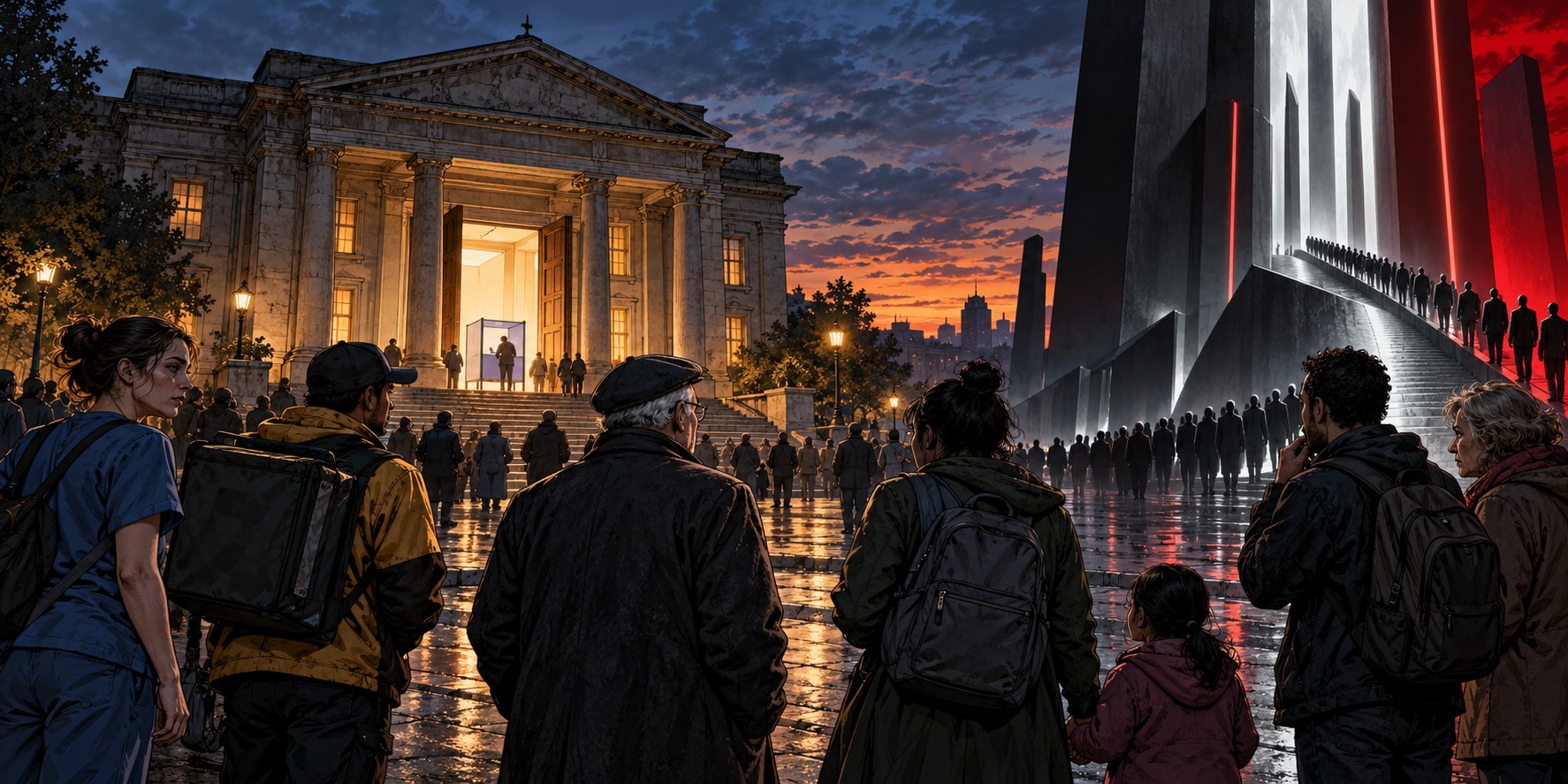
In light of the recent election results, a lot of people I know are celebrating, and I understand why. On Tuesday, Democrats took back both the House and the Senate in what nearly everyone is calling a blue wave. NBC is projecting around 258 House seats for Democrats, the most they've held since 1993, and the party flipped Senate seats in places like Texas, Ohio, Iowa, and Kansas. Voters were angry about the cost of living, the economy, and the war with Iran, and they said so loudly. On election night, Hakeem Jeffries called it a change election and said Democrats need to deliver dramatic change.
I hope he means it. But I'm already seeing signs that business as usual is alive and well in the minds of Jeffries and Chuck Schumer. Less than a day after the polls closed, Schumer was telling reporters that he'll be reelected as majority leader and that the issue isn't him. At least five of the newly elected Democratic senators, including Juliana Stratton in Illinois, Peggy Flanagan in Minnesota, and Abdul El-Sayed in Michigan, have said they won't vote for him. Others, like James Talarico in Texas, wouldn't commit. A Politico poll this summer found that 47 percent of likely Democratic voters didn't think Schumer should stay in leadership. He doesn't seem to have heard any of it.
Jeffries is a more complicated case. A lot of people are celebrating that he's about to become the first Black Speaker of the House, and that's a real milestone. But I've seen a large volume of posts and comments online calling him complicit, a leader of an opposition party that did very little opposing over the last two years. Even before the election, he was taking fire from people in his own party who felt he'd done too little to push back against Trump.
To me, the mandate voters just sent is sailing right over the heads of the old smoke-filled-backroom politicians. Voters asked for something different, and leadership's first instinct is to make sure leadership stays the same.
That's what pushed me to write this. I think democracy is heading for a reckoning, and not just here. People, not only Democrats, are fed up with solutions that don't work. And Democrats have historically been part of that problem. They've worked alongside Republicans to keep the two-party system locked in place, and in my view both parties answer to the same donors. When the choice is between two parties drinking from the same well, a lot of people stop believing the choice means much.
I'm pessimistic about the next two years. Democrats will control Congress, but Donald Trump is still president, with a veto pen, and most legislation still needs 60 votes to get through the Senate. I expect a lot of mild action, stopped by Republicans at nearly every turn. Voters who just sent a clear message may watch two years of that and sour on the whole thing. When people sour like that, they don't always swing back to the middle. They may swing the other way, toward a new authoritarian on the right who promises to fix everything.
That worry isn't just mine, and it isn't just American. Freedom House reported in March that global freedom declined in 2025 for the twentieth year in a row. Only about 21 percent of the world's people now live in countries it rates Free, down from 46 percent twenty years ago. The V-Dem Institute in Sweden counted 44 countries sliding toward autocracy and only 12 moving the other way, and it moved the United States out of its top category, liberal democracy, for the first time in more than fifty years. Not every scorekeeper is that gloomy. The Economist Intelligence Unit found global democracy scores held steady last year. But how people feel points the same way. In a Pew survey this spring across 16 high-income countries, a median of 54 percent said they were dissatisfied with how their democracy was working. In the U.S. it was 69 percent.
When people stop believing a system works, they start shopping for another one, and there are people ready to sell them one.
Peter Thiel, the PayPal and Palantir co-founder, has been making the pitch for a long time. In a 2009 essay for the libertarian Cato Institute called "The Education of a Libertarian," he wrote: "I no longer believe that freedom and democracy are compatible." His argument was that voters will keep using the ballot to grow the state at the expense of individual liberty. He cited the growth of welfare rolls and the extension of the vote to women as reasons libertarians couldn't win elections, a line that caused an uproar and that he addressed in a follow-up titled "Suffrage Isn't the Danger, Other Rights Are." His answer wasn't to fight harder inside politics. It was to find a way out of politics altogether, through new frontiers like cyberspace, outer space, and seasteading, floating communities beyond any nation's reach.
That impulse has a sharper philosophical cousin, the so-called Dark Enlightenment. The ideas grew out of software engineer Curtis Yarvin's blog in the late 2000s, and the British philosopher Nick Land gave the movement its name in a 2012 essay. Their argument is that democracy is a failed experiment and that a country would run better as something like a corporation, led by a CEO-monarch who answers to a board rather than to voters. Yarvin has said he doesn't believe in voting at all. For years this was fringe internet writing. It isn't anymore. Yarvin is a close friend of Thiel's, and Vice President JD Vance has cited him as an influence.
Some of these people are building, not just writing. Próspera is a privately run charter city on the Honduran island of Roatán, set up under a law that let semi-autonomous zones write their own rules and run their own courts. Its backers include a venture fund started by the seasteading pioneer Patri Friedman, with money from Thiel. Honduras later turned against the zones, and its Supreme Court declared the framework unconstitutional in 2024. Próspera kept operating and took Honduras to international arbitration, at first seeking nearly $10.8 billion. In September it named its own civil prosecutor, which Honduran critics called a modern coup. Meanwhile, the investor Balaji Srinivasan's 2022 book The Network State lays out a plan for online communities to crowdfund territory and eventually win recognition as countries, and projects like Praxis have pitched new cities on the same idea.
The appeal is easy to see. If a democracy can't build enough housing, can't keep its promises, and leaves most of its citizens unhappy, people with the means to opt out will be tempted to. Supporters frame these projects as competition for governments that have grown complacent. Critics answer that exit is a privilege of the wealthy, that a city run like a company answers only to whoever owns it, and that Próspera's fight with an elected Honduran government looks less like freedom than like a company overruling a country.
But exit and strongmen aren't the only alternatives on offer. A few countries have found ways to make government work that look nothing like ours, and three keep coming up: Switzerland, Singapore, and the Nordic countries.
Switzerland and Singapore have a lot in common. Both are small. Both are multilingual, with four national or official languages apiece. Neither has much in the way of natural resources. Both sit near the top of the clean-government rankings: in Transparency International's latest Corruption Perceptions Index, Singapore placed third in the world and Switzerland a few spots behind. And both got rich in large part because of choices their governments made. What makes them worth comparing is that those governments rest on nearly opposite ideas about where power should live.
Switzerland's answer is the stranger one. The country has no single head of state. Executive power belongs to a seven-member Federal Council, chosen by parliament, which decides things as a group. There's a president, Guy Parmelin this year, but the job rotates among the seven every year and carries almost no extra power. The seats are divided among the major parties under an unwritten arrangement called the magic formula, so people who would be bitter rivals in most countries govern together and share the blame. Then there's the voting. Since 1848, Swiss citizens have decided more than 600 national questions directly, more than half of all the national referendums ever held anywhere. With 100,000 signatures gathered in 18 months, citizens can put their own constitutional amendment on the ballot. Only about one in nine of those initiatives has passed, but the possibility hangs over everything. Lawmakers write with the ballot box in mind.
Government choices had a lot to do with how Switzerland got rich, though the credit is partial. Its neutrality, recognized by the European powers in 1815, kept it out of both world wars, so its factories and banks came through intact while its neighbors' were wrecked, and nervous money from across Europe flowed in. A 1934 law made it a crime for bankers to reveal client information, turning an old habit of discretion into a national industry, one that later drew heavy criticism as a shelter for tax evasion. A system where policy changes slowly gave investors something rare: predictability. Its schools hold up as well. In September's international tests, Switzerland had the highest share of top-performing students in Europe.
The Swiss design is very hard to capture. There's no single lever to grab, and decisions tend to stick because the losing side had its say. In March 2024, about 58 percent of voters approved a thirteenth annual pension payment over the objections of the government, parliament, and business groups, the first time in Swiss history that voters raised social benefits by popular vote. The cost is speed, and sometimes justice. Swiss women couldn't vote in federal elections until 1971, because the men had to vote to let them, and the first time they were asked, in 1959, they said no. A system that defers to the majority moves at the majority's pace, including when the majority is wrong.
Singapore runs the other direction. The People's Action Party has governed without a break since 1959. In its 2025 election it won 87 of 97 seats. Elections come on schedule, but the question of who governs has had the same answer for more than six decades. Singapore is also the clearest case of a government making a country rich. When it was pushed out of Malaysia in 1965, its income per person was around $500, roughly the level of Mexico and South Africa. By 2024 it was about $90,000. Lee Kuan Yew's government did that on purpose: an Economic Development Board courting foreign manufacturers, infrastructure built ahead of demand, technical education, and a hard line on corruption. The schools show it too. In September's international tests, Singapore ranked among the top two systems in the world in science, math, and reading.
The Singapore philosophy is legitimacy earned by results. Nearly four in five residents live in flats built by the Housing and Development Board, and around nine in ten households own their homes. Retirement runs through the Central Provident Fund, a mandatory savings system where workers 55 and under put in 20 percent of their wages and employers add 17. It's the worker's own money, set aside for retirement, housing, and health care. The costs are real, though. Reporters Without Borders ranked Singapore 123rd of 180 countries for press freedom this year; Switzerland was eighth. Critics point to lawsuits against journalists and opponents, and to a 2019 law that lets the government order corrections to online content. Judicial caning is still used, and the death penalty is mandatory for trafficking drugs above set amounts. Singapore carried out 17 executions in 2025, 15 of them for drug offenses.
Underneath their differences, the two countries share a pattern. In both, the government's choices left most citizens with a real stake. The Swiss get a direct say on the questions that matter to them, and the side that loses one vote knows another is coming. Singaporeans got homes they own and savings with their own names on them. That kind of stake builds trust. Switzerland had the highest trust in national government of any country in the OECD's latest survey, 62 percent against an average of 40, and the OECD has found that people who feel they have a voice in government decisions are about three times as likely to trust it. In Singapore, 77 percent told Edelman's 2024 survey they trusted the government to do what is right.
People who trust their government don't take to the streets, and that kind of calm is exactly what investors look for. Stability brings investment, investment brings jobs and wealth, and wealth makes it easier to keep people content. It's a loop, and both countries have kept it running for decades. It isn't unbreakable. In Edelman's 2026 survey, only 31 percent of Singaporeans said they expected the next generation to be better off.
The same loop runs in the countries that top nearly every quality-of-life list, and they're ordinary democracies. In this year's World Happiness Report, Finland was named the happiest country on Earth for the ninth year in a row, and Iceland, Denmark, Sweden, and Norway filled four of the next five spots. The Nordic countries also lead the EIU's democracy rankings, and Denmark and Finland hold the top two places on the corruption index. The researchers behind the happiness report credit much of it to trust, in each other and in institutions, backed by a welfare state people can count on. Education was long part of that story. In the 2000s, Finland's students led the world on international tests. Finnish scores have fallen steadily since 2006, though, and in September's results every Nordic country posted its lowest reading and math scores on record. Even the best-run democracies have to keep earning it.
Each of these models has a weak point. Switzerland's is paralysis. Singapore's is succession: a system that depends on the people at the top has to keep producing good people at the top, and so far it has only had to hand power over three times. The exit model's weak point is the oldest one in the book. A CEO-monarch is only as good as the CEO, and the people living under one have no way to remove a bad one. Singapore at least keeps the ballot as a backstop. The Dark Enlightenment removes it on purpose.
The countries that work don't share a design. What they share is that they invest heavily in education, and they give ordinary people a stable financial footing, whether that's Singapore's owned homes and mandatory savings, Switzerland's pensions and predictable economy, or the Nordic safety net. People who are well educated and not one bad month away from ruin are harder to frighten and slower to give up on the system they have. That may be the part that travels best.
Which brings me back to Tuesday. Voters just handed Democrats something rare: a clear message and the majority to act on it. The reckoning I'm worried about isn't whether people stay angry. It's where that anger goes next. Democracy doesn't usually fall because someone argues it out of existence. It erodes when enough people are tired, frightened, or fed up enough to trade a messy say in things for a promise that someone competent will just handle it. If the next two years look like business as usual, with the same leaders, the same donors, and the same excuses, the voters who just sent a message won't wait around. The people promising to just handle it will already be at the door. If Democrats spend these two years fighting loudly for the things the working countries have in common, schools that work and families who aren't one bad month from ruin, even when the fight gets blocked, voters will at least know who was trying. If they spend it protecting the leadership, I think we'll find out what the reckoning looks like in 2028.