
The Duty Table
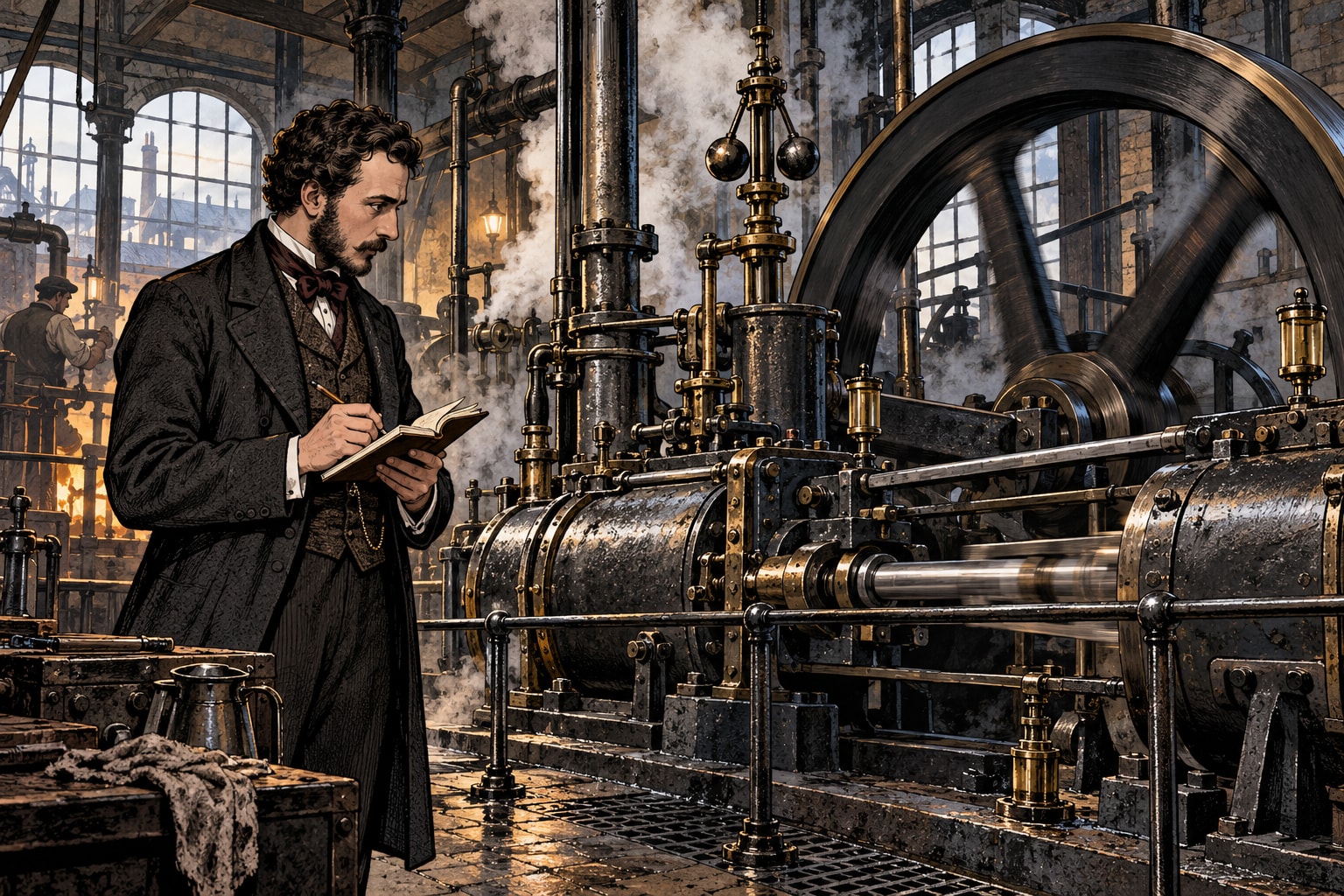
In 1865, William Stanley Jevons published The Coal Question, and in its seventh chapter he does something I keep coming back to. He stops arguing for a moment and prints a table. It lists the "duty" of steam engines, meaning how many pounds of water an engine could lift one foot on a bushel of coal, from 1769 to 1859. The old atmospheric engines of 1769 lifted about 5.6 million pounds. By 1859 the average Cornish engine was doing roughly ten times that. Jevons's point was that every one of those gains made Britain hungrier for coal, not less hungry. The idea now carries his name: the Jevons paradox.
I've been thinking about that paradox in relation to AI, and so have a lot of other people. But what strikes me now is less the paradox than the clock. Jevons was looking back across ninety years of rows. We are trying to read the same kind of table while the rows are still being written, and they arrive in months instead of decades. So the question I want to ask is a simple one. If AI is following the same curve as the older technologies, where on that curve are we?
Start with steam, because Jevons tells the story himself. Thomas Newcomen's atmospheric engine appeared in 1712. It worked, but it ate coal so fast that for decades it only made sense at a coal mine, where fuel was nearly free. When the canal engineer James Brindley inspected one, he concluded it would never spread unless its coal consumption came down, because horses, wind, and water were cheaper. Jevons describes the engine as hanging on the verge of commercial possibility for a long time.
Then came the economizers. John Smeaton nearly doubled the engine's efficiency in 1772. James Watt's separate condenser and expansive working followed through the 1770s and 1780s. Cornish engineers kept squeezing it through the 1820s and beyond. By Jevons's count, the entire history of the steam engine was a history of saving coal. And the coal kept going. Britain mined about 98 million long tons in 1865, the year he published. By 1913 it mined about 287 million, nearly three times as much, with engines better than any in his table.
So the steam timeline looks roughly like this. About sixty years from a working machine to one cheap enough to matter. Another century of compounding efficiency. Peak consumption came around two hundred years after Newcomen. Jevons was writing somewhere in the long middle of that story, which is why he could see its shape.
Light is the cleanest example of Jevons on a long clock. The economists Roger Fouquet and Peter Pearson traced the price and use of artificial light in Britain across seven centuries. Between 1800 and 2000, lighting became about three thousand times cheaper. Over the same span, per-person use rose about 6,500 times, and total use about 25,000 times. Candles, then gas, then kerosene, then the bulb, then the LED. Every improvement in efficiency was swallowed by more light. We did not bank the savings. We lit the night.
Electricity adds a second lesson, and it is the one I find most useful for AI. The economic historian Paul David pointed out in 1990 that electric power reached factories in the 1880s, but manufacturing productivity did not take off until the 1920s, roughly four decades later. The delay was not the technology. At first, factory owners simply pulled out the steam engine and dropped a big electric motor in its place, leaving the shafts and belts and multistory buildings just as they were. They got modest savings and not much else. The real gains came only when a new generation of factories was built around electricity: one floor, a small motor on each machine, work arranged around the flow of materials instead of the flow of power.
So electricity's lag was not a failure of the invention. It was the time it took to rebuild work around the invention, and that took a generation.
David wrote his paper because economists were stuck on a puzzle about computers. The microprocessor arrived in the early 1970s, and by the late 1980s computers were on desks everywhere. In 1987 Robert Solow quipped that you could see the computer age everywhere but in the productivity statistics. David's answer was that the dynamo had looked exactly the same at the same age. He turned out to be right. The payoff from information technology showed up in the 1990s, after offices finally reorganized around the machines instead of bolting them onto the old filing-cabinet routines. Paul Krugman later noted that the lag ended up being about as long as electricity's.
Computing also ran Jevons's rebound at a scale he couldn't have imagined. Every time computation got cheaper, we found more things to compute. We did not use the savings to run the same spreadsheets on less hardware. We put a computer in every pocket.
So by the time AI arrived, we had three versions of the same story on record. Efficiency drives consumption up, not down. And the economic payoff waits on people rebuilding how they work, which has taken decades every time.
Now hold those clocks up to AI. ChatGPT came out at the end of November 2022, which makes this technology, in its public form, not quite four years old.
The efficiency curve is running at a speed nothing in Jevons's table comes close to. The steam engine took most of a century to get ten times better. Epoch AI measured how fast the price of reaching a fixed level of AI performance has fallen, and found declines of anywhere from 9 to 900 times per year, depending on the task. To match the original GPT-4 on a set of PhD-level science questions, the price fell about 40 times per year. In other words, AI is compressing a century of duty-table rows into months.
And Jevons is right on schedule. Blended inference costs fell roughly 67 percent from early 2025 to early 2026, yet enterprise AI spending rose sharply over the same period as companies moved to agents. The International Energy Agency expects data center electricity demand to double by 2030, with demand tied specifically to AI tripling. Cheaper per unit, more in total. The coal is now electricity, and the furnaces are data centers.
Adoption is also fast. By August 2024, less than two years after ChatGPT, almost 40 percent of Americans aged 18 to 64 said they used generative AI. The internet was at about 20 percent at the same point in its life, and the personal computer took three years to reach 20 percent.
But the productivity payoff looks exactly like the dynamo in 1900. McKinsey's 2026 survey found that 80 percent of respondents say AI has made them personally more productive, while only 37 percent report a positive effect on their organization's bottom line. Another 2026 survey of nearly 6,000 senior executives in four countries found that about two thirds were actively using AI, yet roughly 89 percent saw no measurable improvement in labor productivity over the previous three years. That is Solow's observation all over again, almost forty years later.
So where are we? My honest answer is that AI is standing in two places on the old timelines at once.
On the efficiency curve, we are where Jevons stood in 1865. The gains are real and compounding, and every one of them is being spent on more use. Nobody is banking the savings. That part of the story is already in motion and is moving faster than any technology before it.
On the reorganization curve, we are somewhere around 1900 in the dynamo story, or the late 1980s in the computer story. Most of us are doing what those factory owners did. We pulled out the steam engine and dropped the new motor in its place. AI drafts the memo we used to draft, summarizes the meeting we still hold, answers the email that probably didn't need to exist. The shafts and belts are still there. The redesign, where work gets rebuilt around what the tool actually makes possible, has barely started.
I can see this from inside my own firm. We're pushing ahead fast enough that we're starting to look like trailblazers, and I'm in the middle of it. But if I'm honest, we're still holding the meeting that AI summarizes. And when I try to picture the next step, I can't.
I've come to think that's the most historically accurate thing about where we are. The factory owners of 1900 couldn't picture the single-story plant either. It wasn't a failure of imagination. The line shaft was so built into how they thought about work that nobody saw it as a design choice. It was just what a factory was.
The redesign came from noticing what the building was organized around. Everything was arranged to serve the shaft, because power had to travel from one engine through belts and pulleys. Once each machine could have its own motor, that constraint disappeared, and the layout could follow the work instead of the power.
So the question I keep asking is this: what is my work organized around because of a constraint AI might remove? I don't know, and I'm wary of anyone who says they do. But here is where I'd look first.
The meeting. A lot of meetings exist because information moves slowly between people, and gathering everyone in a room was the fastest way to move it. If AI can carry the information, what's left of the meeting is the part where people actually decide something together. Maybe meetings get fewer and sharper. Maybe they don't.
The draft and the review. In law, junior people draft and senior people review, partly because a first draft used to be expensive to produce. When a first draft costs almost nothing, the valuable work shifts toward judging. That raises a question I don't have an answer to: how does anyone learn to judge without first spending years doing the drafting?
The billable hour. It measures time, in a world where time was the main thing being sold. If the time collapses, something else has to carry the value. Or Jevons wins again, and cheaper legal work means more people can afford it, so the total amount of legal work grows, the way Jevons said seamstresses came out ahead after the sewing machine instead of losing their livelihoods.
The document. We treat the brief, the memo, and the contract as the unit of work. They may turn out to be outputs of something else, a living body of knowledge about a matter that documents get drawn from as needed.
Sarah Kessler's New York Times article, "The New Hot Job in Law Doesn't Require a J.D.," puts a name to this kind of work: "legal engineers." If work moves in that direction, I can imagine more of it falling to people in that role. Someone has to understand how a matter actually moves through a firm well enough to rebuild the process: what information needs to travel, where judgment is required, and what needs to be checked before anyone relies on the result. Knowing how to ask AI for a draft is one piece of that. Deciding how the draft fits into the work, and whether the work still needs to happen that way, is a larger one.
I might loosely fit under that category myself, as a "paralegal engineer." I helped with the research in the beginning, and now I'm helping train people to use AI in their work. I don't mean "paralegal engineer" as a settled title, and I'm still figuring out what it would involve. But it gives me a way to describe the direction I may be heading: drawing on what I know about the work to help shape how we do it with AI. I'm happy in my current paralegal role, and I can see that role changing in the time ahead of us.
Perhaps part of the redesign will come from people close enough to the daily process to notice where it bends around an old constraint. Helping others learn these tools also brings me back to the question of how the next person learns the judgment the process depends on.
Any of these could be wrong. Some may already be shifting in ways I can't see from where I sit. But that's the kind of thing that turned out to be the line shaft last time.
There is reason to think this lag will be shorter. David's forty years were partly physical: you had to tear down multistory brick factories. Software and org charts are stubborn, but they are not brick. And unlike the factory owners of 1900, we have the history in front of us. We know the pattern.
But there is a third clock, and it runs at the old speed. AI is digital, yet its coal is physical. Power plants, transmission lines, chips, and data centers are built on the timelines of concrete and steel, not software releases. The efficiency curve is measured in months, the reorganization curve probably in years, and the energy curve in decades. Those clocks don't agree, and I suspect a lot of what happens next will come from the friction between them.
Jevons ended his chapter with a warning. Economy, he wrote, multiplies our wealth and our works, which is gratifying in the present, "but must lead to an earlier end." He was right about the shape of the curve and wrong about the ending. British coal did peak, in 1913, but not because the seams ran dry. It got expensive to dig, foreign competitors got cheaper, and oil came along. The end, when it came, was substitution, not exhaustion.
I think that's the real lesson of the timelines. In none of these stories did efficiency, on its own, save the resource. The payoff from a new technology arrives only after people rebuild how they work, and that has always taken longer than anyone wanted. And the endings tend to come from somewhere nobody in the middle of the story was looking.
Jevons could print his table because he was looking back on it. We're writing ours one row at a time, at a pace he couldn't have imagined. Somebody, someday, will read our rows the way I read his, and they'll know exactly where we were on the curve. I find it a little humbling that we don't.