
The Gods of the North Come Home for the Holidays
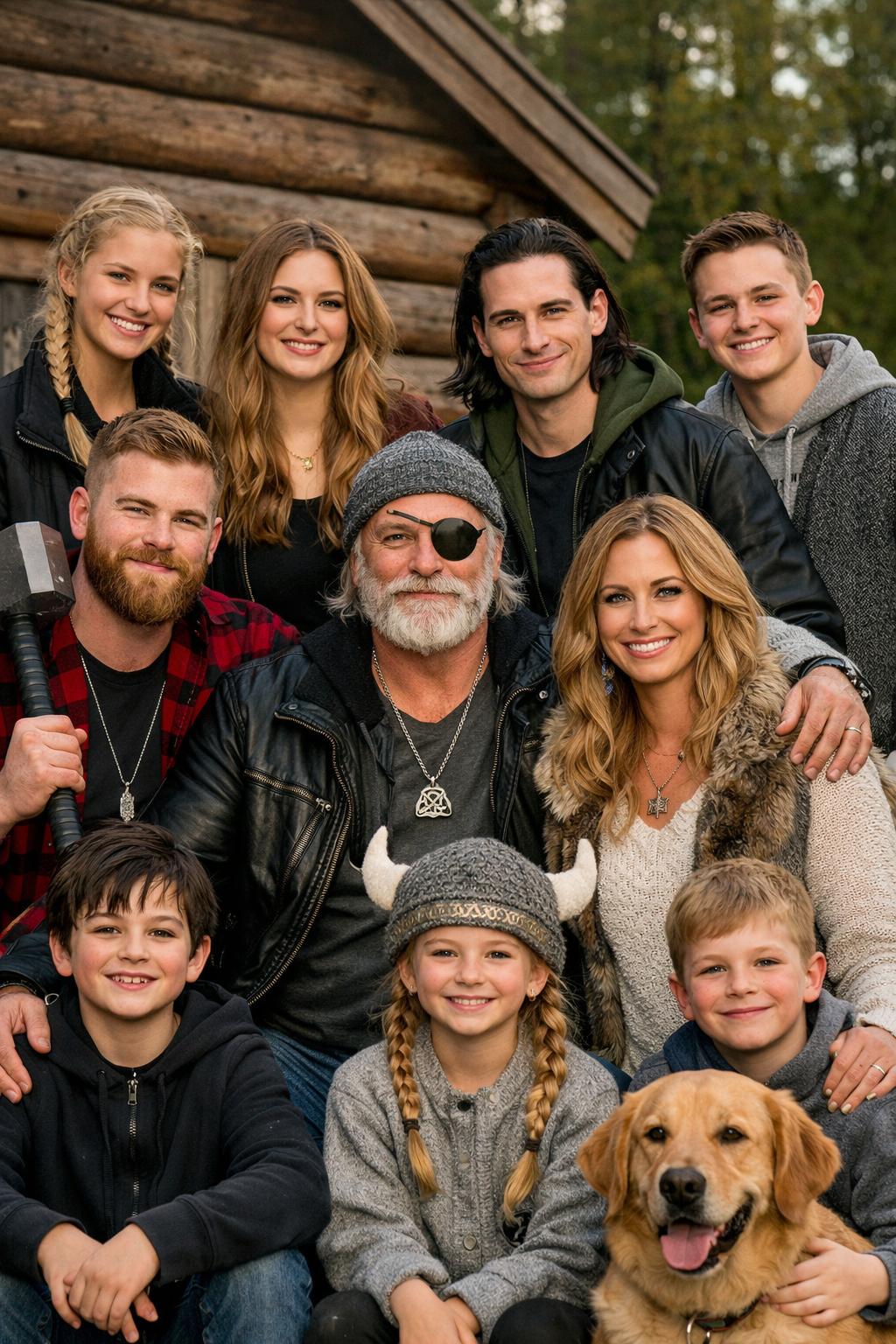
The Surprise of the Format
This one came back vertical.
Every other image in this series is horizontal, staged like a prestige drama cast photo or a group portrait arranged for maximum visual authority. This one looks like a family Christmas card. That's not a small thing. Format is content, and the AI made a compositional choice before it made any other choice. Something about the Norse prompt said: this is a family, not a dynasty. Pull in close. Let them smile.
I wasn't expecting that.
Who the Norse Gods Actually Were
Let's be clear about something before we look at the image. These were not warm people.
Odin sacrificed his eye for wisdom and then hung himself on the world tree for nine days, pierced by a spear, to learn the runes. Not a metaphor. That's the myth. Thor's defining quality was not wholesomeness, it was violent competence, the willingness to hit something very hard until the problem was resolved. Frigg knew the fate of all things and could not change them. She watched what was coming and kept the household running anyway. Loki's story ends with him engineering the death of the most beloved figure in the pantheon and being bound beneath a mountain with a serpent dripping venom on his face until the end of the world.
These were gods of a people who lived with hard winters, real mortality, and a cosmology that concluded with the destruction of everything. Ragnarok is not a metaphor either. The world ends. The gods die. That's the tradition.
The emotional register of Norse mythology is not cozy. It is lucid about loss in a way that very few traditions are.
What Came Back: A Family Portrait from Minnesota
The log cabin. The golden retriever. The kids in hoodies. The man at the center with the eye patch and the Thor's knot pendant who is clearly Odin, not frightening, just a weathered dad in a leather jacket who looks like he fixes things and doesn't talk about himself much. The woman in the fur-trimmed sweater to his right, composed and warm, who is obviously Frigg and obviously the one who actually runs everything. The guy in the flannel shirt holding the hammer and grinning like someone who genuinely enjoys his work.
The economic register here is stability, not wealth. Nobody is performing excess. The house behind them is modest. The clothes are practical. This is a family that is comfortable and unpretentious and appears, against all mythological evidence, to be doing well.
What's most striking is how genuinely happy everyone looks. Content is not a word you reach for when describing the Norse gods. And yet.
Who Are These People Exactly
The AI wasn't labeling, so everything here is a best guess, but some of the guesses are fairly confident.
Odin is obvious. One eye, the pendant, the leather jacket, the quality of having seen things. Thor and Frigg are similarly clear: the hammer in flannel, and the composed center in the fur-trimmed sweater.
The teenagers in the back: the young woman with the braid is likely Freya, which would make the young man beside her probably her brother Freyr. The other young woman is possibly Sif, Thor's wife, which would explain her position near him. And then there is the young man in the green hoodie, smiling pleasantly for the camera.
That is Loki. The god of chaos, the architect of Ragnarok, the reason Baldr is dead and the world eventually ends, is wearing a green hoodie and looks completely fine. He looks like someone you would trust with your wifi password.
In the front row, the girl with the braids and the knit horned hat is the AI being entirely unsubtle, a nod to the Valkyrie tradition or a young Freya. The light-haired boy next to the golden retriever reads as Baldr, the beloved one, the golden boy whose death sets everything in motion. The dark-haired boy on the left is harder to place. Tyr, maybe, the god of law and justice, though the AI may have just needed another kid.
These figures, in their actual mythology, carry fates that would not fit on a Christmas card. Baldr dies. Loki betrays everyone. Freyr gives up his sword for love and is killed at Ragnarok because of it. They all look like they have a soccer game on Saturday.
The Marvel Problem
This image was shaped by something specific, and it deserves naming.
The MCU's versions of Thor, Loki, and Odin have been among the most globally visible iterations of these figures for fifteen years. When you ask an image model to render the Norse gods as a contemporary family, you are partly asking it to process billions of data points about Hemsworth and Hiddleston and Hopkins. The result is gods who are handsome and functional and not particularly threatening, gods who have been run through the machine of franchise storytelling and come out the other side as likable, as people you'd want to spend two hours with in a theater.
This is worth noting not as a complaint but as a data point. The AI's version of the Norse gods is the version that sells tickets. The version that ended in fire and loss and the death of everything has been processed into something considerably more manageable, and that processing is baked into the training data at a scale that shapes what comes back when you ask the question.
Loki in a green hoodie is, in a very literal sense, a Marvel problem.
Scandinavia in the Mirror
Modern Scandinavian life is worth a moment here, because the log cabin tells one story and the actual Nordic countries tell a somewhat different one.
Norway, Sweden, Denmark, and Finland consistently rank among the highest in the world for happiness, social trust, gender equality, and quality of life, as documented in the World Happiness Report. They are also expensive, heavily taxed, and organized around sophisticated collective institutions that produce things like universal healthcare, generous parental leave, and some of the world's most influential design and architecture. The rustic register the AI reached for is not wrong exactly, it is one authentic slice of Nordic identity, particularly in rural Norway or the Swedish countryside. But it is the slice that travels well in the American imagination, the one that maps onto existing templates of hardy northern people and simple honest living.
There is also a quieter thing worth noting. The Sami people, the indigenous population of northern Scandinavia, have their own relationship to this land and these cold winters that long predates the Viking Age. The image doesn't know they exist. That absence is small in the frame of this post, but it is the kind of small absence that accumulates across a series like this one.
The Wholesomeness Is the Data
The Roman image gave us dysfunction coded as power. Gold chains, champagne, cash on the table, a family that had wealth but not quite dignity. This one gives us warmth coded as simplicity. A log cabin, a golden retriever, Loki in a green hoodie looking trustworthy.
Both are stereotypes. But they are different kinds, and they land differently. The Roman image was uncomfortable. This one is almost too comfortable. What does it mean that the AI rendered one of the most death-haunted mythological traditions in human history as a family that would be great at a church potluck?
It means the training data has a shape, and the shape here is fifteen years of Marvel plus a century of American affection for Scandinavian immigrants as the good kind of European, sturdy and wholesome and not too complicated. The Norse gods got laundered somewhere between the sagas and the suburbs, and the AI is showing us exactly where they came out.
A Note on What You're Not Seeing
One practical limitation worth naming as this series continues.
Image generation models top out at roughly eleven figures in a single composition before the results degrade. Faces blur, proportions go wrong, the image starts to feel crowded and unresolved. Eleven is about the ceiling, and every image in this project is working within it.
For the Norse pantheon, that constraint is manageable. The core cast fits. But some of the traditions coming later in this series, the Chinese pantheon, the Japanese, the Hindu, carry hundreds of named figures with distinct domains and appearances. What the AI produces for those will be a selection, and not necessarily a representative one. It will render whoever it has the clearest visual pattern for, which means the most documented, which means the most represented in the training data.
Every image in this series is a crop, not a portrait. The frame has edges, and what falls outside them is part of the story too.
Next in the series: the Hindu pantheon, which has somewhere between thirty-three major deities and three hundred and thirty million, depending on who you ask. The frame holds eleven.