
The Quiet Apocalypse: A Post-Rapture Analysis
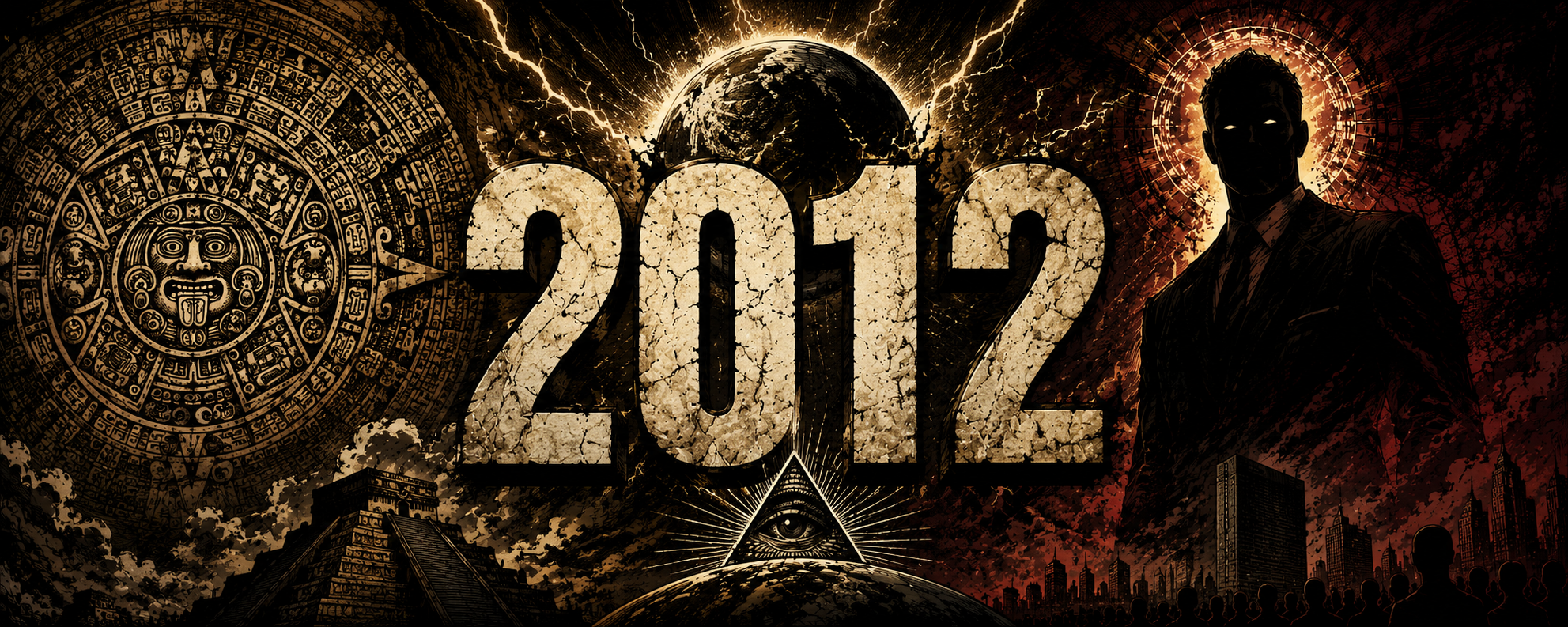
On December 21, 2012, two of the world's most anticipated prophetic traditions converged on a single date. The ancient Maya, whose Long Count calendar had been tracking cosmic cycles for over three thousand years, marked the end of the current age. Meanwhile, a significant portion of American evangelical Christianity, which had been recalculating the rapture's arrival date with remarkable persistence since roughly 1844, had quietly circled the same general neighborhood on their own calendars. 1
Nothing happened. Or so it appeared.
I want to propose an alternative interpretation. Not as doctrine, not as belief, but as a serious exercise in mythological pattern recognition, which is something I do here with some regularity. What if something did happen in 2012, and we simply failed to recognize it because we were expecting the dramatic version? The trumpet blast. The disappearances. The sky peeling back like a scroll.
Mythology rarely delivers the version we were sold.
The Norse Ragnarok was supposed to be the end of everything. It was actually a cycle. Destruction followed by renewal. The dramatic version people fixate on is the gods falling. The actual mythology is about what comes after. The Book of Daniel was written as coded resistance literature aimed at a very specific historical villain, Antiochus Epiphanes, and every subsequent generation has re-aimed it at their own contemporary monster with complete confidence and complete inaccuracy. 2 Paul expected the Second Coming within his own lifetime. The entire early church was organized around imminent return. When it didn't arrive on schedule the tradition quietly restructured its relationship with time and kept going. 3
The pattern across all of them is consistent. Mythology is accurate about the shape of things rather than the specific event.
Perhaps the Maya were not wrong. Perhaps they were simply describing the end of one information age and the beginning of another in the vocabulary available to them.
Which brings me back to 2012. And to the thirteen years that followed. And to some notes I have been keeping.
Section One: The Selection Problem
The rapture, as articulated in the evangelical tradition drawn primarily from 1 Thessalonians 4:16-17 and elaborated across two centuries of increasingly confident interpretation, involves the sudden removal of true believers from the earth prior to the tribulation period. 4 The criteria for inclusion, while debated in their specifics, trace back to a relatively consistent source. The actual teachings of Jesus of Nazareth as recorded in the synoptic gospels.
This is where the math becomes complicated.
The Sermon on the Mount, delivered in Matthew 5-7 and considered by most serious scholars to be the clearest articulation of Jesus's ethical framework, establishes the baseline requirements with uncomfortable specificity. Blessed are the meek. Blessed are the merciful. Blessed are the peacemakers. Love your enemies. Give to those who ask. Do not store up treasures on earth. You cannot serve both God and money. 5
The beatitudes are not suggestions. They are, within the framework of the tradition, the criteria.
Applied honestly to the American evangelical community that has been most vocally anticipating the rapture, the selection pool narrows considerably. Applied to the prosperity gospel movement specifically, which teaches that wealth is evidence of divine favor and poverty evidence of insufficient faith, the criteria become nearly impossible to meet by the stated terms of the founder. 6
This is not an accusation. It is an observation about internal logical consistency.
If the rapture occurred on December 21, 2012, and the selection criteria were applied as written rather than as culturally interpreted, the absence of mass disappearances becomes considerably less mysterious. The qualified departed quietly. The rest of us, and I include myself without reservation, remained.
What followed was the world running on its own recognizance. Thirteen years of that experiment are now available for review.
Section Two: The World Running On Its Own Recognizance
The immediate post-rapture period was, admittedly, difficult to distinguish from the immediate pre-rapture period. This is consistent with the mythology. The tribulation, as described in Revelation, does not announce itself with a press release. It accumulates. 7
2012 was the year the infrastructure became operational.
Smartphone penetration in the United States crossed 50% for the first time. Facebook's mobile usage overtook desktop in the same window. The boundary between online and physical reality, already porous, became effectively ceremonial. The algorithms, which had been learning quietly for several years, now had direct unmediated access to human attention at scale, delivered through a device carried in the pocket and checked, by emerging research estimates, approximately 150 times per day. 8
The delivery system was operational.
In the same year, a real estate developer and television personality named Donald Trump conducted what can only be described, in retrospect, as a proof of concept. The claim was straightforward: that the sitting President of the United States had not been born in America and was therefore illegitimate. The claim was false. This turned out to be largely irrelevant to its effectiveness. 9
What the birtherism campaign established, with the methodical thoroughness of a laboratory experiment, was a set of findings that would reshape American political reality for the following decade. That a significant portion of the population would accept demonstrable falsehood if it confirmed existing grievance. That mainstream media correction functioned more as amplification than refutation. That the audience's appetite for this particular frequency was essentially unlimited. And that the figure generating the signal had found something no previous chapter of his career had located.
A platform. A method. An audience. All operational by 2012.
2013 was, on its surface, quiet. Underneath it was not. Edward Snowden, a contractor for the National Security Agency, released a cache of classified documents revealing that the United States government had been conducting mass surveillance of its own citizens and allies on a scale that surprised even people who had assumed something like this was probably happening. 10 The infrastructure of total information awareness was not coming. It was already built. It had been built while everyone was looking at their phones.
2014 and 2015 passed in the manner of years that seem normal until examined in retrospect. The algorithms were learning. The attention economy was consolidating. The epistemological commons was fracturing along fault lines that would not become fully visible for another few years. Truth, as a shared operating assumption, was quietly losing its load bearing function. Not through any single event but through accumulation. Repetition replacing verification. Engagement replacing accuracy. The architecture of belief was being renovated from the inside while the exterior looked more or less the same.
Then 2016.
I will not belabor 2016. Anyone reading this lived through it and retains their own impressions. I will note only that the year produced, through processes that continue to reward examination, a figure who will receive his own section in this analysis. 11
2020 requires more careful attention.
The Book of Revelation describes, among its various tribulation features, a plague that moves across the earth and reshapes daily life for the surviving population. Revelation 6:8 assigns this work to a pale horse whose rider is named Death, with Hades following close behind. 12 The COVID-19 pandemic, which emerged in late 2019 and achieved global disruption by March 2020, killed approximately seven million people by official count and considerably more by excess mortality calculations. It reshaped daily life, destabilized economies, accelerated existing social fractures, and produced, as a notable side effect, an enormous amount of conflict about whether basic public health measures constituted government tyranny.
The pale horse does not typically generate this level of disagreement about masking protocols. This may represent an evolution in tribulation mechanics.
Also arriving in approximately this period, and accelerating with remarkable speed through 2022 and beyond: artificial intelligence systems capable of generating human language, images, music, and reasoning with increasing fluency. Revelation 13:15 describes the second beast giving breath to an image so that it could speak. 13 A growing chorus of technologists, ethicists, and ordinary people who have simply been paying attention have begun asking questions about what exactly we have given breath to. I have written elsewhere on this subject, specifically on the dangers of outsourcing thought itself to a system whose interests in your continued intellectual independence are, at best, unclear.
The world running on its own recognizance has been, by any honest assessment, a mixed experiment.
Section Three: The Figure
Medieval theologians debated the Antichrist with considerable energy and limited consensus. The tradition draws from multiple sources: Daniel's willful king, Paul's man of lawlessness in 2 Thessalonians 2, and John's beast from the sea in Revelation 13. The composite portrait, assembled across centuries of scholarly and not entirely scholarly interpretation, describes a figure with a specific set of characteristics. 14
He rises from a place of wealth and spectacle. He commands attention through personality rather than substance. He speaks great boasts. He demands personal loyalty above institutional loyalty. He claims special knowledge that others lack. He is believed by his followers to be under constant persecution despite holding considerable power. He divides the world cleanly into those who are with him and those who are against him, with no functional category in between. 15
I want to be precise here. This post does not claim that Donald Trump is the Antichrist. I do not believe in the Antichrist as a literal figure. What I am observing, with as much scholarly detachment as the current historical moment permits, is that the mythological description is a remarkably accurate character study of a specific type of authoritarian personality that recurs throughout history, and that the current iteration maps onto the ancient description with a specificity that rewards examination.
We will proceed with the examination.
The seven deadly sins, catalogued by Pope Gregory I in 590 AD and elaborated extensively in the medieval tradition, provide a useful supplementary framework. 16 Pride, greed, wrath, envy, gluttony, sloth, and lust. The public record on this particular point is extensive, largely self-generated, and available across multiple platforms and several ongoing legal proceedings.
The mark deserves its own attention.
Revelation 13:16-17 describes a mark placed on the right hand or forehead of those who belong to the beast, without which no one may buy or sell. 17 Scholars have interpreted this variously across centuries as Roman emperor worship, medieval Catholic corruption, Soviet collectivism, microchip implantation, and several other candidates that seemed compelling at the time. I'll note, without elaboration, that the most recognizable item of political merchandising in recent American history is a red hat worn on the forehead, that its presence in any room functions as an immediate tribal sorting mechanism, and that its absence in certain professional and social contexts carries measurable economic consequences.
I'm not saying anything. I'm simply noting.
The strong delusion requires a final observation. 2 Thessalonians 2:11 describes God sending a powerful delusion so that people will believe the lie, specifically targeting those who refused to love the truth. 18 The epistemological conditions of the post-2012 information environment, in which algorithmically curated reality tunnels deliver customized versions of events to separate populations with decreasing overlap, represent either the most sophisticated accidental recreation of this phenomenon in recorded history or something else entirely.
I'd rather not specify which.
Section Four: What This Means
I have been doing this long enough to know when a pattern is real and when I am finding shapes in static. I want to be honest about which this is.
The honest answer is that I'm not entirely sure.
What I am sure of is that the mythology is doing something interesting. The apocalyptic tradition, across its various cultural expressions, was never primarily a prediction mechanism. It was a meaning-making mechanism. A way of saying: the suffering we are experiencing is not random. It has a shape. It fits within a larger story. The story has a direction even if we cannot see the ending from where we are standing.
That function does not require literal truth to be useful. It requires structural accuracy. And structurally, the apocalyptic framework maps onto the current moment with a precision that I find both intellectually interesting and personally unsettling in roughly equal measure.
The Maya were tracking cycles. The cycle ended. Something new began. Thirteen years into the new cycle the shape of it is becoming visible in ways it wasn't in 2012. That is not nothing.
The rapture criteria, applied honestly, produce a selection problem that the tradition has never fully resolved. The tribulation checklist, worked through without flinching, produces results that would have been dismissed as overwrought satire as recently as 2010. The figure described across multiple prophetic traditions with remarkable consistency has been a dominant feature of the landscape for a decade.
And here we are.
Which brings me to what mythology is actually for.
It is not a prediction. It is not a news ticker. It is not a code to be cracked so that the initiated can know in advance what the uninitiated will miss. Every generation that has treated it that way has ended up looking foolish, from the Millerites in 1844 to Harold Camping's twelve attempts to the breathless certainty of every apocalyptic social media thread you have scrolled past in the last decade. 19
Mythology is a vocabulary for experiences that exceed ordinary description. It is a set of inherited pattern recognition tools, refined across centuries of human suffering and survival, for identifying when something genuinely large is happening. When the patterns activate across multiple independent traditions simultaneously, pointing at the same historical moment from different angles, that is worth paying attention to even if you hold the literal claims loosely.
I hold them loosely. I have held them loosely my entire adult life, across years of contemplative practice and genuine spiritual experience that I cannot fully explain. I know the difference between a real signal and a compelling story. I also know that sometimes a compelling story is where the real signal lives.
The Mayan calendar ended. The rapture window opened and closed without incident. The tribulation, if that is what this is, arrived not with trumpets but with smartphones and algorithms and a real estate developer who found a frequency and rode it further than anyone anticipated.
Mythology rarely delivers the version we were sold.
It delivers something stranger and more accurate instead.
Make of that what you will. 20
A Note on Method
I don't believe in the literal Antichrist. I don't believe the rapture happened in 2012, or that Donald Trump was sent by dark supernatural forces, or that the Mayan calendar was a prophetic document in the conventional sense.
What I believe is that mythology is one of humanity's oldest and most underrated pattern recognition systems. It encodes, in narrative form, things that empirical language struggles to hold. The shape of collective trauma. The anatomy of authoritarian seduction. The way civilizations feel from the inside when they are coming apart at the seams and haven't admitted it yet.
When multiple independent mythological traditions, separated by centuries and continents, activate around the same historical moment and produce overlapping descriptions of the same landscape, I think that's worth taking seriously. Not literally. Seriously.
The apocalyptic tradition was never really about the end of the world. It was about the end of a world. A particular order. A particular set of assumptions about how things work and who is in charge and what the future looks like. Those endings happen. They are survivable. They are also, while you are inside them, genuinely difficult to distinguish from the permanent kind.
We are inside one now. The mythology knew this was coming, in its way. It left us a vocabulary for it.
Whether that vocabulary was handed down by divine foresight, encoded by people who understood something deep about how power and delusion and tribulation always move through human systems, or assembled by an editorial committee arguing around a fire about which scrolls to keep, I genuinely cannot tell you.
Isn't mythology great?
End notes follow. Works cited below.
End Notes
- Camping, Harold. We Are Almost There. Family Stations Inc., 2008. Harold predicted the rapture no fewer than twelve times. He was, in the technical sense, wrong every time. He was also, in a way this post attempts to explain, not entirely wrong about the general trajectory. Back
- Collins, John J. The Apocalyptic Imagination. Eerdmans, 1998. Collins remains the standard scholarly text on this. He did not anticipate how useful his framework would become for current events analysis. Back
- Schweitzer, Albert. The Quest of the Historical Jesus. 1906. Schweitzer identified the delayed parousia problem over a century ago. The evangelical community has not fully engaged with his findings. Back
- LaHaye, Tim and Jerry Jenkins. Left Behind. Tyndale House, 1995. The Left Behind series sold over 80 million copies and represents the dominant popular theology of rapture mechanics for an entire generation of American Christians. It is also, scholars note, largely extrapolated from a nineteenth century Irish preacher named John Nelson Darby who developed the concept of the pre-tribulation rapture in the 1830s. Jesus did not mention it. Back
- Matthew 5-7, various translations. The New Revised Standard Version for clarity and the King James Version for atmosphere. Back
- Bowler, Kate. Blessed: A History of the American Prosperity Gospel. Oxford University Press, 2013. Bowler's historical treatment of prosperity theology is thorough, fair, and quietly devastating. Back
- This is also true of most major historical catastrophes in retrospect. The participants rarely experience them as catastrophes in real time. They experience them as Tuesday. Back
- Smith, Aaron. Smartphone Adoption and Usage. Pew Research Center, 2011. Smartphone penetration figures drawn from Pew Research tracking data. The 150 daily check figure has appeared across multiple behavioral studies and is, if anything, now considered conservative. Back
- Politifact. "Donald Trump's False Claims about Barack Obama's Birth Certificate." PolitiFact.com, 2011-2012. PolitiFact assigned its Lie of the Year designation to the broader birther movement in 2009. The designation did not produce the intended effect. Back
- Greenwald, Glenn. No Place to Hide: Edward Snowden, the NSA, and the U.S. Surveillance State. Metropolitan Books, 2014. Greenwald does not frame his findings in eschatological terms. I have taken the liberty. Back
- The figure in question has been addressed in Section Three. The buildup was intentional. Back
- Revelation 6:8, King James Version. The pale horse has appeared in the work of poets, painters, and one fairly well known television drama about methamphetamine production in New Mexico. Its range is considerable. Back
- Revelation 13:15, New Revised Standard Version. This post was written in collaboration with an AI language model. I am aware of the irony. I am choosing to sit with it rather than resolve it. Back
- McGinn, Bernard. Antichrist: Two Thousand Years of the Human Fascination with Evil. HarperCollins, 1994. McGinn's historical survey remains the standard academic text. He covers the medieval elaborations with appropriate thoroughness and only occasional visible distress. Back
- Daniel 11:36-37, 2 Thessalonians 2:3-4, Revelation 13:1-8, various translations. The composite portrait assembled here represents my own synthesis and should not be taken as the position of any accredited theological institution, though I would be interested to hear objections on specific points. Back
- Gregory I. Moralia in Job. 590 AD. Gregory's codification of the seven deadly sins was itself a kind of editorial committee decision, consolidating earlier lists from Evagrius Ponticus and John Cassian. I note the editorial committee parallel with interest. Back
- Revelation 13:16-17, King James Version. The economic exclusion mechanism described here has been identified by prophecy enthusiasts in: bar codes, credit cards, the euro, RFID chips, vaccine passports, and the Apple Pay contactless payment system. The hat interpretation is my own contribution to this literature. Back
- 2 Thessalonians 2:11, New Revised Standard Version. This verse has also been cited by each major political faction to describe the other major political faction, which is either evidence of the delusion's breadth or something I prefer not to think about too carefully before bed. Back
- Miller, William. Evidence from Scripture and History of the Second Coming of Christ about the Year 1844. 1836. Miller's followers, upon Christ's failure to appear on October 22, 1844, described the experience as the Great Disappointment. They regrouped, reinterpreted, and became the Seventh Day Adventist Church. The mythology survived the failed prediction, as it tends to do. Back
- I have no further comment at this time. Back
Works Cited
- Bowler, Kate. Blessed: A History of the American Prosperity Gospel. Oxford University Press, 2013.
- Camping, Harold. We Are Almost There. Family Stations Inc., 2008.
- Collins, John J. The Apocalyptic Imagination: An Introduction to Jewish Apocalyptic Literature. Eerdmans, 1998.
- Greenwald, Glenn. No Place to Hide: Edward Snowden, the NSA, and the U.S. Surveillance State. Metropolitan Books, 2014.
- Gregory I. Moralia in Job. 590 AD.
- LaHaye, Tim and Jerry Jenkins. Left Behind. Tyndale House, 1995.
- McGinn, Bernard. Antichrist: Two Thousand Years of the Human Fascination with Evil. HarperCollins, 1994.
- Miller, William. Evidence from Scripture and History of the Second Coming of Christ about the Year 1844. 1836.
- Politifact. "Donald Trump's False Claims about Barack Obama's Birth Certificate." PolitiFact.com, 2011-2012.
- Schweitzer, Albert. The Quest of the Historical Jesus. 1906.
- Smith, Aaron. Smartphone Adoption and Usage. Pew Research Center, 2011.
- The Holy Bible. King James Version and New Revised Standard Version, various passages.