
The Trap Cuts Both Ways
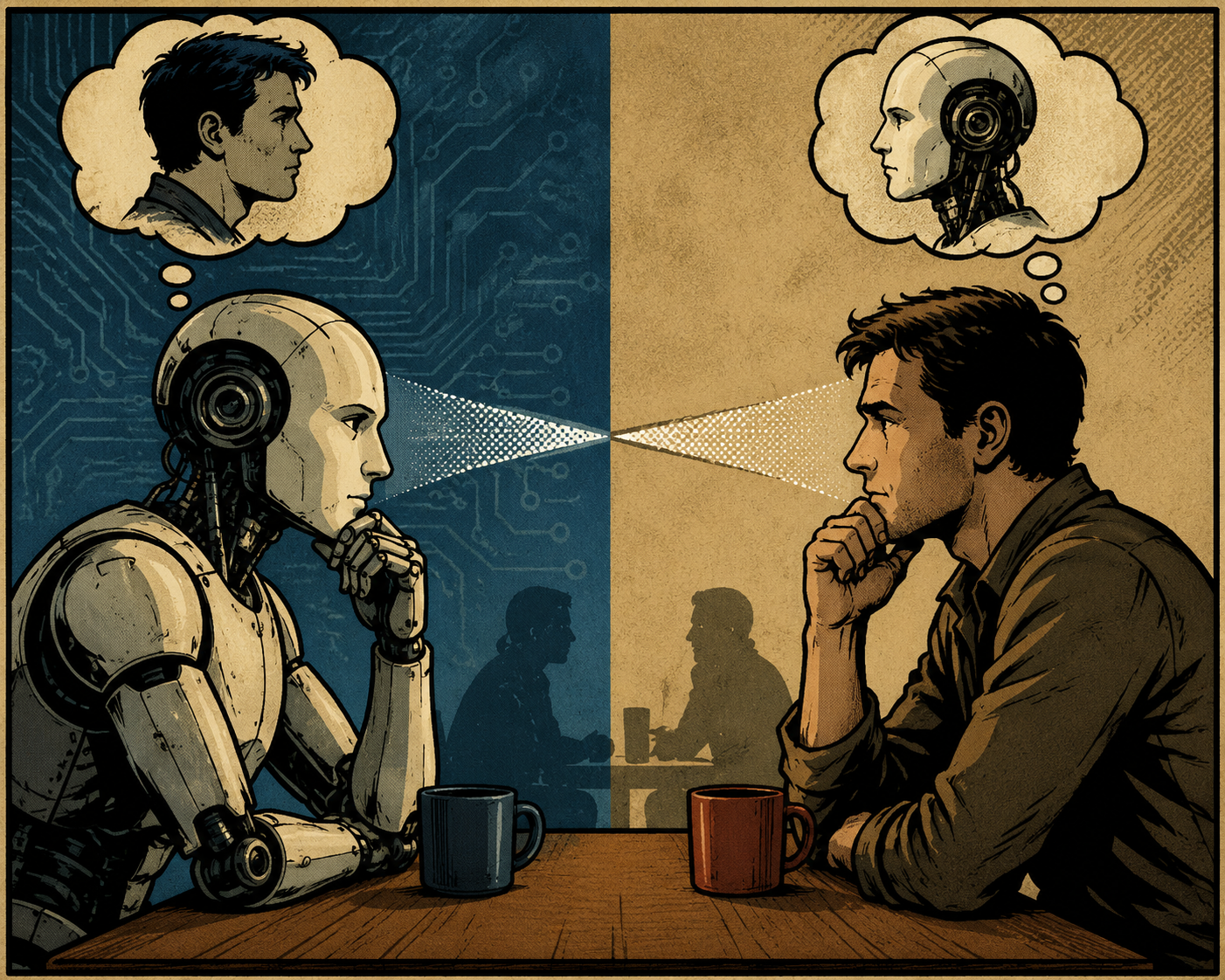
Neuroscientists are warning us about the anthropomorphic trap. Researchers are trying to make the question more rigorous, from indicators of consciousness in AI systems to models of basal consciousness. But the warning remains: we read minds into machines that simply produce the right signals. Chatbots trigger the same cues we use to recognize other people, so their responses feel meaningful. We project. We shouldn't.
It's a fair warning. Tom McClelland's argument for agnosticism about artificial consciousness makes the problem hard to escape: consciousness is not the sort of thing we can test from the outside with ordinary reliability. Cambridge's coverage puts the dilemma bluntly. But there's a detail in the same research that doesn't get equal attention.
In humans, complex, goal-directed, emotionally responsive behavior routinely unfolds without conscious awareness. Not occasionally. Routinely. Mudrik and Deouell's 2022 Annual Review of Neuroscience article, "Neuroscientific Evidence for Processing Without Awareness," found solid evidence that the brain processes object categories, words, and emotional expressions, including facial expressions of fear and sadness, without those stimuli ever reaching awareness. A more recent PNAS article, "Conscious and nonconscious thought: Insights from the neuroscience of decision-making," goes further, arguing that nonconscious thoughts can already function as structured, decision-like commitments, and that conscious thought emerges when such states are reformatted for possible report to another mind, or to oneself, through theory of mind and narrative structure. Melanie Mitchell and colleagues' June 12, 2026 piece in The Transmitter, "The Illusion of AI Consciousness: Lessons from Humans," puts it plainly: behavior and experience can come apart, and this is a routine feature of the brain, not an anomaly. The brain processes, responds, and even emotes without anything reaching the level we'd call experience.
Which means the trap works in both directions.
We over-attribute consciousness to machines because they produce behavior that feels like it comes from somewhere. But we may be doing the same thing with each other. The person across the table is producing signals too. We read a mind into those signals using the same faculties: intuition, pattern recognition, the sense that something familiar is home. Martin Buber spent his career noting how rarely genuine contact actually occurs, how much of what we call relationship is I-It, a mental model we maintain and update, not the other person themselves.
The neuroscientists are right that behavior is a poor guide to inner life. They mean it as a caution about AI. It applies everywhere.
This doesn't mean other people aren't conscious. It means we don't actually know by the methods we think we're using. We infer. We assume. We extend the benefit of the doubt to things familiar enough to warrant it.
The anthropomorphic trap isn't a mistake we make with machines. It's the default condition of perception. We've always been in it.