
What the Mindfulness Research Boom Forgot
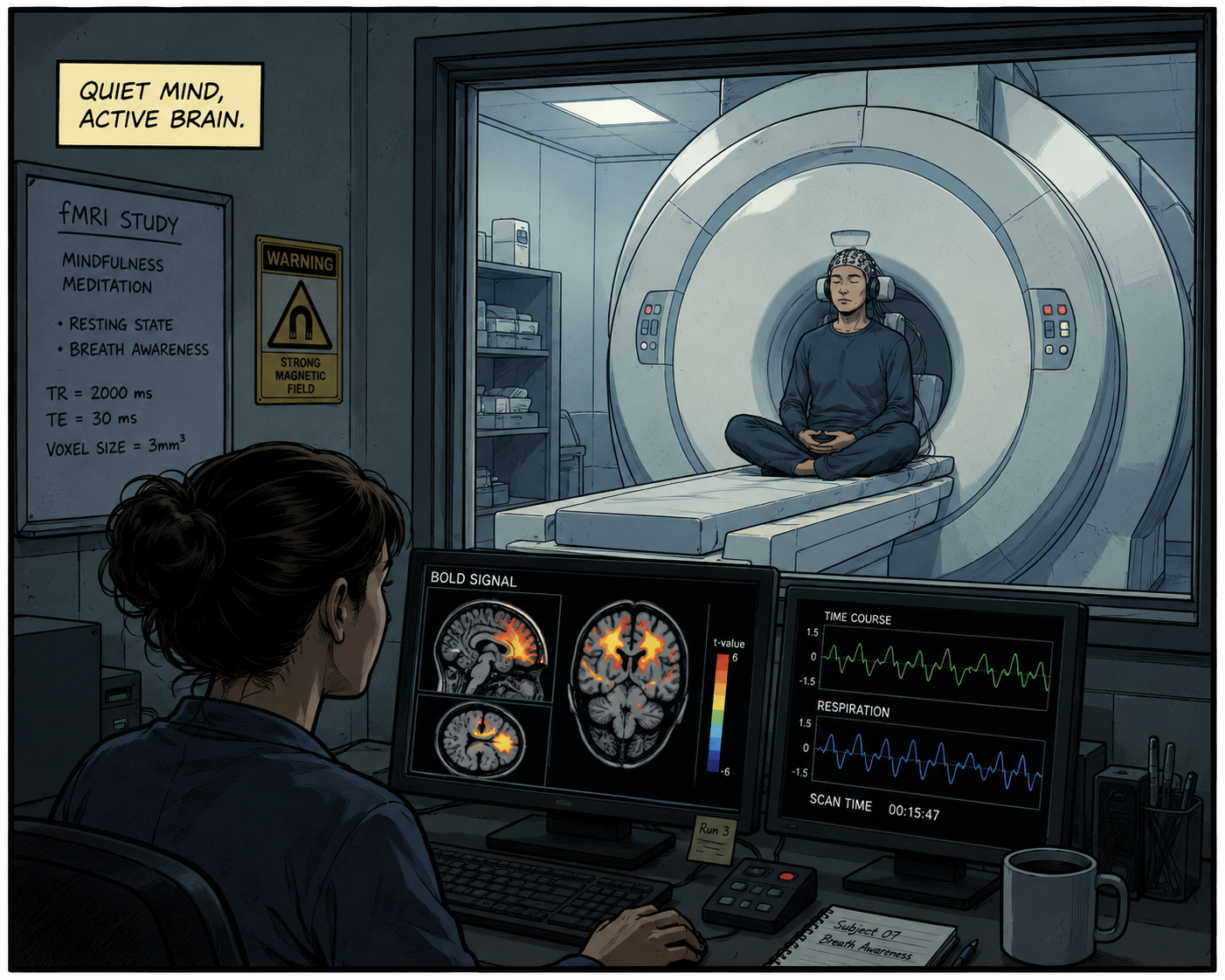
Sometime around 2010, money started moving toward meditation. Not the quiet, unglamorous kind of money that funds a teacher's retreat center or keeps a small dharma community alive. Institutional money. The kind that comes with press releases and quarterly reporting and a clear line back to a problem someone needed solved.
Google launched a mindfulness program for employees called Search Inside Yourself. The US military, facing a crisis of combat stress, moral injury, and suicide rates that conventional treatment was not touching, began exploring whether contemplative practice could do what pharmaceuticals and talk therapy were struggling to do. Hospitals were looking for anything that could reduce dependence on opioids at a moment when opioid dependence had become a national emergency. Corporate HR departments, sitting with data on burnout and turnover and presenteeism, started asking whether teaching people to sit quietly for twenty minutes a day might be cheaper than the alternative.
Behind all of them was the same implicit question, rarely stated directly but always present: but does it actually work?
That question had a particular shape to it. It was not really asking whether the practice produced results. People who had been practicing for years could answer that from direct experience, and had been answering it for a long time. The question was asking something narrower and, in its way, more revealing: does it work in terms we can measure, document, publish, and defend to a board of directors or a hospital ethics committee or a government funding agency? Does it work in the only language we have collectively agreed to trust?
That language is science. And science requires machines.
So funding flowed toward neuroscience labs equipped with fMRI scanners, toward researchers willing to design protocols and recruit subjects and run studies and submit to peer review. The National Institutes of Health became a significant source of that funding, particularly as the clinical applications became clearer. If meditation demonstrably altered how the brain processed chronic pain, that was not just interesting. It was a potential clinical tool with implications for one of the most expensive and damaging health crises in modern American history. The money followed the problem. The research followed the money.
What the researchers found, arriving in papers over the past decade and synthesized more recently in peer-reviewed journals, is being reported with the careful, hedged excitement of genuine discovery. Long-term meditators, defined in at least one major synthesis as people with a minimum of 1,500 hours of practice, show measurable differences in how their minds and bodies work together. The thinking brain and the sensing body are more tightly integrated, more responsive to each other. Information moving up from physical experience registers more clearly and more quickly in conscious awareness.
They process pain differently. Not by feeling less of it in a simple analgesic sense, but by experiencing the raw sensation without the secondary architecture of suffering that most people automatically build around it. The hurt can be present without the story about the hurt, without the resistance and the anticipation and the fear of more hurt, taking over. Anyone who has sat with physical discomfort in a long meditation will recognize exactly what that sentence is describing.
The felt sense of self becomes more fluid. The boundaries of what feels like "me" and what feels like "everything else" are less rigidly defended, more open to revision in the moment. This is not dissociation or confusion. It is, if anything, a more accurate perception of something that was always true about the nature of self, that it is a process rather than a fixed object, a verb the mind mistakes for a noun.
The brain's salience network, roughly the system that flags what is actually happening and what actually matters, becomes more active and more precise. At the same time, its coupling to the prefrontal executive network, the part of the brain that judges and plans and worries and constructs narratives about what everything means, becomes looser. The alarm rings more clearly. The anxious manager who used to sprint in every time the alarm rang has learned, over thousands of hours of practice, to pause.
Remarkable findings. Carefully documented. Rigorously peer-reviewed. Published in journals with impact factors and DOI numbers and supplementary data files available upon request.
Also: completely unsurprising to anyone who has been doing this for a while.
That is not a dismissal of the research. The work is real and the methodology is serious and the documentation matters for the purposes it serves. The 2025 Imaging Neuroscience review Mindfulness, cognition, and long-term meditators: Toward a science of advanced meditation is a useful and careful synthesis of the field. But there is something worth sitting with in the gap between what the science is announcing as discovery and what the practitioners have been reporting as experience for a very long time.
Every person who submitted to those fMRI scans could have described what the researchers were going to find before the first image was processed. Not as theory. Not as belief. As lived, accumulated, first-person knowledge, the kind that arrives not through reading or reasoning but through direct and repeated contact with what actually happens when you sit down, get quiet, and pay attention over years and decades.
I have been doing this for well more than 1,500 hours. I am not a monk or a teacher in any formal sense, but the practice has been continuous and serious for most of my adult life. What the neuroscientists are now carefully describing in the language of salience networks and affective decoupling is not news to me. I watched the integration between body and mind develop gradually over years, watched the relationship with pain shift, watched the edges of what I called "self" become less defended and more interesting. None of it required a machine to confirm. The confirmation arrived through the practice itself, in the only instrument that was ever going to be adequate for the job, which is direct attention applied steadily over time.
The traditions I drew on, loosely and eclectically as is probably true of most Western practitioners of my generation, were not guessing at any of this either. They had mapped the territory with considerable precision. The vocabulary was different. The frameworks were different. But the territory being described was the same territory the neuroscientists are now imaging. Someone sitting in a Zen monastery in 12th century Japan or a Theravada forest tradition in 5th century India was not doing something categorically different from what is happening inside those fMRI machines today. The instrument was the same. Only the observer standing outside it is new.
Jon Kabat-Zinn understood this tension when he built the bridge between Buddhist practice and Western medicine starting in 1979. His strategic choice was deliberate, pragmatic, and in its way a quiet act of sacrifice. Strip the spiritual language entirely. Remove the Buddhist framework. Remove the Sanskrit terminology and the cosmological scaffolding and the explicit references to liberation. Name it something neutral and clinical, Mindfulness-Based Stress Reduction, and walk it through the door that would otherwise stay closed to it. Present it not as ancient wisdom but as a protocol with an eight-week structure and measurable outcomes.
It worked. Mindfulness entered hospitals and then corporations and then neuroscience labs and then the front pages of mainstream magazines. The knowledge got in. It reached millions of people who might never have encountered it otherwise, people in real pain who needed something real and found it. That is not a small thing.
But the price of admission was real too. To get through the door, the practice had to pretend it had not come from somewhere. It had to agree, at least officially, that its origins were beside the point. The permission slip required leaving the tradition's own account of itself outside in the hallway.
What went out with the tradition, and what I do not think the institutions fully understood they were losing, was the teacher.
Not a facilitator. Not a certified instructor with a curriculum binder and a six-week training. A teacher in the older sense: someone who has traveled far enough into this territory that they recognize the landmarks, who has been through the difficult passages themselves, and who knows what it means when a student arrives at one of those passages and does not know what they are looking at.
Because the practice can take you somewhere. That is not a metaphor and it is not a selling point. It is a fact that the traditions took seriously enough to build entire systems around, systems of guidance and transmission and relationship precisely because significant experiences happen, and when they do, the person having them needs someone who has already been there. Not a hotline. Not a worksheet. Someone who knows.
I say this with some personal honesty: I have practiced largely without a teacher, drawn on traditions eclectically, followed my own instincts through territory that sometimes opened up in ways I was not prepared for. In retrospect I would have benefited from a teacher. There were moments I did not fully understand until years later, moments that a more experienced guide might have helped me navigate with less confusion and more clarity. I was fortunate. The practice held me anyway. Not everyone is that fortunate, and it is not a reasonable thing to count on.
Consider what Google was actually trying to do when it launched Search Inside Yourself in 2007. The company was growing fast, its teams were under pressure, and one engineering leader who practiced mindfulness saw an opportunity. The program that resulted was designed to build emotional intelligence, resilience, empathy, and stress management. Better employees. Better teams. Better output. Those are legitimate goals and the program apparently worked well enough that it eventually spun off into its own nonprofit and spread to organizations in over fifty countries.
But notice what the goal was not. It was not to help people wake up in any meaningful contemplative sense. It was not to support genuine transformation or guide people through the difficult and sometimes destabilizing passages that serious practice can open. It was to make people more functional inside a high-pressure environment. The practice was recruited into the service of productivity, which is a perfectly reasonable thing for a corporation to want and a perfectly inadequate container for what the practice can actually do.
The soldier doing an eight-week mindfulness course before deployment, the hospital patient learning breath awareness for chronic pain management, the Google engineer sitting in a lunchtime session between meetings: any of them might have an experience that goes beyond stress reduction. The practice does not confine itself to the use case that got it funded. It does not check the organizational objectives before deciding how far to go. And in the institutional version, stripped of tradition and teacher and any honest framework for what is actually possible, there is often no one in the room who would know what to do if something real happened. The curriculum was not built for that. The facilitator was not trained for that. The whole apparatus was designed for a much more manageable outcome.
William James was describing this same territory in 1902 in The Varieties of Religious Experience, drawing on first-person accounts from practitioners across traditions and arguing for their validity as a form of evidence about the nature of mind. The contemplative traditions he was drawing on were older than his framework by centuries and in some cases millennia. The map existed. It had always existed. What it lacked, in the context of the institutions that would eventually fund the fMRI studies, was the right kind of credential.
First-person testimony from people who had spent decades in direct practice was, in the epistemological framework of modern Western institutions, interesting at best and suspect at worst. It could not be peer-reviewed. It could not be replicated in a controlled setting. It could not be published in a journal with an impact factor.
So we waited. We waited until the machines were good enough and the funding imperative was strong enough and enough institutions had a practical problem that meditation might solve. And then we ran the studies. And the studies found what the practitioners already knew.
That is the actual discovery here, underneath all the data. Not that long-term meditation changes the brain. Not that the practice produces measurable differences in how people process pain and emotion and selfhood. The discovery is what the need for the studies reveals about us, about which ways of knowing our culture is willing to take seriously and which ones it quietly sets aside until they can be made to look like something else.
The meditators sitting inside those scanners were not waiting for the results. They already knew what the study said. They had known it for years. Some of them had known it for decades.
The study was never really for them. It was a permission slip. And the question worth asking now, at a moment when we have the data and the documentation and the peer-reviewed confirmation, is what exactly we needed permission for, and from whom, and why it took this long to ask.