
What We Cut Reveals What We Value
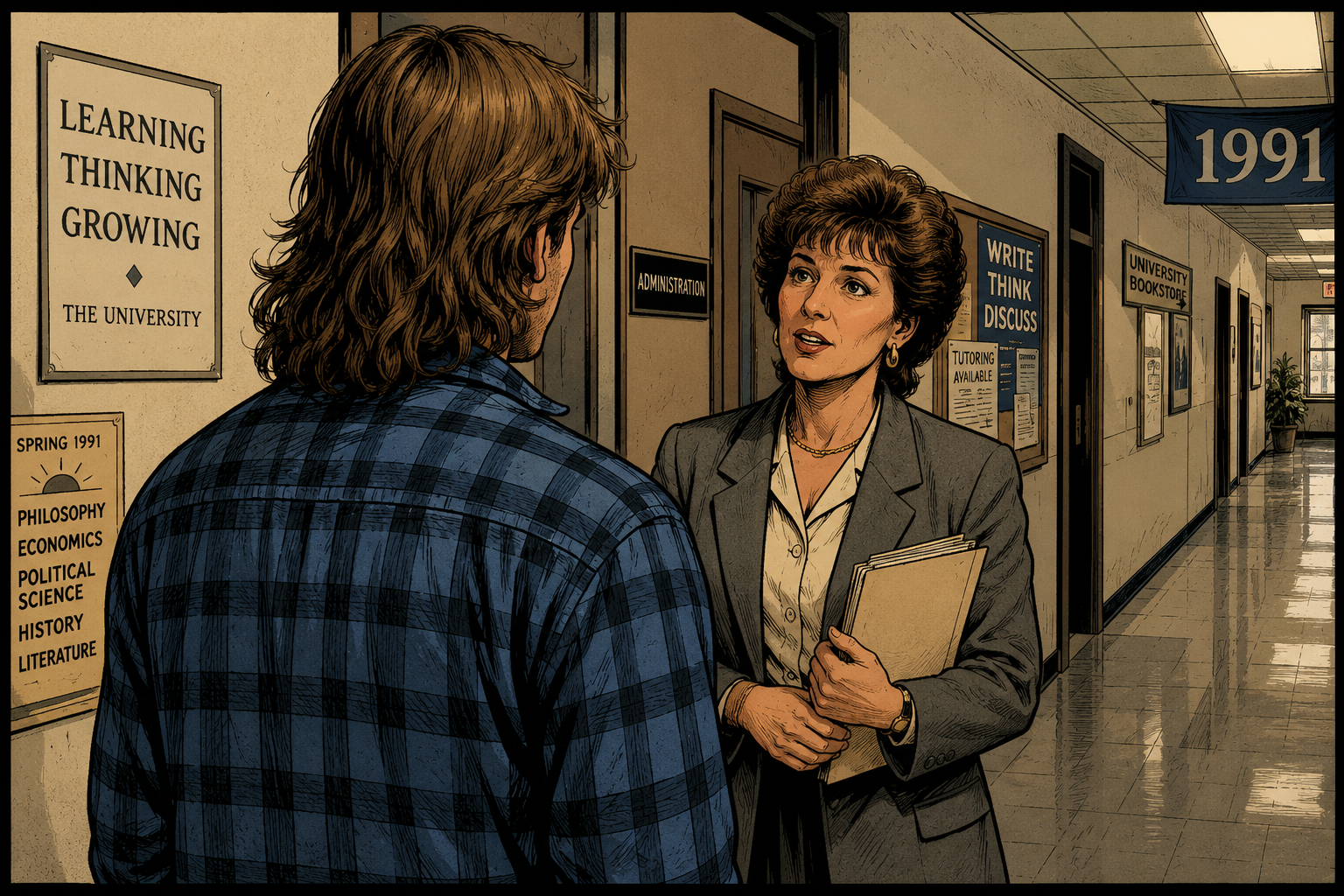
The administrator who pulled me aside in college meant it as a compliment. Most students, she said, were here for training. I was here for an education. I took it as one. I had no idea she was describing something that was already being targeted.
That framing, training versus education, turns out to be a policy position. And right now, the policy is winning.
You can see it in the institutions already being forced to choose. At the University of Oregon, a $65 million shortfall is now being translated into lived institutional facts: Barnhart and Riley residence halls closing, fewer students arriving, and fewer programs surviving. UO President Karl Scholz described the same budget pressure in his May 14 statement. Lookout Eugene-Springfield reported on June 2 that UO expected about 400 fewer nonresident students and its lowest incoming class in 10 years. The Daily Emerald reported in June that Swedish and Swahili were being closed, with the last Swedish students finishing remotely through the University of Minnesota. A few days later, OPB reported that the UO Board of Trustees approved the next year's budget amid warnings of future cuts.
Up the highway in Portland, Portland State University has considered reducing or eliminating 19 academic programs while trying to close a $35 million deficit. OPB's March 9 retrenchment reporting named the departments and programs put on notice: History, Philosophy, Economics, Conflict Resolution, University Studies, World Languages, Politics, Public Administration, and Criminology among them. PSU has lost 23 percent of its enrollment since 2019. Southern Oregon University, OPB noted in the same report, has warned it could be unable to make payroll by February 2027. The cuts are being called financial necessity. They are also a list.
Across the country, the pattern is not subtle. Hampshire College will close after the fall 2026 semester, ending one of the most visible experiments in progressive liberal arts education. The same reporting notes that nearly 300 colleges and universities closed between 2008 and 2023. Anna Maria College closed at the end of the spring 2026 semester. Penn State proposed cutting 49 undergraduate programs, according to WTAJ and The College Fix in late April. Syracuse moved to eliminate 93 low-enrollment programs, and Inside Higher Ed reported in May that buyouts had been extended to 175 professors. These are not abstractions. They are buildings, offices, syllabi, faculty relationships, languages, arguments, archives, and students who thought a certain kind of education would still be there when they arrived.
Read that list again. Not as a summary. As a sequence of things that are actually happening, right now, while you are reading this.
The official explanation is demographics. Birth rates dropped after the 2008 recession, and now those children are not showing up to college in the same numbers. The enrollment cliff was predicted for years. It is real. WICHE projected that U.S. high school graduates would peak around 2025 and then decline for years. Economist Nathan Grawe at Carleton College has been warning about this for years; recent reporting describes the cliff as the result of a birth drought that began after 2007.
But the cliff did not come from nowhere.
People stopped having children at the same rate because they could not afford to. Housing became unattainable. Wages stagnated. Student debt became a defining feature of adult life before most people held their first real job. The social infrastructure that once made a middle-class family financially feasible, affordable housing, accessible healthcare, public investment in education, was dismantled over decades. The American Sociological Association has documented how federal higher-education spending was cut during Reagan's first term, how Pell Grant funding flatlined, and how the model shifted from grants toward loans. That ideology helped create the affordability crisis. The affordability crisis depressed birth rates. Depressed birth rates produced the enrollment cliff. And now the enrollment cliff is being used as justification for cutting the programs that might have produced people capable of questioning the whole arrangement.
The same ideology that created the problem is using the problem to finish what it started.
But demography does not explain which programs get cut first. That is a choice.
When budgets tighten, engineering survives. Business survives. Nursing survives. Philosophy goes. History goes. Literature goes. Languages go. The programs eliminated first are often the ones that produce critical thinkers rather than credentialed workers. That is not an accident of accounting. It is a statement of values, and someone is making it deliberately.
There is another factor that does not always appear cleanly in the budget documents. International students, who often pay higher tuition and have long subsidized parts of the American university model, are facing a more hostile environment. The Institute of International Education reported a 17 percent drop in new international student enrollment for 2025-26, with many institutions citing visa delays and denials. Students who might have chosen the United States can choose Canada, Australia, or Europe instead. The revenue disappears. The crisis deepens. The cuts follow.
Sit with the sequence. Immigration policy reduces international enrollment. Reduced enrollment strains the financial model. Financial strain justifies eliminating the programs that were already ideologically inconvenient. Whether this is coordinated or merely convenient, the outcome is the same. The result looks exactly like what you would design if you were trying to do it on purpose.
Then there is the matter of student loans. New federal borrowing limits are narrowing access to graduate education by category. Graduate students outside designated professional programs face lower annual and lifetime caps, and courts are already being asked to intervene over how those categories are being defined. The effect is not subtle. If your family has money, you can still study whatever you choose. If your family does not, you are pushed toward the approved list. Education becomes a class privilege again. We are back to before the GI Bill, dressed in the language of fiscal responsibility. The rich get philosophy. Everyone else gets vocational training and the debt that comes with it.
I think about what my liberal studies degree actually gave me. Not a job title. The ability to read an argument and find its weaknesses. To write a sentence that does what it is supposed to do. To hold two conflicting ideas at once and work out what they mean together. To understand that history has a shape and that we are inside it. Those skills made me a better paralegal than any paralegal training program would have. They made me a better writer, a better thinker, a better citizen.
The same class of administrators who once praised that education is now signing the closure notices.
Let me say the quiet part out loud. The political valence of education is not imaginary. Pew Research Center has found that college graduates now lean more Democratic than voters without a bachelor's degree, and that the education gap in partisanship is wider than at any previous point in its polling back to the 1990s. An educated citizenry is harder to manipulate, more skeptical of propaganda, more likely to recognize authoritarianism while it is still forming rather than after it has arrived.
Gutting the programs that produce that kind of thinking is not just convenient for this administration. It is the point. You do not need a conspiracy theory to see it. You just need to look at what is being cut, who is cutting it, and who benefits from a population that has been trained rather than educated.
Here is what is not being said clearly enough.
This is not a cycle. Cycles reverse. Programs that close do not simply reopen. Faculty who are laid off do not come back. Institutional knowledge does not regenerate on a ten-year timeline. The students who lose access to these programs now will not wait for better conditions. They will go into the workforce without the tools that make a person capable of self-governance. And their children will inherit a system stripped further still.
We are not in a trough. We are at a threshold. What is being dismantled right now will take a generation to rebuild, if anyone is still around who knows how.
Budgets do not merely balance themselves. They confess. What we protect, what we sacrifice, what we call practical, what we call expendable, all of it tells the truth about us.
The question is not whether we can afford to fund critical thinking. The question is whether the people in power can afford to let us.