
What We're Willing to Pay For
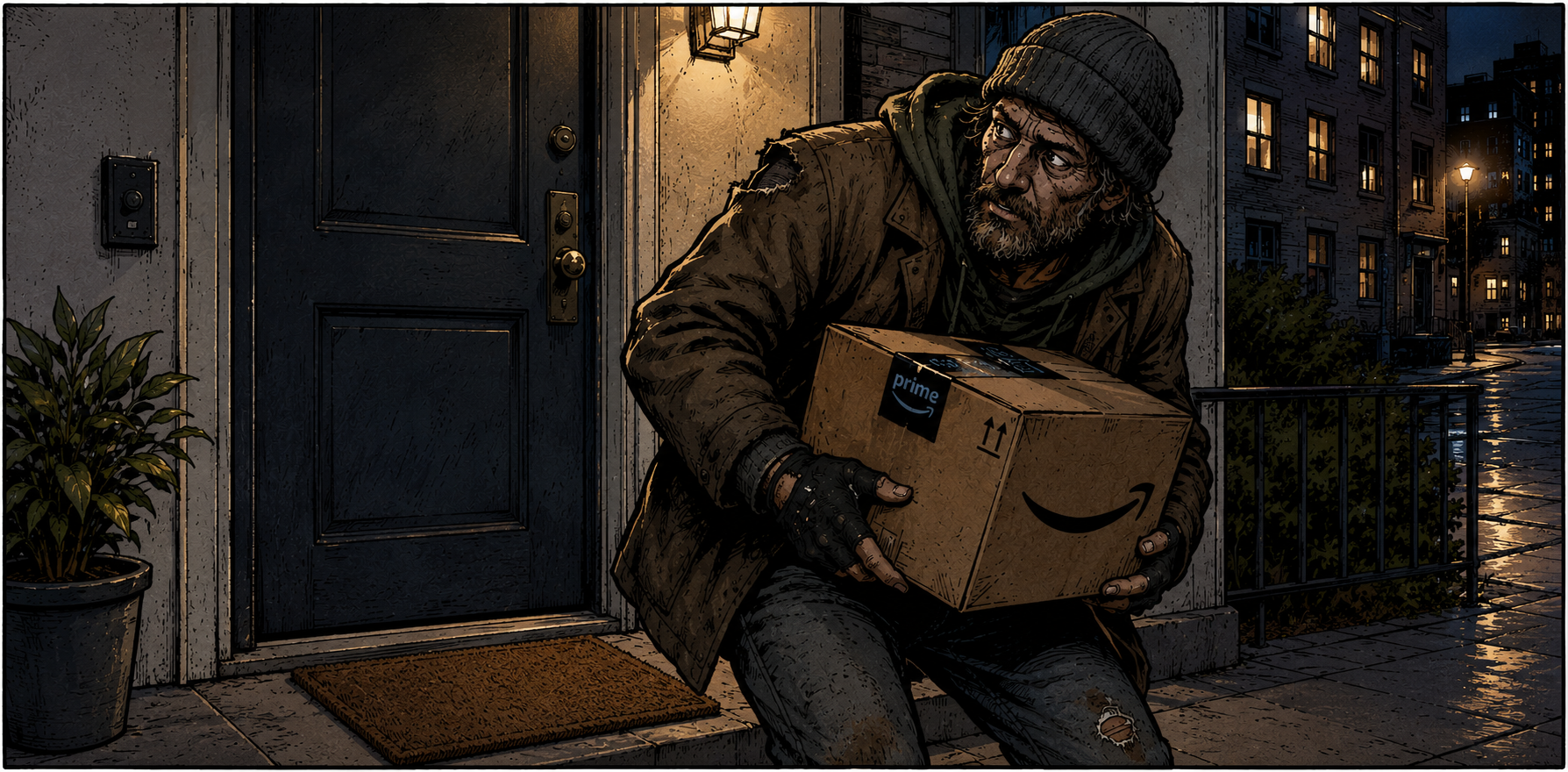
Yesterday evening I walked out to find that a package had been stolen from my porch. Not a particularly valuable one, but that's not really the point. The point is that someone came to my house, looked at something that wasn't theirs, and took it anyway. My first reaction was sadness. My second, once that settled, was something more uncomfortable: I started thinking about who does that, and why.
There will always be people who steal. From every economic class, at every level of society, in every era of human history. Executives cook books. Politicians take bribes. Shoplifters pocket lipstick. Kleptocracy is not a condition of the poor. But there is a category of theft that is not about greed or opportunity or the casual arrogance of people who believe rules apply to others: people who steal because they feel they have no other options. And the size of that category, it turns out, is not fixed. It is a policy choice.
The evidence for this is not subtle.
Japan currently has roughly 2,591 people living without shelter in a country of 123 million. The United States, with a population about 2.7 times larger, has over 770,000. That is not a difference in degree. That is a difference in kind. The U.S. unsheltered population is roughly 100 times larger than Japan's, despite the U.S. being only 2.7 times more populous. Japan's approach involves a rapid-response public assistance system called Seikatsu Hogo, or Livelihood Protection, which is characterized by generality, comprehensiveness, and expeditiousness in getting people housed and supported before their situations deteriorate. The cultural expectation in Japan is that the system will catch you. In the United States, the cultural expectation is that you had better not fall.
Finland offers the cleanest controlled experiment. In 2008, the Finnish government launched a program called Housing First, built on a straightforward premise that most Americans would find radical: give people homes first, then address everything else. No sobriety requirement. No proving you deserve it. Just a door with your name on it. Since the launch of Housing First, the number of homeless people in Finland has decreased by 30 percent, and the number of long-term homeless people by more than 35 percent. Finland is the only country in the EU where the number of homeless people has declined in recent years. As of 2024, Finland estimates that approximately 3,800 citizens are experiencing homelessness, roughly 0.06 percent of the Finnish population.
The philosophical inversion embedded in Housing First is worth sitting with. The old model, used everywhere including most of the United States, treated housing as a reward at the end of a recovery process. Get sober, get stable, get housed. Finland reversed the sequence and discovered, not surprisingly, that stability is easier to build when you are not also trying to survive. When you have a safe home, it is easier to get back on your feet. Professionals at housing units help with benefits, banking, and health issues. The premise that people need to earn basic shelter before they can address the conditions that led to their instability is not a philosophy of recovery. It is a philosophy of punishment.
The connection between homelessness and crime is not merely correlational, though the correlation is strong. It is causal in both directions. People without housing commit survival crimes because survival requires it. Trespassing, petty theft, loitering: these are not moral failures. They are adaptations to deprivation. People commit fewer survival crimes, offenses like theft, robbery, trespassing, and loitering, when they have stable housing. Formerly incarcerated people are ten times more likely than the general public to become homeless, and when they cannot find stable housing, they are more likely to reoffend. Data from the Returning Home Ohio project shows that participants who received supportive housing services were 40 percent less likely to face rearrests than those without housing support.
The Scandinavian countries, Norway and Denmark in particular, maintain some of the lowest crime rates in the developed world, and they do it with comparatively low rates of incarceration rather than high ones. Norway has one of the lowest crime rates in the world and has seen a significant decline in crime in recent years. Their approach is grounded in a welfare infrastructure that makes survival crime largely unnecessary. When people have housing, healthcare, and a functional safety net, the population of people stealing because they are desperate shrinks dramatically. What remains is a much smaller population stealing out of want or pathology, which is a more manageable problem by orders of magnitude.
The United States has made a different choice. We have chosen to treat homelessness as a personal failure, crime as a moral deficit, and poverty as an outcome people deserve. We fund prisons substantially and public housing minimally. We require people to demonstrate they have earned assistance before we provide it, at which point the damage is often already done. We have built a system that produces desperate people, and then we are surprised when desperate people do desperate things.
I am not naive about this. There are genuine individual bad actors in the world. The person who took my package may be one of them. But I have no way of knowing that, and statistically, the odds are reasonable that they were not stealing out of malice. They may have been stealing because Portland, like most American cities, has spent decades producing conditions that make theft feel like an option worth taking.
That is a policy outcome. We built it. We fund it. We could choose differently.
The countries that have chosen differently have the data to show for it. Their streets are not utopias. But their porches are a lot safer than mine.