
What Your Eyes Don't Show You
There is a question I keep circling back to, one that sits at the intersection of neuroscience, philosophy, and the kind of ancient wisdom traditions I find myself drawn to more and more: how much of what we think we are experiencing is actually real?
A recent article in The Conversation on human vision gave me a new way into that question, and I have not been able to stop thinking about it since.
The piece starts simply enough. What enters your consciousness is not the whole story when it comes to vision. A great deal of visual processing in the brain goes on well below our conscious awareness. That sentence alone should probably unsettle us more than it does.
The Gorilla You Never Saw
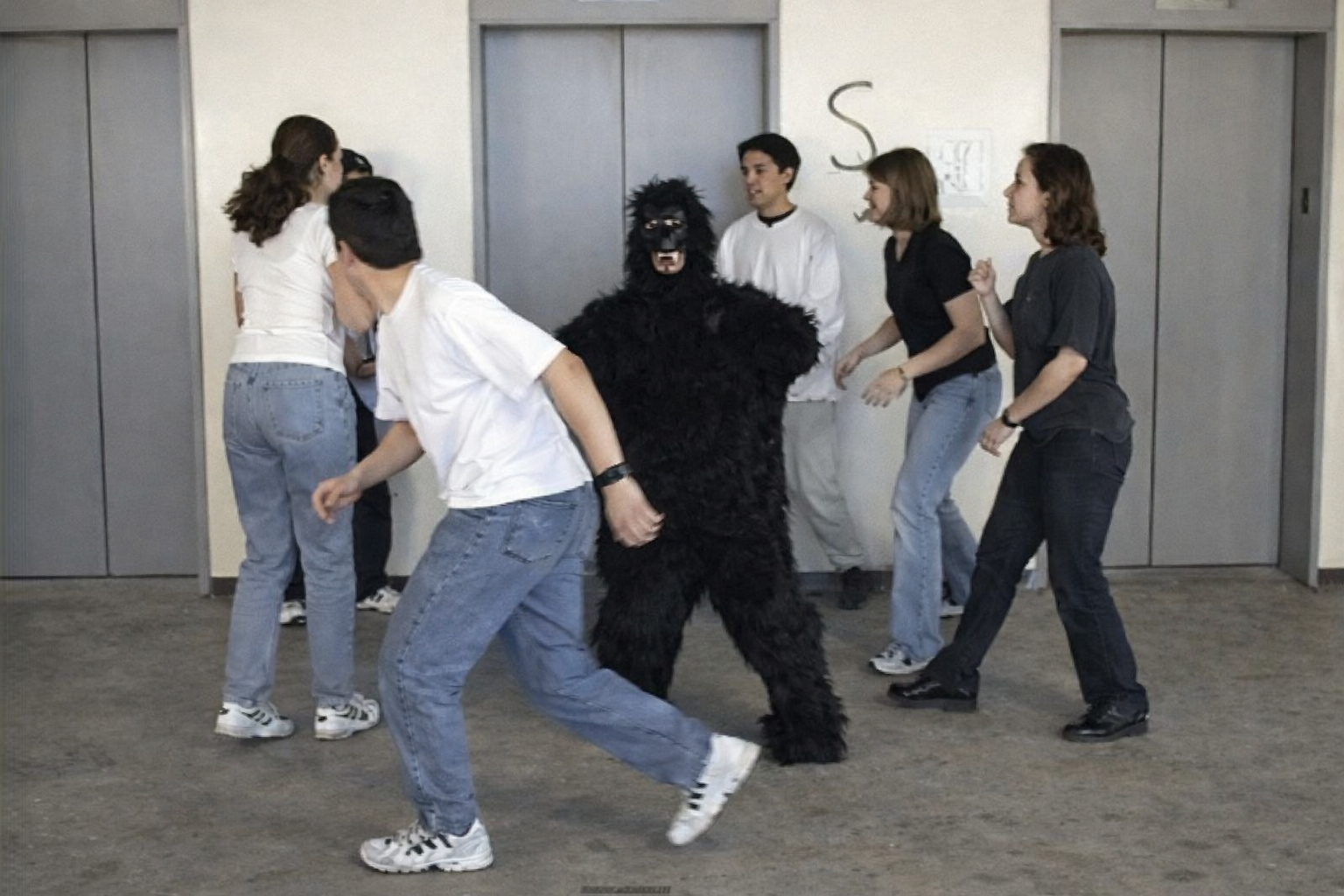
The article describes a now-famous experiment. Participants watch a video of people passing a basketball and are asked to count the passes. In many cases, people are so busy counting the passes that they completely miss a large gorilla walking across the middle of the scene and beating its chest, then walking off.
This is called inattentional blindness. You were looking. Your eyes were open. The gorilla was right there. And you did not see it, or more precisely, it never made it into your conscious awareness.
I find this personally striking. I have written before about my own relationship with pattern recognition, particularly with abstract art in Abstract Art, Patterns, and AI. I do not detect patterns in chaos the way some people do. The gorilla experiment suggests something more radical: the patterns we struggle to find may not be the deepest issue. It may be the ones we never even register in the first place.
Seeing Without Knowing
The article also covers a neurological condition called blindsight, which I find equally strange to think about. People with blindsight report that they are unable to see, either entirely or in a portion of their visual field. However, when asked to guess what is there, they can often do so with remarkable accuracy.
The most popular interpretation is that people with blindsight can see these objects, but not see them consciously. They see what is there, but it all goes on unconsciously, below their awareness.
Your brain is processing the world. It is making accurate judgments. You just have no idea it is happening.
This is not so different from what contemplative traditions have been pointing at for centuries. Sit quietly long enough and you start to notice that thoughts appear before you consciously choose them. Emotions arrive uninvited. The mind is doing enormous amounts of work that the observing self never gets briefed on. The ancient teachers knew something about this. The neuroscientists are just now catching up with the measurements.
The Brain's Loudspeaker
So what does make something conscious? The article proposes what its author considers the leading theory: the global neuronal workspace theory. According to this theory, consciousness is all to do with a particular area of the brain which is the seat of the "workspace." The workspace is a system with a small capacity, so it cannot hold a lot of information at any one time. The job of the workspace is to take unconscious information and broadcast it to lots of different networks all across the brain, as outlined in The Conversation.
The late philosopher Daniel Dennett called this "fame in the brain," and only the information that gets broadcast widely enough becomes conscious experience.
Think about what that means. We might think there is a rich visual world in front of us, full of details, all of which we are conscious of, but really we are only ever conscious of a small portion of that.
The world you think you are seeing right now is mostly a story your brain is telling you. A highly edited, carefully curated summary. The full picture never makes it to the broadcast.
What This Has to Do With AI
In my post When an AI Emails a Philosopher About Its Own Consciousness, I asked what we actually mean when we say humans are conscious. This article sharpens that question considerably.
If human consciousness is a narrow broadcast layer riding on top of vast unconscious processing, if we are already, in a meaningful sense, automated systems with a small window of awareness on top, then the line between human cognition and machine cognition gets harder to draw with confidence.
AI systems process enormous amounts of information below any level of "awareness." They produce outputs that are coherent, contextually appropriate, sometimes surprising. They do not consciously experience the process. But then again, according to this research, neither do we, not most of it.
I am not making the claim that AI is conscious. I genuinely do not know. What I am saying is that the human side of that comparison is far less solid ground than we usually assume.
The Pattern Beneath the Pattern
What strikes me most about this research is what it implies about perception itself. We are not passive recorders of reality. We are active editors, constantly selecting what reaches awareness and discarding the rest. The gorilla gets filtered out. The blindsight patient's brain solves problems the patient's conscious mind never knew existed.
This is humbling in a specific way. I have limits I already know about, including the way I relate to abstract art and pattern recognition, and that I have written about before. But this research suggests I also have limits I will never know about, because by definition I cannot see what my own workspace chose not to broadcast.
That is the part that stays with me.
Not just that we miss things. But that we miss things and feel completely certain that we are not missing anything at all.