
Pack of One
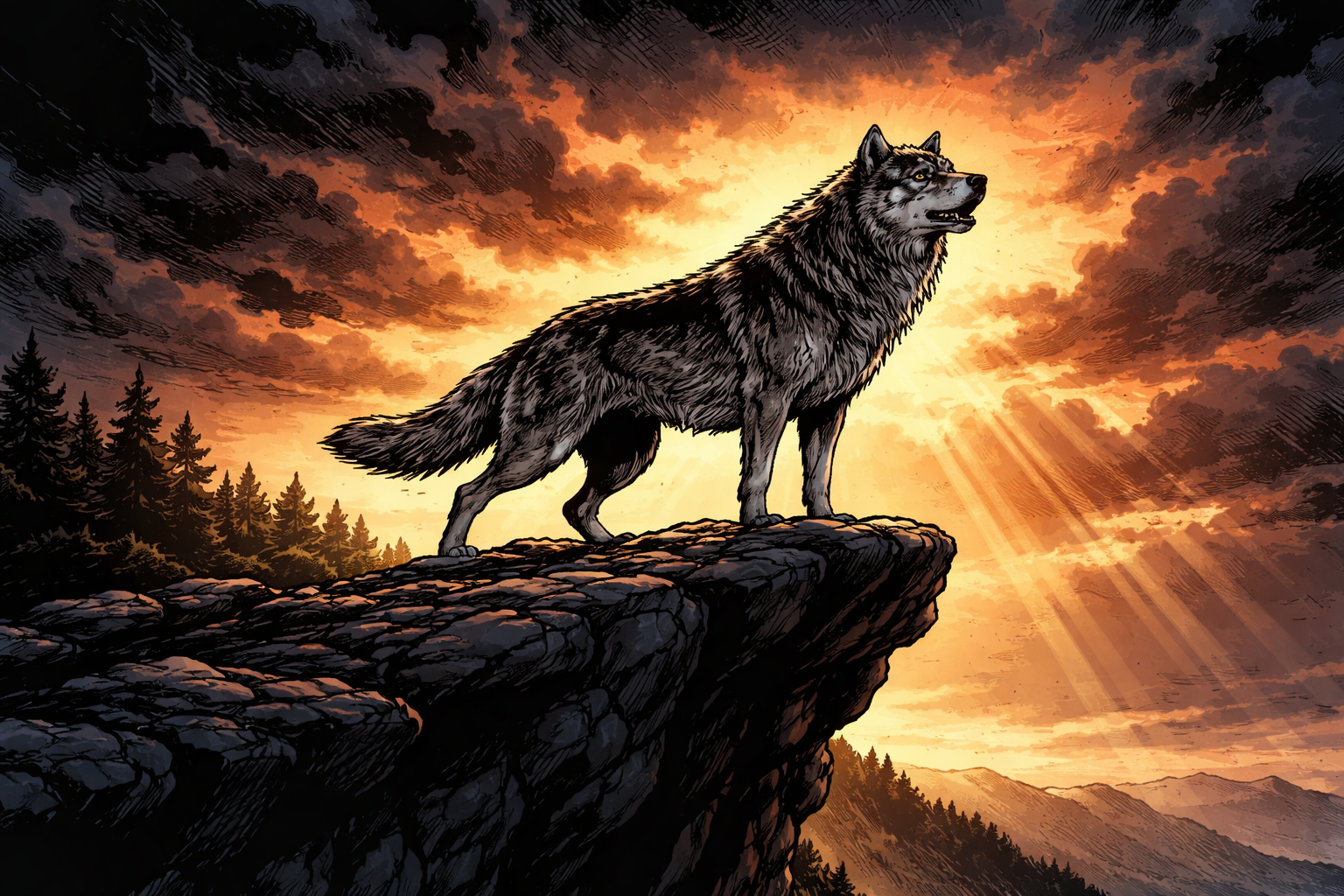
My dog is anxious.
He is a sweet, ridiculous animal who has decided that I am the center of the universe and that the universe is in constant danger of collapse. When I leave the room, he follows. When I sit down, he appears at my feet within thirty seconds. When I put on shoes, his existential distress becomes visible. He is not being dramatic. He genuinely believes, on some level, that if I disappear, he disappears too.
I used to think this was a quirk of his particular personality. I've come to think it's something more honest than that.
Dogs are pack animals, and my dog knows it. What he's responding to isn't neurosis, it's biology. The pack isn't a preference for him. It's the operating condition under which his kind survives. Alone is not a state he's built for, and some part of him understands that clearly, even if he can't articulate it. I've started to think his anxiety isn't a malfunction. It's accurate threat assessment.
Wolves, from whom dogs descend, are among the most thoroughly studied social animals on earth. The data on lone wolves is not encouraging. Research tracking wolf populations in Minnesota found that annual mortality among lone dispersers ran at roughly double the rate of wolves integrated into packs and pairs. Dispersers that fail to find a mate often return to their original pack or simply die. Even young wolves driven off to find new territory don't typically embrace solitude. They look for other wolves. The goal of leaving the pack is almost always to form a new one.
The lone wolf is a romantic figure in human culture. In nature, it's mostly a phase, and a dangerous one.
I've been turning that over in my mind lately, because I think something analogous is happening to us.
The Pack of One
I've written before about the loneliness epidemic, Japan's hikikomori phenomenon, the U.S. Surgeon General's 2023 advisory, the quiet crisis of social withdrawal spreading through wealthy nations like a slow leak. I won't retrace that ground here, but I want to add a frame I've been sitting with.
We are increasingly a society of packs of one.
Not lone wolves, exactly. The lone wolf mythology implies a choice, a preference for solitude, an independence that is chosen and worn with pride. What I'm describing is different. It's structural isolation that feels like autonomy. People living alone at record rates, working remotely, consuming media through personalized feeds, moving through days that involve fewer and fewer unscripted encounters with other human beings. The pack instinct remains. The pack has dissolved.
Research linking social disconnection to premature mortality now places it in the same category as smoking up to 15 cigarettes a day. People with strong social bonds are roughly 50 percent less likely to die over a given period than those with fewer social connections. These aren't soft findings about happiness and mood. They're mortality data. The pack isn't just nice to have. It's, apparently, keeping us alive.
My dog knows this. He just can't explain it.
The Echo Chamber Gets Personal
Here's where I want to push further than I have before, because I think the loneliness problem has a second layer that isn't getting enough attention.
The term "echo chamber" has been used so often in political contexts that it's started to lose its edge. We hear it and think: partisan media bubbles, algorithmic news feeds, people who only talk to people who agree with them. That's real, but it's a narrow version of a wider problem.
I want to reclaim the phrase and use it more precisely.
An echo chamber, as I've come to understand it, is not just a room where outside voices agree with you. It is any idea you hold that you have stopped subjecting to friction. It is the thought you repeat to yourself, in whatever form, without ever really challenging it. The echo isn't necessarily coming from the walls. It can come entirely from inside your own head.
Most of us do this more than we'd like to admit. We have positions we haven't examined in years. Preferences we've never questioned. Stories about ourselves and the world that we've told so many times they feel like facts. That's human. The problem is when the environment around you is specifically designed to make that easier.
Which brings me to AI music.
I've been experimenting with AI-generated music, feeding decades of accumulated lyrics into tools that can build tracks around them. It's been genuinely interesting, occasionally startling, and last week, one of the songs gave me an earworm. I caught myself humming a melody I couldn't get out of my head.
Then I realized: I am almost certainly the only person on earth who has ever had that song as an earworm.
That sounds like a small thing. I want to argue it isn't.
Earworms are, historically, a communal experience. A song gets stuck in your head because it got stuck in enough heads that you couldn't avoid hearing it. "Don't Stop Believin'" is an earworm because somewhere north of a hundred million people encountered it and spread it like a particularly catchy virus. The stickiness is social. It requires shared exposure.
My AI song has had exactly one listener. It exists inside a personal echo chamber so complete that not even the earworm escapes.
Now multiply that across an entire media landscape.
Streaming platforms have been algorithmically narrowing our music consumption for years, serving us more of what we already like, steering us away from the unfamiliar. The same is happening with news, with entertainment, with information of every kind. We are each, quietly and continuously, being handed a custom-built version of reality shaped around our existing preferences. The algorithm does not pause. It does not introduce friction. It does not suggest that you might benefit from hearing something that challenges you, because challenge is not good for engagement metrics, a pattern I've written about in the AI divide.
The personal echo chamber is the pack of one's interior life. You're not just alone. You're alone inside a world constructed to confirm the shape of you.
The Tempo Problem
There's something I want to add to the standard echo chamber critique, because I think it's underappreciated.
The issue isn't only the content of what we're consuming. It's the pace.
My post on cognitive dissidents, people who deliberately sit with uncomfortable ideas rather than rushing to resolve them, touches on this from another angle. The mindfulness tradition I've practiced for a long time makes the same point differently: the problem isn't the thought, it's the speed. Most of us resolve cognitive dissonance as fast as possible because the discomfort is unpleasant. The algorithm understands this and exploits it. Every uncomfortable pause is filled with the next recommended video, the next post, the next hit of familiar content.
The personal echo chamber isn't just a filter on information. It's a machine for eliminating the pause. And the pause, that quiet moment between the thought and the explanation, is precisely where genuine thinking tends to happen.
Shared culture used to create involuntary pauses. You heard a song you didn't choose, saw a news story you didn't expect, ran into a neighbor with different politics and had to figure out what to do with that. The friction was built into the environment. It was annoying sometimes. It was also infrastructure.
We are systematically dismantling that infrastructure, one personalization at a time.
What This Costs
I don't want to overstate the bleakness here, partly because I'm constitutionally resistant to pure doom and partly because I think naming a problem clearly is more useful than spiraling about it.
But I do think the cost is real, and it operates on multiple levels simultaneously.
There is the biological cost. Pack animals without packs get sick and die younger. The human data tracks with the wolf data more closely than we'd like.
There is the cognitive cost. Minds that are never challenged, never introduced to the unfamiliar, never asked to sit with friction, atrophy in ways that are hard to measure but easy to observe.
And there is the cultural cost, which I find hardest to quantify but most troubling. Shared experience is not just entertainment. It is the substrate on which trust, empathy, and common identity are built. When everyone is living inside a different custom reality, the ability to find common ground doesn't just become difficult. It becomes structurally nearly impossible, because you're not just disagreeing about values. You're disagreeing about facts, about which sources are real, about what actually happened. You are, in some meaningful sense, living in different worlds.
The personal echo chamber doesn't just reflect your existing beliefs back at you. Over time, it builds a world that feels self-evidently true, because you've never been shown a door that leads anywhere else.
The Other Way
I've written elsewhere about what I call cognitive dissidents, people who resist the mind's instinct to tidy up its contradictions too quickly. The cognitive dissident isn't someone who disagrees with everything. It's someone who pauses before resolving. Who stays in the friction long enough to learn something from it.
That posture is the opposite of the personal echo chamber. Not agreement with everyone. Not performative open-mindedness. Just a willingness to notice when a door is closing and to hold it open a little longer.
My dog cannot do this. His anxiety is hardwired, and I am not going to be able to explain to him that I always come back. He lives in the present moment in a way that would make a Zen master envious and a cognitive behavioral therapist nervous.
But we can do it. We're built for it, when we choose to be.
The pack isn't just other people. It's the shared reality you build with them, the songs you both know, the news you've both seen, the experience you can reference without explaining. Lose the pack and you lose the world you held in common, the same risk behind my argument in We Taught the World to Read.
That's worth more than an earworm. Though I'll admit, the song was pretty good.