
Rainbows End Is Arriving on Schedule
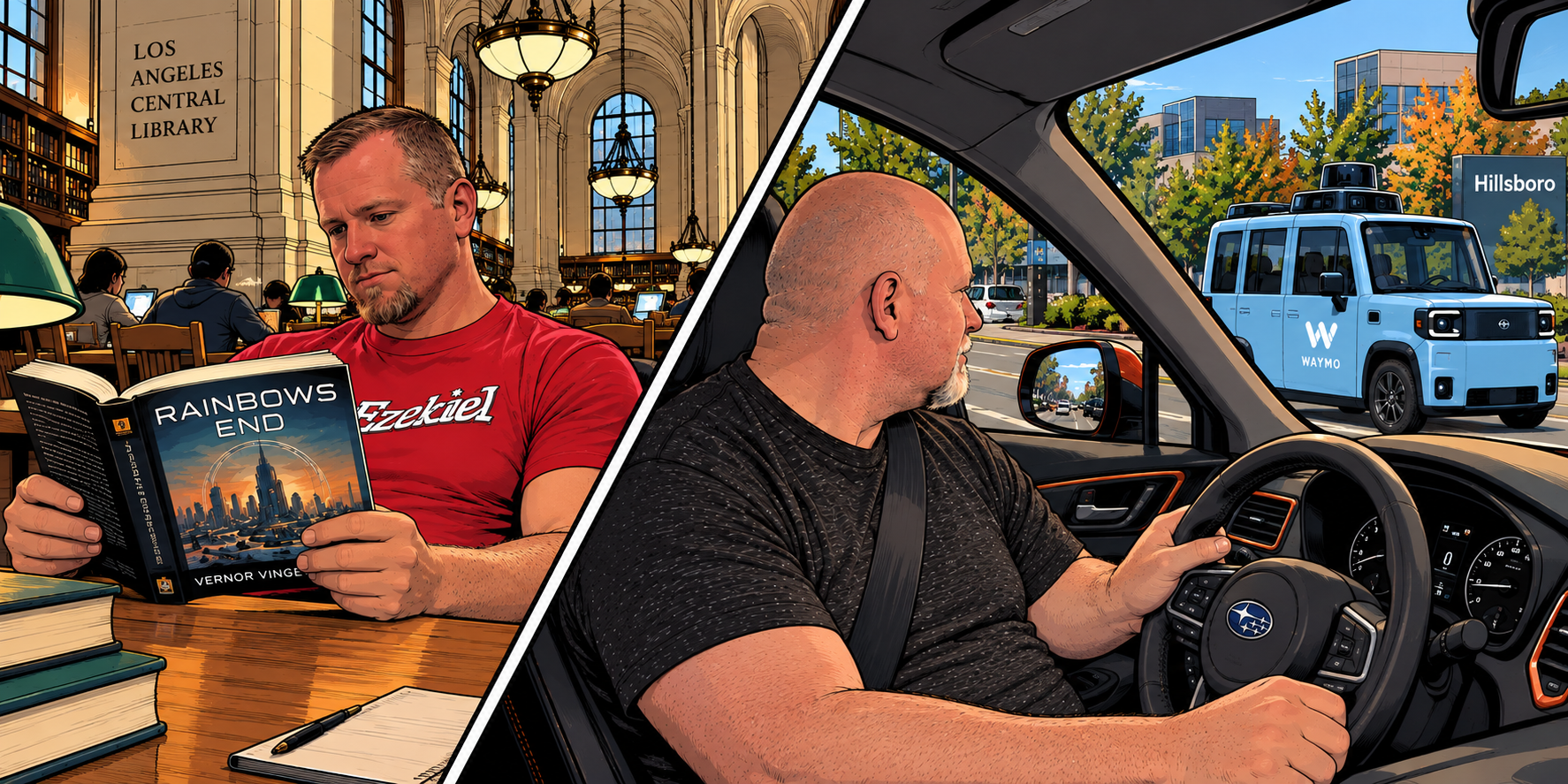
I've seen two of them now, out on the west side of the Portland metro. Baby blue, boxy, rounded at the corners, with sensor pods bristling off every edge. I had no idea whose they were. I just knew, the way you know a deer from a dog at a distance, that nobody needed to be driving it. If anyone was sitting up front, I didn't notice.
When I looked it up, it turned out to be a Waymo Ojai, the company's newest robotaxi, mapping our streets ahead of a service that doesn't legally exist here yet. And my first thought was that I'd read about this before. Almost twenty years ago.
In 2007, a librarian handed me Vernor Vinge's Rainbows End. I'll come back to why that's funny. It's a novel published in 2006 and set in San Diego in 2025, and I didn't pick it up for the futurism. I read it because a librarian told me to. But the futurism is the only part that stayed. I remember very little of the plot. What stuck was the world.
The costumes
Everyone in the book wears their computer, with displays built into contact lenses, and walks through a reality layered with whatever skin they've subscribed to. Fans gather into "belief circles," tribes built around a shared fictional world, and they show up in public wearing it: virtual costumes, virtual creatures, a shared hallucination you can opt into. That is still the closest fictional description I know of what a deeply personalized digital world feels like when it is not hidden inside an app but worn on the body.
In 2007 I had no frame for that. I didn't know what furries were. Looking back now, that's exactly what the belief circles look like: people choosing a second skin and a tribe to wear it with. Today we have the furries, we have the smart glasses, and we have fandoms that function like small nations. We're one pair of contact lenses away.
There's a darker side I didn't see in 2007 either. A skin you subscribe to is a world edited to agree with you. Two people can stand on the same corner and see different buildings, different signs, different neighbors, each one confirmed in whatever they already believed. Vinge wrote them as playful fandoms, but I read them now as personal echo chambers you can walk around inside. We already have those. We just carry them in our pockets instead of our eyes. Our feeds are skins, curated by algorithms that learn what we want to see and show us more of it. I once caught myself humming an AI-generated song I'd made, and realized I was probably the only person on earth who'd ever had it stuck in their head. I wrote about this in Pack of One: having so many options is changing the way we see the world. We customize everything we consume, build our own personal echo chambers, and lose the commonality we used to share with each other. The contact lenses will only make the wall thinner and harder to notice.
The cars
The part I loved most was the transportation. Cars that sit waiting in huge garages, then come and get you and take you wherever you need to go. No owning, no parking, no driving. That was the detail I most wanted to be true. Now it's quietly rolling past me on the way to the grocery store.
The kids
What Vinge may not have pictured is who the cars would end up serving first. This month, Waymo launched teen accounts in Nashville: kids 13 to 17 can hail a driverless ride on their own, linked to a parent's account, anywhere in a 50-square-mile service area. Nashville is the second city after Phoenix, and the company says more are coming.
That matters more than it sounds. Car crashes are the leading cause of preventable death for American teenagers, about eight a day, and a teen driver's risk of dying doubles with just one friend in the car. Waymo's teen accounts let kids bring three, and nobody in the car is a sixteen-year-old behind the wheel.
The quote that stuck with me came from a WKRN story about the Nashville launch. A teenager named Asher described riding home from a concert alone, playing his music as loud as he liked, "kind of like I was in my own little bubble." What he's describing isn't just mobility. It's a ride without a chaperone. For most teenagers, getting home means a parent at the wheel: the check-in questions, the fight over the radio, the quiet supervision. Waymo removes the parent without removing the ride. That's real independence, and I think it's a good thing. But it runs on the same logic as the feeds in our pockets: a private space tuned to exactly what you want, with nobody else's preferences in the room. The technology doesn't create the echo chamber from scratch. It just gives it wheels.
The pitch is independence for teenagers and time back for parents. The quieter implication is bigger. A generation might grow up without ever needing to learn to drive, the same way my generation grew up without needing to learn to ride a horse. In Vinge's San Diego, that was simply how things were. In Nashville, it started last Tuesday.
The books
At the center of the novel is a project to digitize a university library by shredding it: the books are ground up, the pieces blown down a tunnel, photographed mid-flight, and reassembled as data. Reviewers at the time read it as satire.
Which is why it's funny that a librarian gave me this book.
Then court filings in a copyright case against Anthropic revealed Project Panama, a program that bought millions of physical books, cut off their spines, scanned the pages, and discarded what was left. This summer, used booksellers started reporting mysterious bulk orders for obscure, out-of-print titles.
I'm not as horrified by this as some people are. Paper doesn't last forever. Libraries burn, flood, get defunded, get culled. A book captured accurately is a book that survives, and I'd rather have a faithful digital copy of an obscure 1950s physics text than let it molder in a warehouse and disappear. That is the logic behind the digital preservation work libraries have been doing for years, even when the business model around it is not yet a democratic one.
My problem is what happens next. As far as I know, those scans aren't going into a great public library that anyone can search. They're going into training sets. The court's own reasoning was that the digital copy replaced the paper one without being redistributed, and that's exactly the issue: the knowledge is preserved, but it's locked in someone's vault. Vinge's shredded library was at least meant to be read. I'd love to be proven wrong on this. That concern is the part that feels less like a neat dystopian trope than a real governance problem, the kind that shows up whenever access and ownership are separated.
The cures
The book's protagonist, Robert Gu, is a poet recovering from Alzheimer's thanks to medicine that doesn't exist yet. That part hasn't arrived. It's the part I'm hoping for most.
The long game
And then there's the thing the book only gestures toward and I keep imagining past it: a future where the average person, not just the rich, gets to keep going. Repaired bodies, extended minds, maybe some form of continuity that outlasts the body entirely. Virtual immortality for everyone, not a luxury tier.
The scorecard
So here's how a novel set in 2025 is holding up. Costumed tribes: check. Self-driving cars: check, now with kids riding solo. Shredded libraries: check, grimly. Cures and a longer life for everyone: not yet.
Vinge got the delivery date right on the first three. I'd like him to be right about the rest.