
The Long Road Out of Plastic
A Michigan State chemical engineer named John Dorgan once ate gummy bears made from a wind turbine. More precisely, he ate candy made with potassium lactate recovered from a recyclable resin his team designed for turbine blades. The story recirculated this month as if it were new. It isn't. An abstract for the work was listed for a physics meeting in March 2020, and Dorgan presented the result again at the American Chemical Society in 2022. I could not find a peer-reviewed paper on this specific blade resin or evidence of a field-tested blade made from it.
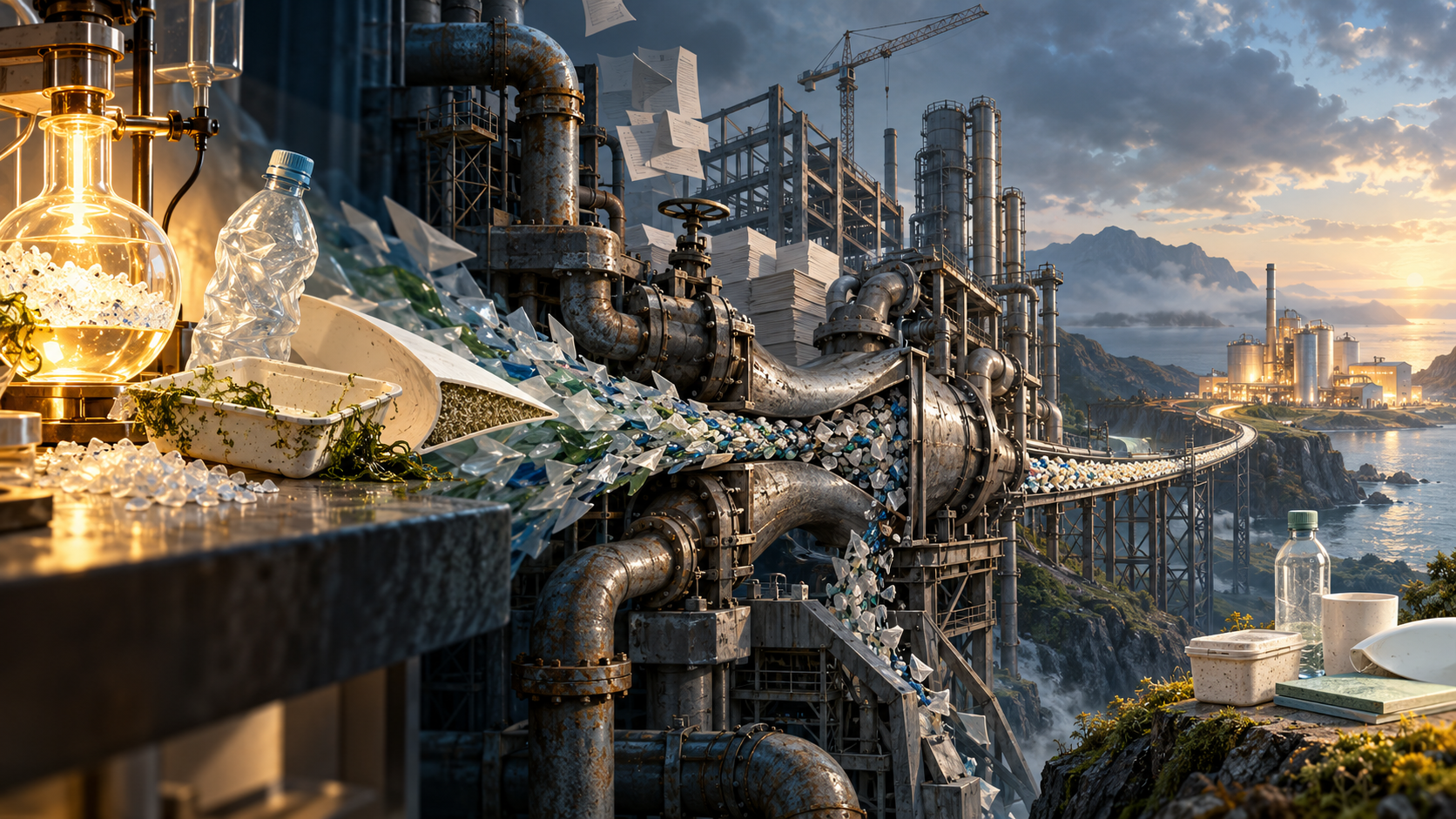
That gap between a great headline and a finished product turned out to be the real story. When I went looking for what has actually changed, I found two broad avenues for getting out of our plastic problem. One is to replace at least some plastic with a material that uses less fossil feedstock or has a better end of life. The other is to break down the plastic we already have, sometimes with help from microbes. Both are real. Both work in the lab. And both have a long way to go.
Avenue one: replace it
The idea here is not always to make a cup, tray, or bottle harmlessly vanish. Sometimes it is to use less petroleum resin. Sometimes it is to make a material meant to be recycled or industrially composted. Those are different achievements, and it matters not to blur them together.
I've written before about Panasonic's kinari, a molding material that mixes cellulose fiber with resin. It is probably the furthest along of anything I looked at. You can buy it. A kinari pendant lamp went on sale in Japan in June for about ¥46,000. Its shade is about half cellulose fiber, cutting its petroleum-derived resin roughly in half. Half is real progress. It is also still half.
Others are moving too:
- Avantium, a Dutch company, makes FDCA, a plant-derived building block for PEF, a recyclable polyester intended for bottles and packaging. Its first commercial-scale plant produced its first batch of FDCA in September, years behind schedule. The company expects its first commercial sales near the end of this year. PEF is not designed to biodegrade. The appeal is that it can replace some PET uses while using plant feedstock and fitting into existing recycling systems.
- Notpla, in London, makes seaweed coatings that replace the plastic lining in takeout boxes. Its packaging is rolling out across Imperial College London's food outlets, where the university expects the switch to displace more than 450,000 single-use plastic items a year.
- Sulapac, in Finland, makes wood-chip-and-biopolymer materials used in caps for luxury brands including Chanel. Its important practical advantage is that it runs on existing plastic-molding equipment.
- NatureWorks has been making PLA, a plant-based plastic, for years. In April it opened a 75,000-ton-per-year plant in Thailand. That is real industrial scale. But PLA usually needs industrial composting conditions, which means the material alone does not solve the disposal problem.
- Mater-Bi, made by Italy's Novamont, is the sort of older, less glamorous success story that rarely becomes a headline. The company makes compostable materials for bags, food service, and agricultural film using ordinary plastics-processing methods. It reported 150,000 tonnes of annual capacity in 2019. Again, compostability only helps where collection and composting systems exist.
Some of these stories stall for years. I remembered a story about plastic bags made from jute and half suspected it was hype. It turns out to be real. It's called the Sonali Bag, or "golden bag," developed in Bangladesh by scientist Mubarak Ahmad Khan from jute cellulose. It looks and feels like a plastic bag.
But its present status is harder to pin down than the old headlines suggest. A 2021 report said a state-run mill was making about 15,000 bags a day, but that figure is not from late 2024. The Sonali project was still described as a pilot in 2024, when Bangladesh resumed serious enforcement of its long-existing ban on polythene bags and officials discussed new funding. This October, the state news agency reported that unused equipment from the pilot had been handed to a university. I could not find evidence that Sonali Bag has reached sustained commercial production. That uncertainty is almost the point: a technically successful material can spend years between a demonstration line and a real factory.
Others don't stall so much as end. Danimer Scientific was a pioneer in PHA, a plastic made by microbes that can biodegrade in settings where ordinary plastic does not, including under certified marine test conditions. Danimer went bankrupt and was sold. PHA has struggled to compete on price with ordinary plastic, and good intentions do not cover that gap.
Avenue two: break it down
This is the avenue that makes for better headlines. In 2016, researchers in Japan found a bacterium, Ideonella sakaiensis, that could use PET plastic as a carbon source. A few years later, scientists studying one of its plastic-digesting enzymes made a version that worked better.
One thing worth knowing: most serious efforts are not about releasing bacteria into landfills. They use enzymes, the chemical tools microbes make, in sealed industrial tanks. In the best version of this process, the enzymes break PET back down into its original building blocks, which can then become new plastic.
- Samsara Eco, in Australia, opened a scale-up plant in 2025 for enzymatic recycling of nylon and polyester. It is a real plant, but not yet its full commercial one: the company's proposed 20,000-tonne nylon 6,6 facility is planned for 2028.
- Carbios, in France, is a useful reminder that even a celebrated first plant can be held up by financing. Its planned Longlaville enzymatic PET-recycling facility had been expected to begin production in the first half of 2028. The company missed its September 2026 financing target and says construction will resume once financing is complete. It has not announced a new production date.
- Breaking, a company that emerged from the Colossal Biosciences incubator, is betting on a living microbe called X-32. The company says it can break down up to 90 percent of certain plastic samples in under 22 months. That is the company's own early-stage claim. It is also biodegradation rather than recycling: Breaking says the end products are water, carbon dioxide, and biomass, not new plastic feedstock.
There is a less headline-friendly branch of this work that is further along: chemical recycling. Eastman says its Tennessee molecular-recycling facility began operating at scale in March 2024, with capacity to process 110,000 metric tons of waste a year. It uses methanolysis, not microbes, to unzip polyester into its starting molecules. It is not a miracle, and it needs energy and a supply of usable waste. But it is a running industrial plant, which is more than can be said for most of the enzyme stories.
A 2025 study from researchers at NREL, UMass Lowell, and the University of Portsmouth modeled a PET-enzyme process that could be cheaper than making virgin PET. The model estimated $1.51 per kilogram for the recycled product versus $1.87 for U.S. virgin PET. That is a lab, engineering, and spreadsheet result—not a running plant—but it is exactly the kind of result that might eventually make investors take a second look.
The same wall
Put the two lists side by side and a pattern shows up. The science often works. What stops it is money, scale, collection, and disposal infrastructure.
Ordinary plastic is cheap, strong, and made in enormous factories that already exist. Every alternative has to compete with that, usually starting from a single first-of-its-kind plant. First plants run late. Avantium's had weld and piping problems. Carbios ran short on financing. The Sonali Bag has spent years suspended between a pilot and a market. Danimer ran out of road entirely.
Even Dorgan's turbine resin hits the same wall. He said himself that there is not enough of the plant-based plastic his resin needs, and that far more would have to be produced before anyone builds turbines from it.
The ones gaining ground share a few habits. They run on equipment factories already own. They start small, in places where buyers will pay a little more: a designer lamp, a luxury cap, a campus takeout box. And they move slowly.
The long middle
None of this is a reason for despair. It is a reason for patience, and for a little skepticism when a story promises that some microbe or miracle material is about to make plastic disappear.
We are in the long middle, the stretch after the lab breakthrough and before the thing shows up everywhere. It is the least exciting part of any invention's life, and the part where many of them quietly die. The headlines will keep coming, some of them recycled like Dorgan's gummy bears. The real news will be slower: a second plant, a lower price, one more product on a shelf.
I'll keep watching for that kind of news. It's harder to find, but it's the kind that counts.