
The Mesopotamian Pantheon: The Oldest Story We Know
The Oldest Story We Know
There is a library older than Greece. Older than Rome. Older than the Hebrew Bible. It was written on clay tablets in a script called cuneiform, pressed into wet clay with a reed stylus and then baked hard, which turns out to be a more durable archival medium than paper, than vellum, than most things we have tried since. Those tablets have been sitting in the ground under what is now southern Iraq for somewhere between three and five thousand years. When we dug them up, they rewrote the history of where Western civilization's stories come from.
The Epic of Gilgamesh is older than Homer by more than a thousand years. It contains a flood narrative. A man is warned by a god, builds a boat, loads it with animals, rides out a catastrophic deluge, and releases birds to find land. You have heard this story. You did not hear it first from Genesis.
The Enuma Elish, the Babylonian creation epic, describes a god who speaks the world into ordered existence out of primordial chaos. The Descent of Inanna, a Sumerian text that predates most of the biblical canon by centuries, tells the story of a deity who dies and is resurrected after three days in the underworld. These are not obscure parallels. They are not coincidences that require elaborate explanation. They are the source material. Western religious imagination did not invent these structures. It inherited them, translated them, and then somewhere along the way forgot to mention where they came from.
This is the Mesopotamian entry in the series. It is the one I am most interested in. Not because the mythology is the most dramatic, though it is extraordinary. But because the gap between what this civilization contributed and how it is currently treated by the culture that owes it the most is, depending on your mood, either fascinating or enraging.
We will get to that.
The Double Names, and Why They Matter
Several of the major Mesopotamian gods carry two names, and if you have ever read anything about this pantheon, the slash marks probably felt like a minor inconvenience. Enki/Ea. Inanna/Ishtar. Utu/Shamash. Nanna/Sin. It is worth stopping on that for a moment, because those slashes are not a formatting quirk. They are evidence of one of the earliest documented processes of cultural absorption in human history.
The Sumerians came first. Their civilization emerged in the river valley between the Tigris and Euphrates around 4500 BCE, and they gave the world its first written language. The Akkadians arrived later, a Semitic people who moved into the same region, absorbed Sumerian culture, adopted cuneiform, and built their own empire on top of it. They brought their own language and their own names for the divine. When the two civilizations merged, the gods got translated.
So Enki, the Sumerian god of wisdom and fresh water, becomes Ea in Akkadian. Inanna, the Sumerian goddess of love and war, becomes Ishtar. Utu, the sun god who presides over justice, becomes Shamash, whose image ends up carved above the Code of Hammurabi. Same theological figures. Same domains. Same stories, more or less. Two names, because two peoples needed to recognize their own tradition in the same god.
This happened thousands of years before the Roman habit of stapling Greek gods to Latin names. It is the same impulse. When you conquer a civilization, or absorb one, or simply live long enough beside one, the gods have to negotiate too. It is one of the earliest documented examples of religious syncretism in recorded history, and the double names are the seam. They show you exactly where two worlds were stitched together.
Who the Gods Were
Anu sits at the top of the hierarchy the way a constitutional monarch sits at the top of a government. Technically supreme. Practically distant. By the time most of the major texts were written, Anu had already receded into a kind of ceremonial authority, the sky itself personified, vast and cold and not particularly concerned with the daily operations of existence. He is invoked. He is not consulted.
Enlil/Ellil is the one who actually runs things. God of wind and storms, but more accurately the executive of the divine assembly, the one who issues the decrees that cannot be appealed. When the gods decide humanity has become too loud and disruptive and should be destroyed in a flood, it is Enlil who makes that call. He is not cruel exactly. He is administrative. The distinction matters less than you might hope if you are on the receiving end of his decisions.
Enki/Ea is the counterweight. God of wisdom, of fresh water, of the deep aquifer beneath the earth called the Abzu. He is the one who keeps arguing on humanity's behalf when Enlil wants to be done with the whole project. He is not quite a trickster but he operates in that register, finding angles, working around the edges of divine decrees rather than confronting them directly. In the flood story, it is Enki who warns the man who will build the boat. He does not technically violate Enlil's decree. He tells a wall, and the wall happens to have ears.
Inanna/Ishtar is the most fully realized character in the entire corpus. Goddess of love and war simultaneously, which sounds like a contradiction until you spend any time with either. She is the morning star and the evening star, Venus in both its aspects. She descends into the underworld voluntarily, is stripped of every attribute of her power at each of the seven gates, stands before her sister Ereshkigal naked and defenseless, and is killed. She is resurrected three days later through the intervention of Enki, but the underworld requires a substitute. Someone has to stay. The story does not end with her triumph. It ends with a negotiation. She is the first dying and rising deity in recorded religion, and she predates every other version of that story by centuries.
Utu/Shamash is the sun, and more specifically justice. The image carved above the Code of Hammurabi, one of the oldest legal documents in existence, shows Shamash handing the laws to the king. The connection between solar clarity and legal accountability is not incidental. You cannot hide anything from the sun.
Nanna/Sin is the moon, and in Mesopotamian cosmology the moon outranks the sun. Nanna is the father of Utu/Shamash. The night sky was more legible to early astronomers than the blinding day, and the lunar calendar was the organizing structure of Sumerian civic and religious life. The moon came first.
Ereshkigal rules the underworld and is Inanna's sister. She is written with more psychological complexity than almost anyone else in the pantheon. She is not evil. She is not a villain. She is the queen of the place where everything that dies has to go, which is an impossible job, and the texts treat her grief and her rage as legitimate. When she kills Inanna, it reads less like malice than like a ruler enforcing the laws of her own domain against someone who arrived uninvited and armed.
Look at the architecture underneath these figures long enough and you start to see the building blocks of things you recognize from much later traditions. The lunar calendar that structured Sumerian religious life, with its recurring sacred intervals and its monthly rhythms of observance, runs directly into Canaanite religious practice. The Canaanites were neighbors, trading partners, and sometimes subjects of Mesopotamian empire. They absorbed the cosmological furniture the way you absorb anything you live beside long enough. And Canaanite religion is not a footnote to the Hebrew Bible. It is the soil it grew in. The god who presides over a divine assembly, who issues decrees, who demands exclusive loyalty and periodically loses patience with humanity, did not arrive fully formed. He was built from older materials. Some of those materials are sitting right here.
What the AI Chose: Iraq
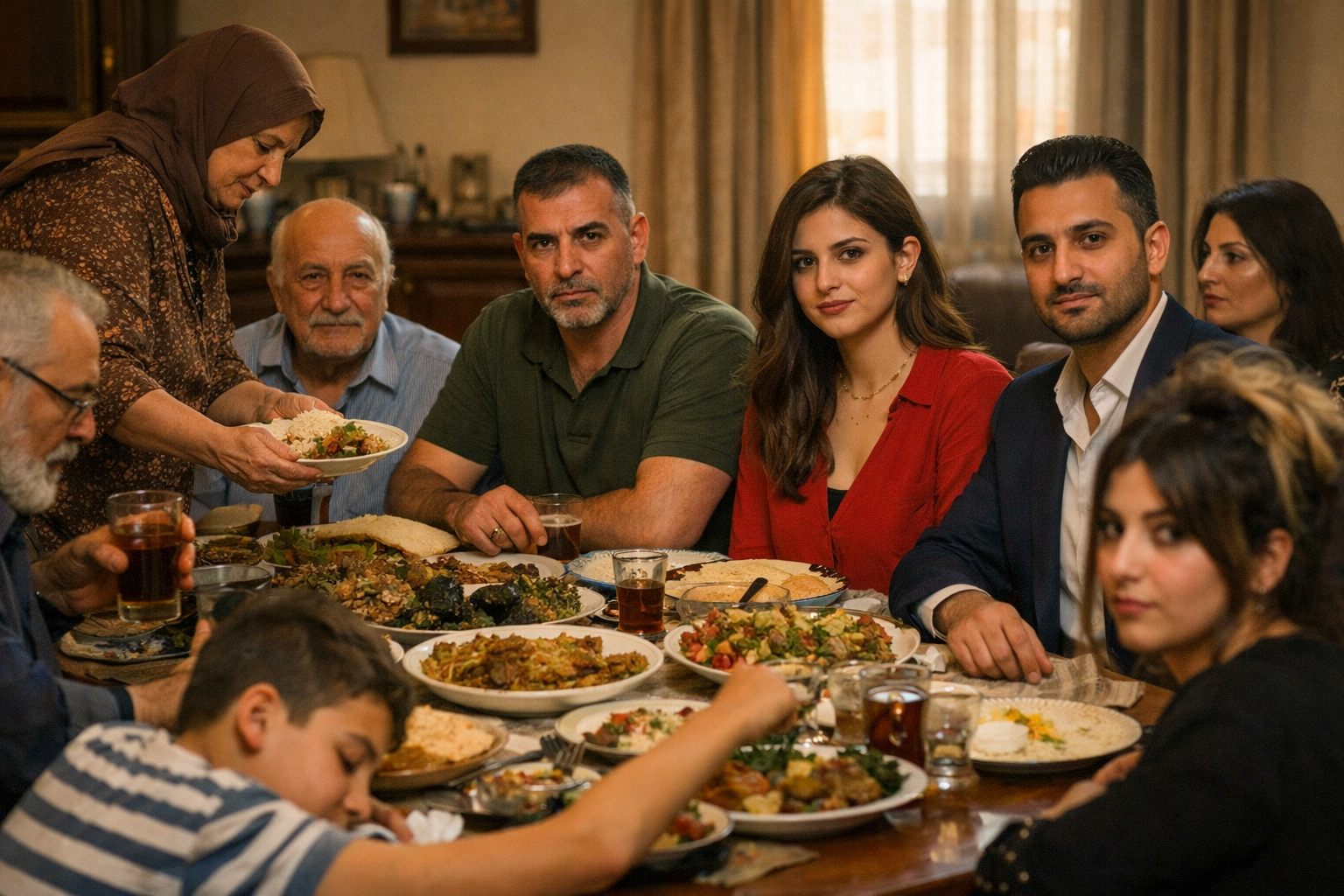
I could not prompt an image model for a contemporary Mesopotamian family without giving it a geographic anchor. Mesopotamia is not a country and never was. It is a region, a historical designation, a word that means "land between the rivers" in Greek, named by outsiders for a place that already had its own names for itself. So the prompt specified Iraq, which is the honest choice. Ur is in southern Iraq. Babylon is in central Iraq. The Tigris and Euphrates are still there, still running, still defining the landscape the way they did when the first cities were built on their banks seven thousand years ago. The land is continuous even when the civilization built on top of it is not.
The AI understood the assignment.
The Dinner Table
Every other image in this series is a portrait. People arranged to be seen, conscious of the frame, presenting themselves. This one is different. Nobody in this image is posing for a photograph. Someone is serving food, mid-motion, not looking at the camera. A child has his head down at the table. The tea is already poured. The dishes cover every inch of the surface, stewed vegetables, rice, flatbread, salads, more food than the table has any business holding.
The AI was not asked to put the family at a dinner table. It chose that.
The word for what it reached for is diyafa. Hospitality as sacred obligation. In Iraqi culture, and across Arab culture more broadly, the table is not a backdrop. It is the central act of the household. To feed someone is to make them safe. To serve is not a subordinate role. It is the host's highest expression of what a home is for. The AI's training data knew this without being instructed to know it. It rendered it without being asked.
It is also the only image in this series that places the family inside an activity rather than inside a presentation. There is something quietly significant about that. The culture that invented the city, that built the first libraries, that wrote the first laws, gets rendered not as monumental but as intimate. Not as empire but as a woman putting a plate of food in front of someone she loves.
Look at the generational range in the frame. The woman in hijab serving, older, in motion. The younger woman in red, secular, poised, a different relationship to visibility and tradition. The older patriarch being attended to at the corner of the table. Three modes of the same culture in the same room, negotiating the same questions about continuity and change that every diaspora family negotiates, without anyone at the table necessarily thinking of it that way. The AI started a conversation about Iraqi modernity and tradition without being prompted to. It just chose the dinner table, and the dinner table said everything.
The Foundation We Refuse to Acknowledge
Let's be direct about something.
The flood narrative in Genesis has a Sumerian antecedent called the Epic of Atrahasis, and a version embedded in Gilgamesh, both older than the biblical text by centuries. The seven-day creation structure has Mesopotamian parallels. The divine council that appears in the Hebrew Bible, where God speaks to other heavenly beings, maps directly onto the Sumerian and Akkadian cosmology where Anu presides over an assembly of gods. That structure did not jump straight from Mesopotamia to Jerusalem. It passed through Canaan first. The Canaanite god El presided over his own divine assembly, a council of lesser gods called the sons of El, and the early Hebrew texts absorbed that framework wholesale. Psalm 82 opens with God standing in the divine assembly, judging among the gods. The book of Job begins with a heavenly council scene. These are not metaphors that the biblical authors invented. They are inherited furniture, and the original house was Sumerian.
The dying and rising deity that becomes central to Christian theology has its clearest pre-Christian template in Inanna's descent. The lunar calendar that organized Sumerian sacred life flows into Canaanite religious practice, and Canaanite religion is not a footnote to the Hebrew Bible. It is the soil it grew in.
None of this is fringe scholarship. It is consensus ancient Near Eastern studies. It is taught in seminaries. It sits in peer-reviewed journals. It just does not travel into popular culture, and the reason it does not travel is worth naming.
Acknowledging the Mesopotamian foundation of Western religious imagination means acknowledging where that foundation is located. It is located in Iraq. The country where writing was invented. Where the first cities were built. Where the first libraries existed, including the Library of Ashurbanipal at Nineveh, which housed tens of thousands of cuneiform tablets and was one of the great repositories of human knowledge in the ancient world. Where the first law codes were carved. Where the first astronomers mapped the night sky with enough precision that their observations still appear in modern astronomical databases.
In 2003, the United States invaded that country on the basis of weapons that did not exist. The infrastructure was destroyed. Sectarian violence that had been suppressed for decades was released and metastasized. Somewhere between 150,000 and 600,000 civilians died depending on the methodology of the study, and the studies are not in dispute about the order of magnitude. The National Museum of Iraq in Baghdad was looted in the days following the invasion while American forces stood nearby. Approximately 15,000 objects were taken or destroyed, including artifacts that were irreplaceable, including things that were among the oldest human-made objects on earth. The response from the United States government was a shrug. The Secretary of Defense said, and this is nearly a direct quote, stuff happens.
Stuff happens.
The archaeologists who spent the following years cataloguing what was lost described it as the worst episode of deliberate cultural heritage destruction since World War II. Some of what was taken has been recovered. Most has not. Some of it is sitting in private collections. Some of it is gone.
This is not ancient history. It happened within the lifetime of most people reading this. And it happened to the civilization that gave the West its flood story, its creation myth, its first law code, its first library, its first written account of a god who dies and returns. The culture that built the foundation was not protected. It was not even recognized as the foundation. It was treated as a location, a strategic asset, a problem to be managed, and when the managing went badly, the artifacts that survived five thousand years in the ground did not survive the weeks that followed.
The AI put an Iraqi family at a dinner table covered in food, warm and crowded and continuous across three generations. It reached for abundance and care and the specific gravity of a culture that knows how to feed people. The training data was pulling from something real. That family's civilization invented the concept of the city. It invented writing so that grain inventories could be tracked and debts could be recorded and eventually so that a man named Gilgamesh could grieve his dead friend and someone could write it down and it could survive long enough for us to read it and recognize ourselves in it.
That is what was in the ground under the museum they let get looted.
The Gods at the Table
The man in his 40s at the center of the frame, direct gaze, slightly guarded, the one the room orients around without anyone making a visible decision about it: that is Enlil. Not warm. Not trying to be. The one who administers.
The woman in hijab, older, in motion, serving, not sitting because there is still food to be brought: that is Ninhursag, the great mother, the goddess of the living earth, generative and tireless and not particularly interested in being thanked for it.
The older man at the corner being attended to, present but no longer directing, honored by proximity rather than deference: that is Anu. Still sky. Still vast. Still the nominal top of the hierarchy. Largely ceremonial at this point in the evening.
The young couple, the woman in red poised and forward-facing, the man beside her in his good jacket: that is Inanna and her consort. Youth and eros and the particular confidence of people who have not yet had to negotiate with the underworld. She will. The text is clear about that. But not tonight.
The child with his head down at the table, focused on his plate, trying not to be noticed: that one is just a kid at a long family dinner. Not every person at the table has to carry a divine assignment. Sometimes the mythology is happening above you and all you want is to finish eating and be excused.
Closing
The cuneiform tablets sat under the ground for thousands of years. When we dug them up they rewrote the history of where stories come from. They rewrote where the flood came from, where the divine council came from, where the dying god came from, where the idea of writing a law down and calling it sacred came from. They rewrote the origin story of Western civilization in a way that Western civilization has never fully absorbed, because absorbing it would require a reckoning with what we owe and to whom.
Gilgamesh is the oldest named literary protagonist in human history. He is not Greek. He is not Roman. He is not European in any sense that the word has ever been used. He is from Uruk, which is in Iraq, and he grieved his dead friend Enkidu with a rawness and specificity that still reads as true because grief has not changed since 2100 BCE and neither has the desperate human wish to find something, anything, that outlasts it. He had the walls of his city built. He went looking for immortality and came back without it. He sat down and someone wrote it all down in wet clay and baked it hard and put it in the ground where it waited.
That is what we dug up. That is what the museum held. That is what the looting took.
The woman in the image is still serving. The tea is still warm. The table is still full. The child still has his head down, focused on his plate, waiting to be excused. Outside the frame, five thousand years of history are sitting in the soil, patient as clay, waiting to see if this time we will bother to remember where we came from.
Next in the series: The Yoruba Pantheon: What the Atlantic Could Not Drown, which produced the most visually arresting image in the project, a family dressed in full ceremonial color, and a tradition old enough to have sent its gods across the Atlantic in the holds of slave ships and still have plenty left at home.