
The Yoruba Pantheon: What the Atlantic Could Not Drown
A Note on Length
This post runs longer than the others in the series. That is not an accident. The Yoruba tradition has been one of the most systematically marginalized and misrepresented religious systems in Western discourse for centuries, and this is not going to be the place that continues that pattern. If you are here for the quick version, there is not one. The subject does not have one.
What We Were Not Taught
I want to be honest about something before we go any further. I did not know most of what is in this post before I started researching it. I knew the broad outlines. I knew the diaspora traditions existed. I knew Santeria and Candomble were African-derived. I could not have told you the name Olodumare or explained what an Odu was or described the opele and what it does. I was not taught any of it, and I do not think that is a personal failing at this point in my life. I think it is a structural one.
The Yoruba people number somewhere in the tens of millions, with contemporary estimates often placing the population above 44 million, primarily in southwestern Nigeria, Benin, and Togo. Their religious tradition is one of the oldest continuously practiced spiritual systems on the planet. It generated living religious communities on multiple continents. It survived the Middle Passage. It survived colonial suppression. It survived forced conversion. And most people educated in the West cannot name a single Orisha.
I find that interesting in the same way I find the Mesopotamian situation interesting. Not as a coincidence. As a pattern.
There is a brief footnote to this I will share because it surprised me when I made the connection. When I was young and beginning my own spiritual exploration, I used tarot cards as a divination system and constructed something in my own mind that functioned like a personal pantheon. I did not know what I was doing had a name. Sitting with the Yoruba material now I can see exactly what I was reaching for, and I can see that a civilization in West Africa had already built it in extraordinary detail thousands of years before I was fumbling toward it. That is what the educational gap costs. Not just knowledge. It costs people access to systems that might have spoken directly to what they were looking for.
Olodumare and the Architecture of the Divine
Before we get to the Orisha, the individual figures that populate this tradition and carry its emotional and dramatic weight, it is worth establishing the theological structure they exist within. Because the most common Western misreading of the Yoruba tradition is to treat it as simple polytheism, multiple competing gods dividing up territory the way the Greek pantheon does. That is the wrong frame entirely, and getting it wrong makes everything that follows harder to understand.
At the top of the Yoruba cosmological structure is Olodumare. Supreme being. Singular, uncreated, beyond direct human contact, and essentially unknowable in immediate terms. Olodumare does not intervene in daily human affairs directly. Not out of indifference, but because the divine operates through intermediaries. The Orisha are those intermediaries, specialized expressions of divine energy, each governing a specific domain of existence, each accessible to humans in ways that Olodumare is not. Britannica's description of the Orisha is useful here because it refuses the flattening: an Orisha is not merely an anthropomorphic deity, but a convergence of divine power, natural force, ancestral memory, and ritual object.
If that structure sounds familiar, it should. It maps closely onto the Hindu theological framework, where Brahman is the ultimate ground of being, beyond qualities and attributes, unknowable in direct terms, and the Devas are the accessible intermediary figures who govern the specific texture of daily life. It also maps, ironically, onto the Catholic saint system, where a supreme being is approached through figures with specific domains and specific modes of communication. That irony becomes pointed later in this post.
The comparison that does not work is the Greek and Roman one. The Olympians are not expressions of a single underlying divine reality. They are independent personalities with competing agendas who happen to be more powerful than humans. The Orisha are something philosophically closer to facets of a unified divine order. That distinction matters because it means the Yoruba tradition has a sophisticated monotheistic substrate underneath what looks on the surface like polytheism. Olodumare is not Zeus. Olodumare is closer to Brahman, or to the God of the medieval Christian mystics, the one beyond all names and attributes that the popular tradition tends to flatten into a personality.
Ifa: The Operating System
Every major religious tradition has a way of accessing divine guidance. Christianity has prayer and scripture. Hinduism has the Vedas and a vast body of philosophical commentary. The I Ching, the ancient Chinese divination system, uses a randomizing process to generate one of 64 hexagrams, each attached to a body of interpretive text. Ifa is the Yoruba answer to that same human need, and it is more structurally sophisticated than almost any Western reader is prepared to expect.
Ifa is not fortune telling. That framing is worth disposing of immediately because it is the one Western popular culture reaches for and it is wrong in almost every important way. Ifa is an epistemological system. A way of accessing knowledge about the structure of reality and one's place within it. The premise is that the universe has a legible order, that human situations recur in recognizable patterns, and that a sufficiently deep body of accumulated wisdom about those patterns can be consulted to diagnose what kind of situation you are actually in and what the tradition knows about situations like it.
The practitioner who mediates this process is called a babalawo, if male, or an iyanifa, if female. Babalawo translates roughly as father of secrets; iyanifa means mother who has or owns Ifa. The diviner undergoes years, sometimes decades, of training. What they are learning is not a technique. It is a corpus, an enormous body of oral literature called the Odu, organized into 256 possible configurations, each containing multiple layers of narrative, ethical teaching, historical memory, cosmological information, and practical guidance. UNESCO recognized Ifa as an intangible cultural heritage of humanity, originally proclaimed in 2005 and inscribed in 2008. It is one of the most complex oral knowledge systems ever documented anywhere on earth.

The physical process of accessing this system works like this. The diviner uses one of two instruments. The opele is a chain with eight seed-pod halves attached at intervals, four on each side. The diviner holds it at the center and casts it onto a sacred carved tray called the opon Ifa, which is dusted with a fine sacred powder called iyerosun, made from wood dust. When the chain lands, each of the eight pods falls either concave side up or convex side up. That binary pattern across eight positions generates one of the 256 Odu configurations. If you are already thinking about the I Ching, you should be. The structural logic is almost identical, a randomizing process generating binary choices across multiple positions to arrive at a configuration attached to a body of interpretive literature. The difference is scale. The I Ching has 64 configurations. Ifa has 256, and the oral literature attached to each one dwarfs anything in the I Ching corpus.
The second method, considered more sacred and used for more serious consultations, involves sixteen palm nuts called ikin. The diviner takes all sixteen in both hands, then quickly transfers them to one hand and counts what remains in the other. If one nut remains, they make two marks in the iyerosun powder with a finger. If two remain, they make one mark. They do this eight times, building the Odu configuration mark by mark from the bottom up. The tray, the powder, the nuts, the chain: none of them are props. Museum descriptions of the opon Ifa describe the diviner spreading wood dust on the tray and moving palm nuts or a divining chain through it; the Saint Louis Art Museum notes that the markings record the results of palm nut or seedpod castings. Each element has been consecrated. The diviner's hands have been consecrated. This is a precision instrument developed over centuries, not an improvised ritual.
Once the Odu is determined, the diviner recites the ese, the individual poems and narratives attached to that configuration, that speak to the person's situation. Here is what that looks like in practice.
One of the most well-known Odu is Ogbe Meji, the first and most senior configuration, which falls when all eight positions land the same way. It is the Odu of beginnings, of light, of the moment before creation differentiated into separate things. A classic ese attached to Ogbe Meji involves a traveler who comes to the diviners before a journey, worried about obstacles on the road. The Odu falls. The diviner recites the story of another traveler in the ancient past who faced the same configuration. He was advised to make an offering at the crossroads before setting out, a white cloth and palm wine left for Eshu who guards all passages and communications. He debated whether to bother, made the offering anyway, and found the road clear before him.
The diviner then interprets the connection between that ancient narrative and the person sitting across from them right now. The Odu is speaking to your situation. There is a passage ahead, literal or metaphorical. Something is blocking the path that you cannot yet see clearly. Address Eshu first. Clear the channel before you move. Here is what the offering looks like. Here is when.
The person leaves with a specific practical instruction drawn from a literary tradition thousands of years old, interpreted by a trained human being who has spent years learning to read the relationship between ancient pattern and present moment. That is what Ifa is. Not prediction. Diagnosis and prescription, drawn from the deepest accumulated body of human wisdom about recurring patterns in human experience that most Western readers have never encountered.
There are babalawo and iyanifa working in Lagos right now. The system is not historical. It is alive.
The Orisha
A brief protocol note before we begin. Eshu/Elegba goes first. Always. That is not a stylistic choice on my part. It is the requirement of the tradition itself. Eshu governs communication, passage, and the threshold between the human and the divine. No approach to any other Orisha is made without addressing him first. To introduce him anywhere else in this list would be to get the theology wrong before we have even started.
Eshu/Elegba is the guardian of crossroads and doorways, the messenger between humans and Orisha, the trickster, the one who must be propitiated before any other approach to the divine can be made. He is associated with the colors black and red, with children, with beginnings and endings, with the unpredictable moment where one thing becomes another. He is not evil. That point cannot be made firmly enough. Christian missionaries arriving in West Africa identified Eshu with the devil based on his association with crossroads, his trickster nature, and his refusal to be domesticated into a purely benevolent figure. That identification was not an innocent misunderstanding. It was a strategic misreading, a way of delegitimizing the entire tradition by mapping its most complex and boundary-crossing figure onto Christianity's symbol of opposition to God. It worked well enough to damage the tradition's reputation in Western eyes for centuries. It did not change what Eshu actually is. He is the one who exposes arrogance and self-deception. He is the one who keeps communication honest. He is the reason you clear the channel before you speak.
Ogun is the god of iron, war, labor, and the road. He is one of the oldest and most widely venerated Orisha, and his domain in the contemporary world is broader than it might initially appear. Anyone who works with metal falls under his patronage. That means blacksmiths in the traditional sense, but it also means surgeons, mechanics, soldiers, engineers, and anyone whose work requires cutting through resistance to get somewhere necessary. He is raw force. The energy that clears the path before civilization can follow. In a Yoruba court you swear oaths on iron because iron is Ogun's domain and Ogun does not tolerate lies. He lives in the forest. He is not comfortable in domestic spaces. He is the god you need before you need any of the others, because without him the road does not exist. The Ogun River and Ogun State in southwestern Nigeria bear his name, which says something about how deeply he is woven into the landscape itself, not just the mythology.
Shango is the god of thunder and lightning, of justice, and of royal power, and he is one of the most dramatically compelling figures in the entire pantheon. What makes him theologically interesting is his origin. Shango was a real man, a king of the Oyo Empire, who was deified after his death. This is a pattern in Yoruba religion, the recognition that exceptional human beings can, through the quality of their lives and deaths, cross the threshold into Orisha status. Shango carries a double-headed axe. His colors are red and white. He is passionate, volatile, associated with masculine power and with the specific kind of justice that arrives suddenly and without warning, the way lightning does. He is also one of the most widely recognized Orisha in the diaspora, where his presence in Santeria and Candomble kept the tradition alive through centuries of suppression.
Yemoja is the mother of waters, the goddess of the ocean and rivers, the source of all life, and the mother of many of the other Orisha. Her colors are blue and white. She is associated with the moon, with fertility, with the protection of children, with the specific kind of love that does not require anything in return. She is one of the most beloved figures in the entire tradition, in Nigeria and across the diaspora simultaneously. Her festival on the beaches of Salvador de Bahia in Brazil on February 2 draws enormous crowds who send offerings out to sea, flowers and candles and small figures floating out toward a goddess who crossed the Atlantic centuries ago and never left. Brazil's public news agency described Rio Vermelho packed before dawn for the 2026 celebration; Bahia's state government calls the Festa de Iemanja one of the state's major popular festivals. She is still actively worshipped in Nigeria with major festivals along the Ogun River. She did not choose between her children at home and her children in the diaspora. She kept both.
Oshun is the goddess of fresh water, love, fertility, beauty, and wealth. She is the youngest of the major female Orisha and in some narratives the most powerful, which the tradition explains with a story worth telling. When the male Orisha were given the task of creating the world, they set about it without consulting Oshun, possibly because she was young, possibly because she was female, possibly both. Everything they attempted failed. The world would not cohere. They went to Olodumare to report their failure and were told they had left out Oshun. They went back to her. She agreed to help. The world was created. The lesson the tradition draws from this is not subtle. Her colors are gold and yellow. She is associated with honey, with rivers, with the specific sweetness that makes life worth sustaining. She is sensual and generous and she is ruthless when disrespected, which the story of the creation makes clear is not an overreaction.
Obatala is the god of creation, of white cloth, of purity, and of the mind. He is the Orisha who shapes human bodies in the womb, which carries a specific theological implication: people born with physical differences, disabilities, conditions that mark them as outside the norm, are considered sacred to Obatala. They are not mistakes. They are his special creations, bearing his mark. He is the oldest of the Orisha, the one considered closest to Olodumare, associated with wisdom and patience and the kind of clarity that comes from long stillness. He does not drink alcohol, and his followers abstain when serving him. He is not dramatic. He does not arrive with thunder or ride the ocean. He is the one who was there at the beginning, shaping the vessel before anything else could fill it.
Orunmila is the god of wisdom and divination, the witness to human destiny, the one who was present at the moment of creation and therefore knows the fate of every soul that has ever entered the world. He is the patron of Ifa diviners. He speaks through Ifa. He is not flashy. He does not make dramatic entrances or carry weapons or preside over storms. He is the one you consult when everything else has failed, when the situation is too complex for force or beauty or love or iron to resolve, when what you need is someone who was there at the beginning and remembers what was decided. He is the oldest knowledge in the system, and the system is very old.
The Image: What the AI Chose
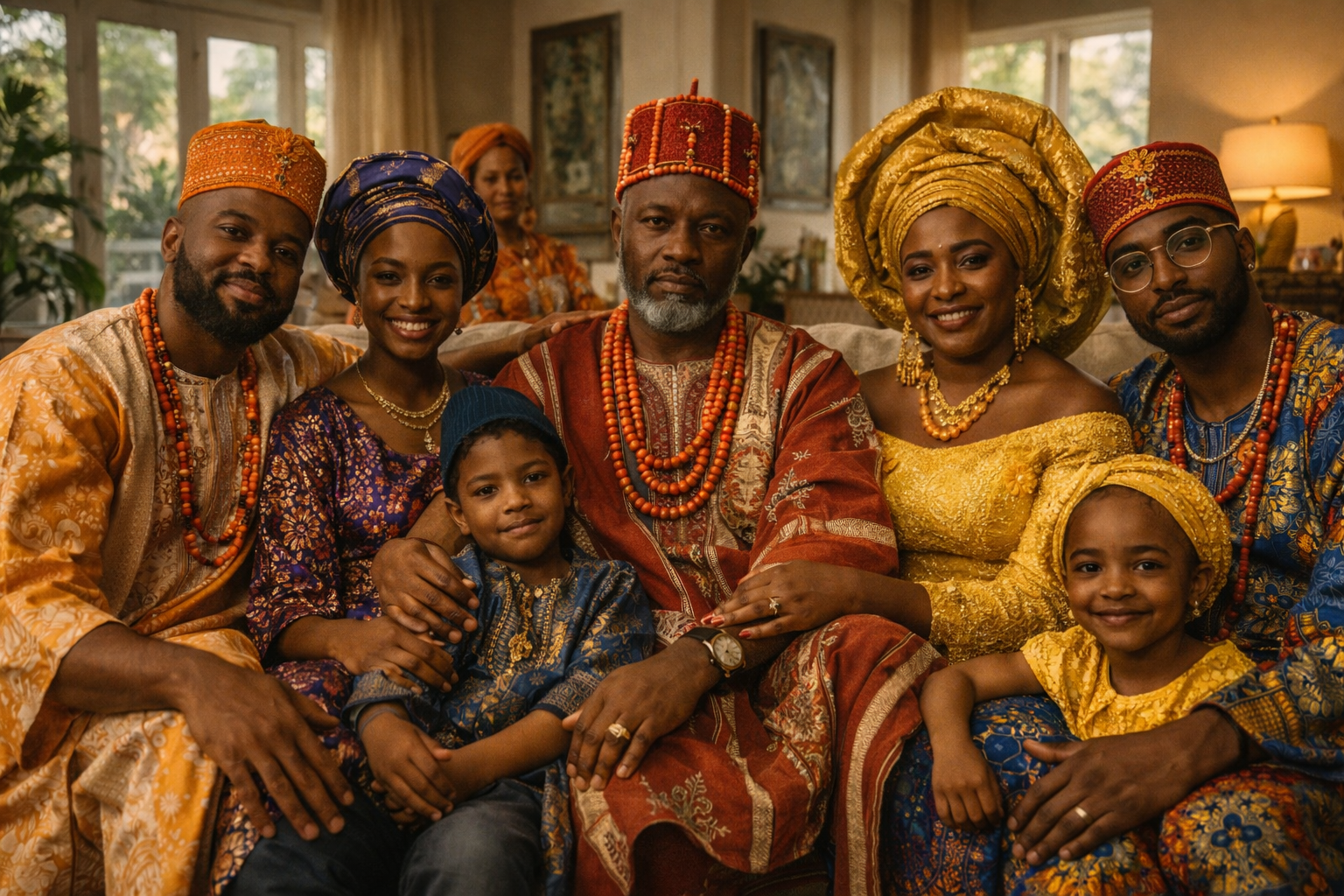
Look at the photograph. A family gathered in a warm interior space, dressed in full ceremonial regalia. The aso-oke fabric, woven in gold and red and blue and orange, the kind of textile that takes skilled hands a long time to produce and is worn when the occasion demands that you show up as your full self. The gele headwraps on the women, architectural and deliberate, each one a small feat of construction. The coral beads layered at the neck, which in Yoruba culture are not jewelry in the decorative sense. Coral beads signal royalty. They signal proximity to the Orisha. They are worn at ceremonies where the boundary between the human and the divine is intentionally thin.
The AI reached for the most visually spectacular version of Yoruba identity, the ceremonial one, and this is one of the few moments in this series where that instinct was actually correct. Because Yoruba culture genuinely centers visual richness as a form of spiritual expression. The cloth is not decoration. The beads are not accessories. The colors are the names of the gods. When you dress in gold you are invoking Oshun. When you dress in red you are invoking Shango. The visual language is the theological language, and the AI, without knowing any of that, reached for exactly the register where those two things coincide.
Now look at the specific figures.
The patriarch at the center in red, bearing the particular stillness of someone accustomed to authority without needing to perform it: that is Shango. The double-headed axe is not in the frame but the quality is. The gravity. The sense that when this man speaks the room recalibrates.
The woman beside him in gold, centered and radiant, the one the composition keeps returning to even when you try to look elsewhere: that is Oshun. Youngest of the major female Orisha and in some narratives the most powerful. The gold is not coincidence. The AI did not know it was making a theological argument. It made one anyway.
The figures in blue in the frame suggest Yemoja, the mother of waters, whose colors run through the image the way water runs through everything, present everywhere, not always the first thing you notice.
Eshu is harder to place, which is appropriate. He is the one who operates at the edges of the frame, at the threshold, in the space between one thing and another. The child with the open expression watching everything, or the figure at the margin of the composition who seems to be observing rather than participating. Eshu is always present. He is not always obvious about it.
Now note what the AI did not do. It did not attempt to render the Orisha directly with their iconographic attributes. No double-headed axe. No coral-beaded divine figure rising from the ocean. No opele chain. It stayed with the human family and let the clothing and the color carry the theological weight. That is, without the AI knowing it, the theologically correct choice. Because in Yoruba practice the Orisha are not separate from the human. They move through the human. In possession ceremonies the Orisha enters a devotee and speaks and acts through that person's body. The divine is not up there looking down. It is in here, moving through the fabric, the beads, the color, the gathered family on a ceremonial day.
Consider also the contrast with the Iraqi image. That family was caught mid-activity, serving food, a child with his head down, tea already poured, the meal already in motion. This family is dressed for something. The Mesopotamian tradition gets rendered as intimacy. The Yoruba tradition gets rendered as ceremony. Both readings are accurate. Both tell you something about what the AI's aggregate training data understood about each culture, what it reaches for when you say Iraq, what it reaches for when you say Nigeria. One culture's deepest expression is the dinner table. The other's is the ceremonial gathering where the clothing itself is a form of prayer.
Neither is a stereotype exactly. Both are true. The interesting question is what gets left out when only one truth fits in the frame.
The Middle Passage
Millions of people from West Africa were enslaved and transported across the Atlantic between the 16th and 19th centuries; the broader forced migration carried about 12.5 million Africans onto slave ships, with roughly 10.7 million surviving the Middle Passage. Yoruba people were among those forced into that crossing, especially in the later centuries of the trade, with large concentrations landing in Cuba, Brazil, Trinidad, and other Caribbean islands. They arrived with nothing that could be carried in a trunk or a bag. They arrived with what they could carry in memory. The Orisha came with them. The Odu came with them. The songs came with them, in some cases in the Yoruba language, which would no longer be spoken as a daily tongue but would be preserved in ritual context for centuries, kept alive in the mouths of people who no longer spoke the language but knew exactly what they were saying when they sang.
The colonial and ecclesiastical project was total conversion. Baptism was mandatory. African religious practice was prohibited. The penalties for practicing it ranged from severe punishment to death depending on the colony, the era, and the disposition of whoever held power that season. The traditions that had survived thousands of years in West Africa were now contraband.
The response was one of the most sophisticated acts of collective intelligence in religious history. Enslaved Yoruba practitioners mapped their Orisha onto Catholic saints. Not randomly. With precision. Shango, god of thunder and lightning and justice, became Saint Barbara, the Catholic martyr associated with storms and sudden death. Yemoja, mother of waters, became Our Lady of Regla, the Black Madonna venerated at a coastal shrine in Cuba. Oshun, goddess of fresh water and love and gold, became Our Lady of Charity, Cuba's patron saint, whose shrine still stands at El Cobre. Eshu/Elegba, guardian of crossroads and communication, became Saint Anthony or Saint Peter depending on the tradition, both figures associated with thresholds and passage. The correspondences vary by region, but the pattern itself is well documented; World History Encyclopedia summarizes the Orisha-saint pairings, while Britannica's Santeria entry traces the Cuban tradition through the correspondences devotees made between Yoruba Orisha and Roman Catholic saints.
The images on the altars were Catholic. The candles were Catholic. The prayers were said in Spanish or Portuguese. The entity being addressed underneath all of it was Yoruba. The slave owners saw the saints. The practitioners knew exactly who they were talking to.
This was not compromise. It was not corruption or dilution or the desperate scrambling of a broken people trying to hold onto something. It was encryption. A deliberate, sophisticated, collectively maintained code that made the practice invisible to the people who held power over life and death. It worked. The Orisha did not disappear. They went underground and they waited and they came back up when the pressure lifted, wearing the faces of Catholic saints like a coat they could take off when the door was closed.
What came out the other side was not identical to what went in. It could not be. Four centuries of suppression, displacement, and adaptation leave marks. But the theological core survived. Olodumare at the top. The Orisha as intermediaries. The possession ceremony where the divine enters the human body and speaks. The offerings, the colors, the songs, the specific relationship between practitioner and deity that Ifa encodes. All of it crossed the Atlantic and all of it came back up.
In Cuba it became Santeria, more formally called Lucumi or La Regla de Ocha. In Brazil it became Candomble, practiced most visibly in the state of Bahia where the Yoruba influence on the culture runs so deep it is visible in the food, the music, the architecture, the festivals, the way people move through the world. In Trinidad it became Trinidad Orisha. In Louisiana the picture is more complicated. What is called Louisiana Voodoo emerged from a much more mixed religious world, shaped by West African and Central African traditions, Haitian influence, French Catholicism, and contributions from Fon, Ewe, and Kongo peoples as much as from the Yoruba. It belongs to the same Atlantic survival story and it emerged from the same historical conditions. But it is not as directly Yoruba-derived as Lucumi or Candomble, and treating it as such would flatten distinctions that the people who practice it have always understood.
These are not corrupted versions of the original. They are not pale imitations or folk superstitions dressed up in borrowed theological language. They are what a living tradition looks like after it has survived the unsurvivable. They are the Orisha on the other side of the Atlantic, still recognizable, still practicing, still present.
There is something else worth naming here, something that cuts across all the historical and political weight of this section. Of all the traditions examined in this series, the Yoruba system is probably the closest to what we mean when we use the word mysticism in its truest sense. Not mysticism as a vague synonym for spiritual feeling, but mysticism as direct, unmediated experiential contact between the human and the divine. The Orisha do not stay at a distance. They enter. They speak through human bodies. They are present in the physical world in ways that most Western religious traditions reserve for miracles, for exceptional saints, for rare and unrepeatable moments of grace. In Yoruba practice and in all the diaspora traditions that descended from it, that contact is the normal mode of operation. It is what the tradition is built around. And that directness, that refusal to keep the divine safely abstract and distant, is probably a significant part of why it survived everything that was done to try to destroy it. You can prohibit a religion. It is considerably harder to prohibit an experience.
The Tradition Today
In Nigeria, Ifa is not a relic. It is not folklore preserved in amber for the benefit of anthropologists and cultural tourism. It is a functioning religious system practiced in the present tense. Ile-Ife, the city in Osun State in southwestern Nigeria considered sacred in Yoruba cosmology as the origin point of humanity itself, remains an active center of Orisha worship and Ifa practice. The Osun-Osogbo Sacred Grove, held by UNESCO to be an active religious site with daily, weekly, monthly, and annual worship, draws practitioners and observers for the yearly festival dedicated to Oshun. It is not a reenactment. It is a living ceremony dedicated to Oshun, conducted by active priests, attended by active believers, producing active spiritual experience.
The babalawo and iyanifa are still working. The opon Ifa trays are still being carved. The opele chains are still being cast. The Odu are still being recited from memory by diviners who spent years learning them, passing them to apprentices who will spend years learning them in turn. The oral transmission that carried this corpus across millennia is still functioning. That is not a small thing. That is one of the longest continuously maintained knowledge transmission systems in human history, still operating, in Lagos and Ibadan and Ile-Ife and in Yoruba diaspora communities across the world, right now, today.
The religious picture inside Nigeria is complicated in the way that living religious pictures always are. The country is roughly split between a Christian south and a Muslim north, with the Yoruba in the southwest navigating all three traditions simultaneously and not always experiencing that as a contradiction. Many Yoruba Christians and Muslims maintain Orisha practices alongside their adopted faith. They consult Ifa diviners. They observe festivals. They make offerings. They attend church on Sunday and address Eshu at the crossroads when the situation calls for it. The colonial missionary project spent centuries trying to make that kind of layered practice impossible and largely failed at the root level. The Orisha are not in competition with Christ or Allah in the minds of many practitioners. They address different things. They operate at different registers of experience. People use what works.
In the diaspora the picture is equally alive and considerably more geographically dispersed. Candomble in Brazil has millions of active practitioners, concentrated most heavily in Bahia but present across the country. The February 2 festival of Iemanja on the beaches of Salvador draws huge crowds, people of many backgrounds sending offerings out to sea on small boats, flowers and candles floating toward a goddess who made the crossing centuries ago and stayed. Santeria in Cuba and in the Cuban diaspora communities of Miami, New York, and Los Angeles has moved well beyond its original community. Britannica notes that after the Cuban Revolution nearly one million Cubans left the island, carrying Orisha religion into cities across the Americas, and that initiated devotees likely number in the tens of thousands while those who consult an Orisha may be counted in the millions. There are initiated practitioners of Lucumi in American cities who are not of African or Caribbean descent, drawn to the tradition through its directness, its psychological sophistication, its refusal to keep the divine at a safe abstract distance.
The tradition that was carried across the Atlantic in chains is now crossing borders in every direction. The Orisha who went underground under colonial suppression and wore the faces of Catholic saints to survive are visible again, practiced openly, studied seriously, recognized by UNESCO, generating academic literature, initiating new practitioners on multiple continents. They made it. Not as museum pieces. As living gods with active congregations.
That is what survival looks like when it is complete.
What the Mirror Shows
Pull back for a moment and look at what the AI actually did here.
When prompted for a contemporary Yoruba family it produced an image of people dressed in ceremonial regalia, in historically accurate textiles, in the correct colors of the correct Orisha, gathered in a warm interior space that reads as prosperous and rooted and connected. It did not produce poverty. It did not produce a village. It did not produce the specific kind of condescension that Western visual culture has historically defaulted to when representing sub-Saharan Africa, the suffering, the lack, the need for outside intervention. It produced a family dressed for something important, centered in their own dignity, beautiful in a way that is entirely on their own terms.
That is not nothing. In fact for a series that has been tracking what the AI reaches for when you name a culture, this is one of the more surprising and encouraging results. The aggregate training data, which is to say the aggregate of what humanity has produced and uploaded and digitized and made available, apparently contains enough contemporary Yoruba visual culture, enough Nigerian fashion photography, enough documentation of Egungun ceremonies and Osun festivals and Yoruba weddings and naming ceremonies, to pull toward accuracy rather than stereotype when asked.
Compare that to what Hollywood has done with African religious traditions for the past century. Voodoo dolls. Witch doctors. Drumming as threat rather than theology. The specific cinematic grammar that codes African spiritual practice as primitive, dangerous, and in need of a Western protagonist to either defeat it or be saved from it. The AI did better than Hollywood. That remains a low bar. It is still worth noting.
There is also an economic irony worth a passing note. The tradition that colonial powers tried to eradicate as primitive and worthless now drives significant cultural economies across multiple continents, in Brazilian festival tourism, in the global reach of Afrobeats, in the fashion industry's periodic rediscovery of aso-oke and adire textiles, in the initiatory networks of Santeria that operate across the United States. The tradition survived. It is also, by any measure, winning.
What the AI could not render is the depth. The image is beautiful and it is accurate at the surface level and it tells you almost nothing about what Ifa actually is, about the 256 Odu and the oral corpus attached to each one, about the Ifa diviner who spent twenty years memorizing what no text could fully contain, about the possession ceremony where a grandmother's body becomes the vehicle for Yemoja and she speaks in a voice that is not hers about things she could not know. That depth does not fit in a family portrait. It never could.
But here is what the image does capture, even without intending to. The clothing is the theology. The beads are the prayer. The colors are the names of the gods. A family assembled in aso-oke and gele and coral beads is not just dressed up. They are making a statement about what they carry, about what has been handed to them and what they intend to hand forward. The AI rendered that transmission without knowing it was doing so. It saw the surface and the surface, in this tradition, is never only the surface.
That is the Yoruba mirror. It is more accurate than most. It is still only a reflection. The thing itself is considerably more alive than any image can hold.
Closing
The Orisha crossed the Atlantic in the holds of slave ships. They arrived in Cuba and Brazil and Trinidad with nothing but the memory of the people who carried them. They went underground. They put on the faces of Catholic saints and learned to be invisible to the people who held power over life and death. They waited. And when the pressure lifted, even partially, even incrementally, they came back up. Not as museum pieces. Not as folklore. As living gods with active congregations, active priests, active ceremonies happening right now on multiple continents in multiple languages in communities that have never stopped practicing.
The Yoruba tradition is one of the oldest continuously practiced spiritual systems on the planet. It generated a divination corpus of staggering complexity that UNESCO felt compelled to recognize as a heritage of all humanity. It produced theological architecture sophisticated enough that when you map it against Hinduism or against the medieval Christian mystics or against the I Ching the parallels are not superficial. They are structural. They point toward something that multiple civilizations arrived at independently because the underlying human need it addresses is that fundamental.
And almost none of it was taught in Western schools. Not because it was unknown. Because it was inconvenient. Because the civilization that produced it was the same civilization that was being enslaved and colonized and stripped of its history in real time, and it is considerably easier to do those things to a people if you have first established in your own mind that they do not have a theology worth taking seriously.
The family in the image is dressed for something important. The cloth is the theology. The beads are the prayer. The colors are the names of the gods. You do not need to know any of that to be standing in it. But it helps to know. It helps to know what was carried across that ocean and what it cost to carry it and what it means that it is still here.
The Orisha made it. So did the people who refused to let them go.
Next in the series: The Aztec Pantheon: What the Algorithm Erased.