
Two Bullets
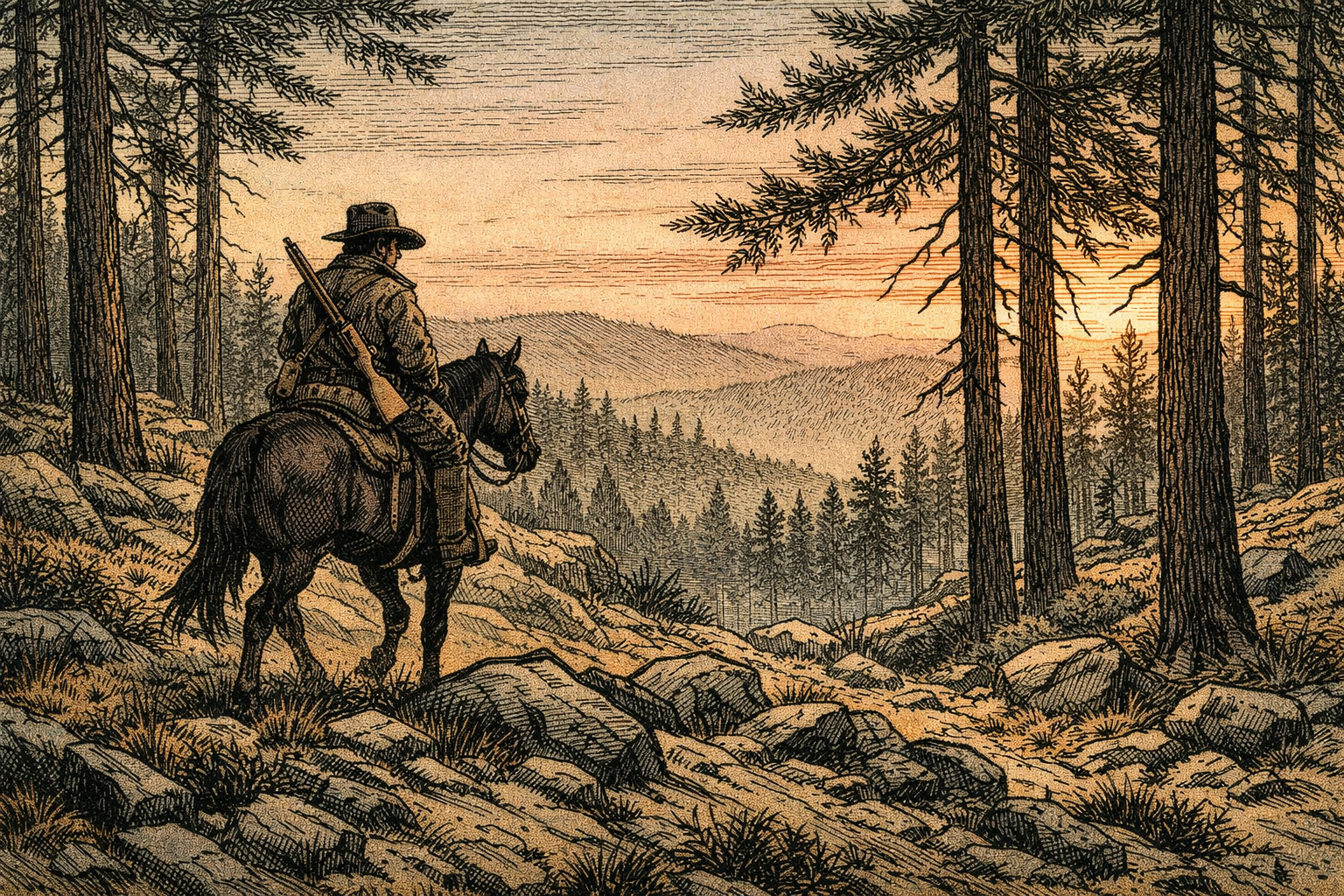
He walked into the mountains alone. He carried a rifle and two bullets.
The first bullet was for the deer. One shot. If he missed, he did not deserve it - that was his rule, self-imposed, unwritten, absolute. No one had given it to him. No one was there to enforce it. He held himself to it anyway, every time, because that was the kind of man he was.
The second bullet was for himself.
Not out of despair. Not as a dramatic gesture toward his own mortality. Out of realism, plain and functional, the same realism that told him to check the weather before he left and to know where water was before he needed it. He knew where he was. He knew what could happen on a ridge in country that does not register whether you return. A fall on loose shale. An animal. A wrong step at the edge of something. No rescue was coming. If something went wrong out there, that was simply the nature of where he had chosen to walk.
He did not talk about this in town. It came out the way things come out between men in that place and time - around a fire probably, late, answering a question rather than volunteering anything. It landed with his son. His son carried it for decades. His son told me last year, for the first time.
Some inheritances arrive as stories, and some arrive as a word carried home from somewhere far away.
That is the whole essay in miniature. Everything else is explanation.
My grandfather was born in 1889 in Eastern Oregon. He came from a large family - his mother began having children around 1881 and continued well into the 1890s, and he sat somewhere in the middle of that group. Several siblings did not survive childhood. This was not unusual. It was not dwelt upon.
His mother was a schoolteacher, which is either ironic or perfectly logical depending on how you look at it. She had the knowledge and the vocation and the genuine intent to educate her children. She also had nearly a dozen of them, in a place that made everything harder, in a time that asked more of mothers than most people now can imagine. Her son reached sixth grade and stopped. Not from lack of intelligence. From the arithmetic of necessity. What she could not give him in formal knowledge, the land gave him in something else - no grades, no textbooks, just seasons and animals and weather and the ongoing practical problem of feeding a family in country that offered no credit for effort, only results.
He spent his life in the high desert country of Eastern Oregon - Vale, Juntura, the surrounding territory of Malheur County. He was by all accounts a stoic man. Private. Reliable. Not given to performance of any kind. He was also, by any measure, one of the finest rifle shots in the region - not a hobby, not a sport, but a skill practiced nearly every day from childhood because the stakes were real.
He died three years before I was born. I never met him. I knew his wife, my grandmother - salt of the earth, present in my life, a silhouette of who he was by proximity and the things she did not say as much as the things she did. I have a few photographs. They show his face, the set of his jaw, the way he held himself. They do not show his interior. What I know of him has arrived in fragments: reputation, behavior, secondhand description, and one story about what he carried when he hunted alone.
I am trying to reconstruct a mind from those fragments.
Eastern Oregon in the late 1800s and early 1900s is not a romantic backdrop. The distances are real distances. The temperatures are real temperatures. The isolation is not a feeling but a fact measured in hours and miles.
No electricity reaching most of where he lived. No radio, no film, no recorded music, no telephone in any everyday sense. An occasional newspaper, days or weeks old by the time it arrived. A book if someone had thought to bring one from somewhere that had them.
When you were alone, you were alone with your own mind. Not alone with a phone and its ten thousand escape routes. Not alone with a feed that replenishes itself the moment you reach the bottom. Alone - with whatever was already in your head and whatever you could build from it.
Silence was not something he chose as a practice. It was the condition of his existence, the way weather was a condition and distance was a condition. The stillness was already there, every day, and the question was only what he would do with it.
The answer was philosophy. He just never called it that.
Sixth grade. That is the institutional measure of his education, and it is not a flattering one.
But there are two kinds of education and we tend to treat only one of them as real.
Institutional education transmits accumulated knowledge - frameworks, vocabulary, context, centuries of trial and error compressed into something absorbable. It is genuinely valuable. It is not the only path to depth.
The other kind has no comfortable name. Call it the education of consequence. It transmits discipline, pattern recognition, realistic assessment of risk, emotional regulation under pressure, the habit of seeing conditions as they are rather than as you wish they were. It does not give you vocabulary for what you know. It gives you the knowledge first and leaves the vocabulary to others.
Survival in that environment required exactly the things philosophers have spent centuries trying to teach: discipline - doing the necessary thing whether or not you felt like it; realism - accepting what is rather than what you prefer; emotional control - because panic is a luxury the terrain cannot afford you; acceptance - understanding which things are within your power and releasing the ones that are not.
These are not frontier platitudes. They are the core of Stoic philosophy, arrived at without ever hearing the word Stoic, developed in a place that had no library, refined over a lifetime of walking alone into country that would not carry you out if you fell.
He lacked schooling. He did not lack depth.
Go back to the two bullets.
The first one is about skill and a standard he set for himself with no external enforcement. One shot. If he misses, he does not deserve the animal. He was exceptional with a rifle - not because he had been trained by anyone but because he had been practicing since childhood and because the stakes were real. He could make the shot. He knew he could make the shot. He held himself to one chance anyway.
This is what philosophers call virtue: the thing you do when no one is watching, because you have decided who you are and you live inside that decision regardless of whether anyone sees.
The second bullet is about what happens when you are honest enough with yourself to acknowledge the full reality of where you are. He knew the terrain. He knew that life does not make exceptions for good intentions or for the fact that your family is waiting at home. A fall, a wrong encounter, a sudden change in conditions - any of these could end a trip that started like every other trip. He accepted this the way he prepared for weather - not with drama, not with despair, but with the flat acknowledgment that it was part of the situation.
The Stoics called this memento mori - the deliberate awareness of death held close not to induce fear but to strip away everything that distraction accumulates around a life, leaving only what is essential. Marcus Aurelius returned to it constantly in his private journals. Epictetus built an entire philosophy around the acceptance of what is not in our control, including the hour and circumstances of our death.
My grandfather almost certainly never heard of either of them. He practiced what they described every time he loaded the rifle.
The two bullets together form a complete philosophy. Control what you can - your skill, your preparation, your standard, your one shot. Accept what you cannot - the terrain, the animal, the weather, the thousand ways a mountain can end a person who is paying less than full attention. Do not pretend either truth is not there.
He never named this. It came out at a fire, answering a question, and then it was over. The philosophy was embedded in the behavior, invisible to him, legible only from the outside and only in retrospect.
Epictetus was a slave in Rome in the first century. He taught that the only things truly within a person's control are their own judgments and responses - everything else must be accepted as outside your domain. Marcus Aurelius was a Roman emperor who had every text and teacher available to him, and who wrote privately about discipline and mortality and the obligation to act rightly regardless of outcome or audience, never intending publication.
Both were working in a tradition with texts and lineages and centuries of accumulated refinement. They were in a conversation with the past.
My grandfather was in a conversation with the landscape.
He arrived at the same conclusions. Act from your own standard regardless of whether anyone is watching. Hold the reality of death close and let it clarify rather than paralyze. Control what is within your power and accept what is not. He got there without the tradition, without a vocabulary for what he was working out, without any awareness that anyone else had worked out something similar.
Marcus Aurelius had access to every library in the Roman world. My grandfather had ridges and silence and consequences. The distance between their conclusions is not very large.
Certain truths do not require literacy. They require exposure to reality at sufficient depth and duration.
He did not tell the two-bullet story in town. This detail matters more than it might seem.
A lesser man might have made something of it - worked it into his reputation, let it become part of a local identity. He kept it quiet. It came out at a fire, in country, answering a question. He said what was true and then it was over and he did not make it into anything more.
The Stoics wrote about the discipline of speech: say what is necessary, no more; do not perform your wisdom; let what you do carry more weight than what you say. He lived that principle without knowing anyone had thought it worth writing down.
His silence was not emptiness. It was integrity.
I keep thinking about the chain of transmission. He said something true at a fire somewhere in Eastern Oregon, sometime in the first half of the last century. His son heard it and held it for decades. Last year his son told me. I am the third person in this chain.
What else did he carry that was never passed on? What other things did he work out, alone on those ridges, that ended with him because no one happened to ask the right question at the right fire?
I am working from the fragments.
He was born in 1889. My father was born nearly fifty years later. I was born more than thirty years after that. He died three years before I arrived.
That gap means I am not writing about someone I knew. I am reconstructing a person from what has survived the distance - photographs, reputation, secondhand impressions, and one story about two bullets.
The photographs show a man. The face, the posture, the context. They do not show the interior. Looking at them, I see someone who appears to have thought about things. I am aware I may be projecting. I am also aware that projection and legitimate perception can coexist.
Pre-Socratic philosophers survive mostly in fragments - sentences quoted by later writers, ideas reconstructed from what others said about them. We do not have Heraclitus whole. We have shards and we do our best with them.
He is my pre-Socratic. I am working from the shards.
About fifteen years ago I walked a ridge in Eastern Oregon with my father and a rifle. It was the last time I hunted. The country there does not flatter you or pretend that your presence in it is anything other than temporary and conditional. The scale is too large for that.
The wind comes without announcement. The ground changes underfoot in ways that require you to watch where you step rather than where you are going. The distances in every direction go on past the point where detail is visible. You are aware, in a way that is difficult to be aware of elsewhere, that no one knows exactly where you are.
That ridge - or one very much like it - is where he walked. Not in that decade, but the same ground. The high desert does not change the way cities change. The silence that shaped him is still available, still asking the same thing of anyone willing to stand in it long enough.
I have been where he might have stood. I cannot claim to know him from this. But standing on a ridge like that, alone, with a rifle and the full awareness that no one is coming if something goes wrong - you understand something about the texture of his daily reality that is difficult to arrive at any other way. The noise that normally occupies the unused parts of your mind goes quiet. Not because you have meditated it away. Because the terrain is asking for all of your attention and there is nothing left over for distraction.
He lived in that state not as a retreat or a practice but as the condition of ordinary life.
I want to be careful here, because what follows is easy to say badly.
Over the years I have kept practices that reduce the noise - limited media, deliberate quiet, meditation, various contemplative approaches that have accumulated over time. I have had what I can only describe as mystical experiences - moments that fall outside ordinary cognition, carrying a quality of clarity or expansion I do not have better words for and am not going to oversell.
The conditions under which such experiences tend to occur, across traditions and centuries, share a family resemblance: solitude, silence, physical engagement with landscape at a scale that reduces the self to appropriate proportion, the proximity of real consequence, the absence of distraction and the resulting confrontation with one's own unmediated mind. Monks build monasteries in mountains for reasons that are not only aesthetic.
He walked into those conditions every time he went out. Not as spiritual practice. As breakfast preparation, essentially.
I wonder - carefully, without claiming to know - whether the ridge ever gave him something beyond the practical. Whether the silence that produced his philosophy also produced, on some morning or evening, something he would not have had words for and would not have mentioned at any fire. I leave it as a question rather than an answer because that is what it is.
Every time he walked out, he made certain assumptions: no rescue is coming, there is no margin for error that someone else will absorb, I may not return and I have made my peace with that before I take the first step.
These were not dramatic statements. They were operational - the same category of acknowledgment as checking the weather. But the repeated, genuine, fully inhabited acceptance of real consequence does something to a person over time. It produces a particular quality of attention. It produces, eventually, a particular kind of person - someone for whom the essential questions have been asked and answered because the situation required it.
Modern life has, rightly and at great effort, reduced the immediate physical stakes of most daily existence. These are genuine goods. But something accompanies the reduction of genuine risk that we do not discuss much. The conditions that shaped him - isolation, silence, consequence, the complete absence of anything to distract him from his own thinking - are mostly gone. And what goes with them is not just the hardship.
He had no choice but to be alone with his mind. Distraction is now the default. Silence is the thing that requires effort, chosen deliberately and maintained against the current of everything designed to prevent it. What he had by default, I have to build every day. I am not sure I fully succeed. I am not sure most of us do.
He walked into the mountains alone. He carried two bullets.
He was not performing anything, not making a statement, not living deliberately in any self-conscious sense. He was going to get food and being honest about the conditions. The philosophy was what grew in the silence around those facts, over decades, in a landscape that had no interest in his interior life and therefore gave him complete freedom to develop it.
Epictetus wrote about it. Marcus Aurelius practiced it in private journals he never meant for anyone to read. Contemplatives have sought the conditions for it in mountains and deserts for centuries. He found it anyway - without the texts, without the tradition, without a vocabulary for what he was working out or any awareness that others had worked out something similar.
He mentioned it at a fire. His son carried it for decades. His son told me last year.
What he believed was not written down. It was carried. It arrived to me as a story about two bullets and a rule about shooting and a flat acknowledgment of where he was and what that meant.
Silence is not empty. It is where thinking happens.
We may be losing the conditions that produce people like him. I am not sure we have noticed.
He walked into the mountains alone. He carried a rifle and two bullets.
Neither of them was symbolic to him.
That was exactly the point.