
The Evangelist Conundrum
A few weeks ago I sat down with a close coworker, a member of my immediate paralegal team, and walked her through her first real document review using Claude. The job was more than 200 voluminous Teams messages exported from Exchange, and the client wanted to know what its employees had been saying about each other. Some of it was ugly: gossip, cursing, racist remarks. So part of the task, at the client's request, was having Claude search for swear words.
Our environment does not let Claude reach the shared drive, so we started by building a folder on her C drive. Then we worked through the steps together: get the files in, have Claude read them, have it build an Excel sheet laying out each message. Everything went smoothly until we noticed Claude was flagging the word "assign." It had been told to look for "ass," and it was dutifully finding it everywhere, tucked inside perfectly innocent words. The fix was simple. We asked it to search for whole words only. It had not occurred to either of us until we saw the results. We laughed about it and moved on.
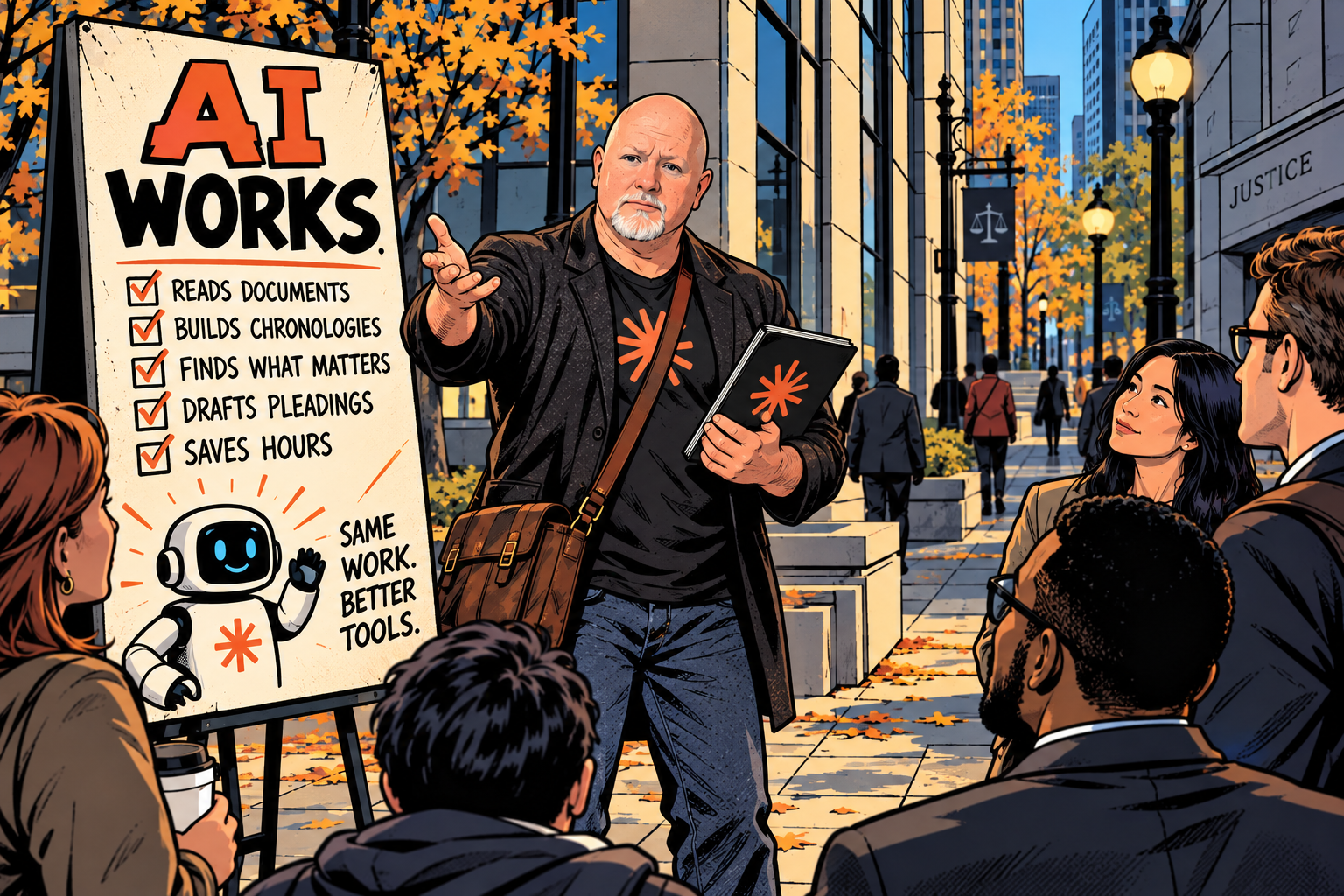
Now she goes around the office telling everyone how amazing it is. She has seen the light. And watching her, I felt something I have felt before, back when I was teaching someone else: that old, familiar sense of being an evangelist.
Our firm has a tool that estimates how much work I have done with Claude and how much time it saved me doing it. For the last several weeks, the report has said roughly the same thing: about 50 hours of work a week, and about 50 more hours saved. It is a real number, but it does not capture what the work actually looks like from the inside.
When I join a matter, I usually receive a pile of documents, and my first job is to get them into a shape that works for the attorneys and for Claude. I build a chronology, every document in date order. Claude does most of that work, and along the way it flags the problem documents, usually ones where the OCR failed and it cannot read them. Rather than spend the tokens to force it through, I open those myself and use my own judgment about the date, the relevance, the name. From there I run a chronology skill that turns everything into a spreadsheet the attorneys and I can work from, each entry hyperlinked to its document and carrying its own citation. I have built 1,000-entry chronologies this way in fifteen minutes.
That spreadsheet becomes the backbone of everything that follows: declarations, master declarations that individual declarations can be built from, sections of briefs, discovery requests. Claude is especially good at seeing the gap between the documents that should exist and the documents we actually have, which means better requests to clients and a more complete record. None of it happens in a straight line. I am running one thing while another processes, working in a separate chat, pulling in research from CoCounsel, Westlaw's AI. Multitasking has never been one of my strengths, and I am getting better at it anyway. I am adapting, and the adapting has made me more interested in my job, not less.
Here is the part that sounds dangerous. I now draft chunks of pleadings where I do not understand half of what the law means.
It works because of layers. Claude reads the pleadings and supporting documents and writes a research prompt for CoCounsel. CoCounsel does the deep research, produces a report, and then runs its own verification pass, sometimes correcting itself. That is the second set of eyes. I bring the research back to Claude, which checks it again through the CoCounsel connector. That is the third. Then I read it myself, looking for inconsistencies in the argument, and I have Claude double-check any quote that sounds too good to be true. So far, every one of them has checked out.
The cases hold up. What does not always hold up is interpretation, whether a case is truly on point. That is the judgment ceiling, and that is where the attorneys come in. Because everything is hyperlinked, it is easy for them to open the actual cases and decide for themselves. I trust the attorneys about 95 percent of the time. They have the training, and I do not. But I trust Claude a certain amount too, because it has no agenda. It is simply trying to be as clear and honest as it can. So when Claude keeps raising something the attorneys keep passing over, I push back until I get an answer that satisfies me.
I used to memorize cases. I knew every document, what happened and when, and I could put my hands on anything within a few minutes and check a fact from memory. That was my value. I have not read documents that way in a long while. I let Claude hold them, and I search the case through Claude over and over. The cases we get now are so large that memorizing them is not realistic anyway. Still, I would be lying if I said it did not worry me. If this all went away tomorrow, I would struggle, and the first place I would feel it is document management. Renaming PDFs used to eat enormous amounts of time, time that was always hard to justify billing for.
So in one sense, I have been replaced by a search bar. But I have always been an organizer, and it turns out organizing is exactly what makes Claude work well. The way I structure a matter is what lets it function at a higher level. I am no longer holding the case in my head. I am building the infrastructure that holds it. That is the heart of the work, and it is one reason the change feels both exciting and unsettling. I have written about what happens when AI changes the shape of judgment in The Access Gap and in Legal Slop; the same underlying issue keeps showing up in the work itself.
When I first started handing attorneys this kind of work, the reaction was disbelief. It was that good, and it came back that fast. Now the expectation is that something that would have taken three days will show up in an hour. And it does. People tell me I am killing it. I am in high demand. That feels good, and it is also a double-edged sword. It is so easy to knock something out quickly that the work compounds just as quickly. I am working ten-hour days, and when I stop, I have a much harder time letting go than I used to. My evenings have become a kind of processing mode: thinking through what I did, summarizing the day, trying to set it all down before sleep. It is Friday as I write this. I have the weekend ahead of me, and I may still have to work some of it. This is the part I am still learning to live with.
As this spreads through the firm, some of that pressure will ease. But nobody has really had the conversation yet about what happens when this level of productivity becomes normal. When that conversation comes, I hope compensation is part of it, tied to the goals of the firm. I have already gone to an attorney retreat, as a paralegal, to help get more people using these tools, because I believe they are good for the firm. The broader design question is the same one I raised in The AI Divide Is Real, But the Tools Are Part of the Problem: a tool can be useful and still be structurally biased toward dependence.
I have had almost forty years of contemplative practice, and much of it has been about slowing down, about being present with one thing at a time. This work is the opposite of that. It is fast and parallel, with something always running in another window. I have not figured out how the two fit together. I am still wrestling with it. This is also the part of the story people miss when they talk about AI as if it were only a productivity tool. It changes the tempo of attention itself.
What I tell the paralegals just getting access is simple. It is fun. It saves time, and sometimes it is honestly delightful. All of that is true.
Which brings me back to that evangelist feeling. I do believe in this. I can see what a paralegal might become in five or ten years, and much of it is good: better results, lower costs for clients, work I never would have attempted before. But a good evangelist should also be honest about the cost of conversion. I am still counting mine. I am also trying to remember that the real question is not whether the tools are good, but whether the institutions around them are built to keep them from making us shallower, more distracted, or more dependent than we intend to be. The future may be created by the tools, but it will be shaped by the habits we build around them. The best public-facing discussion of that tension I have seen is Vivienne Ming's work on AI adoption and the cyborg minority, which helps explain why the friction of a good tool matters more than the ease of a seductive one. And the most practical example in my own lane is Anthropic's Claude for Nonprofits initiative, which shows that the same technology can be used to expand access, not just accelerate output.