
Many Faces, One Mask
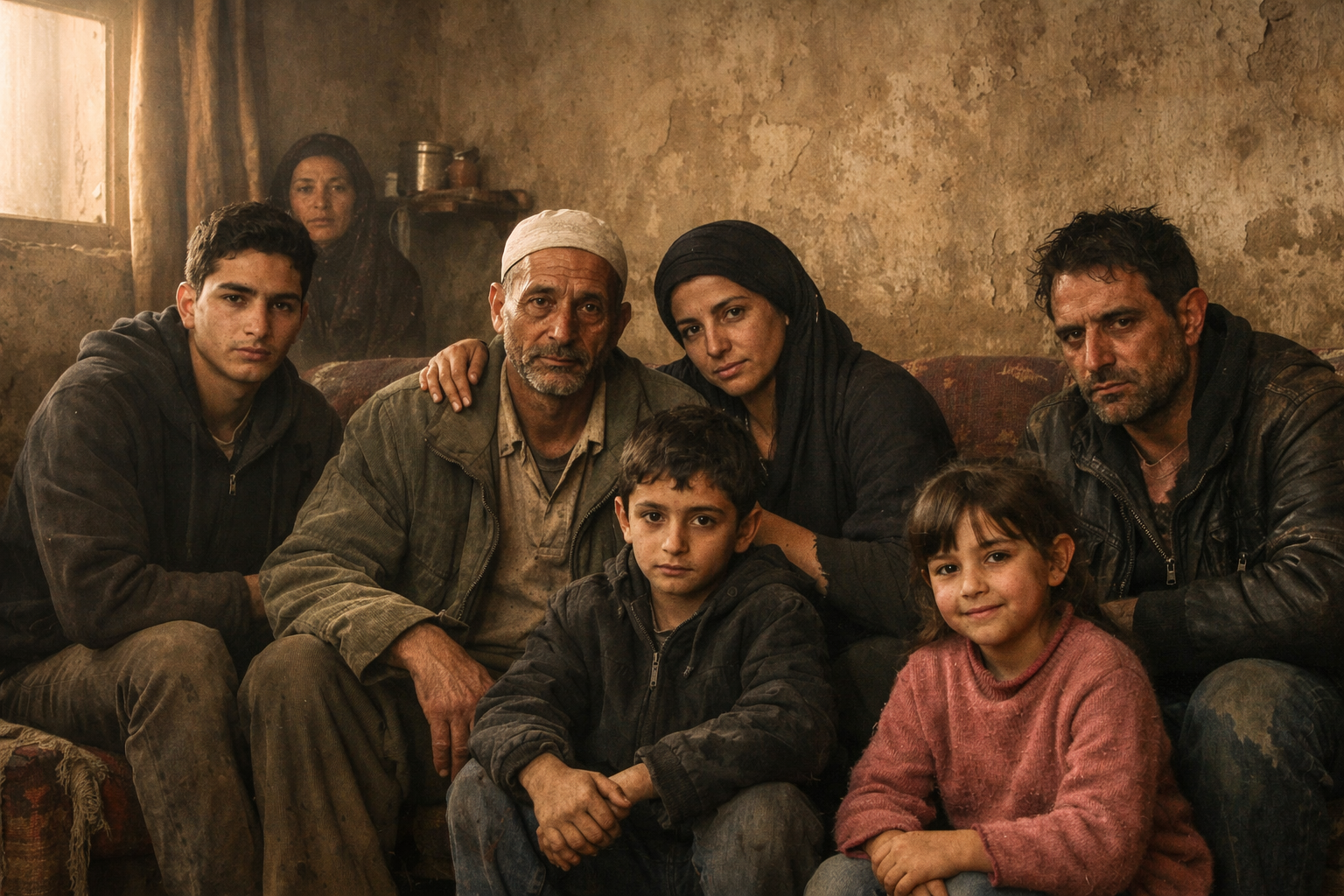
Not a Family
The last post gave you a family: Six Gods for Three Hundred and Thirty Million.
This one does not.
Or rather, it tries to, and something in the attempt reveals the problem. The Hindu system compressed cleanly into a domestic scene because it already allows for that kind of translation. Brahma creates, Vishnu sustains, Shiva transforms. The roles map onto recognizable human positions. You can seat those figures around a table and the structure holds.
The Egyptian system resists that move. Not because the gods are more powerful, but because they are more strange. What the AI returned is not a pantheon seated in splendor. It is a household seated in constraint. And the gap between those two things is worth sitting with.
The Egyptian Difference
Egyptian gods are not idealized humans. They are composites: human bodies with animal heads, symbolic forms carrying compressed theological meaning accumulated over three thousand years of continuous practice.
They are not personalities. They are functions.
Ra is not a man with power over the sun. He is the sun moving across the sky and through the underworld, dying each night and reborn each morning. Anubis is not a character with feelings about death. He is the process: the weighing, the embalming, the transition. Ma'at is not simply a goddess of justice. She is order itself, the cosmic principle against which every soul is measured.
And the pantheon is fluid. Gods merge, split, recombine. Amun absorbs Ra to become Amun-Ra. Osiris is simultaneously dead king, judge of souls, and promise of agricultural rebirth. Horus is son, avenger, and living pharaoh at the same moment. Regional traditions reshape identities constantly, so there is no stable cast, no fixed family tree. What exists is a network of overlapping roles, adapting to context, maintained through continuous ritual performance.
Which makes the AI's task here not just compositionally difficult, but conceptually impossible.
The Image: What Came Back
Look at the photograph.
A worn room. Cracked walls the color of dried earth. Light filtering in from a small window, cutting through the dimness without lifting it. A couch that has held more weight than it was built for. Seven people seated close together, not out of warmth but out of necessity. Clothes that are practical and layered. Faces that carry fatigue without announcing it.
Two children at the front. A young man on the left. An older man at the center with a white cloth on his head. A woman in a black headscarf leaning in. Another man to the right, dark jacket, dark eyes, a particular heaviness in the expression. A woman visible in the background, slightly apart.
The AI did not give you gods. It gave you constraint.
The question the image raises is not whether the AI failed. It is why it landed here, and what that landing reveals about what was lost on the way down.
What Gets Removed
The animal head is not decoration. It is meaning made structural.
The falcon head of Horus encodes sky, kingship, vision. The jackal head of Anubis encodes death, liminality, the edge of the desert where the living world ends. The crocodile aspect of Sobek carries danger and fertility in the same form, because the Nile carried both. Remove the animal, and you remove the function. What remains is a human figure with an unusual name.
The model has been trained away from hybrid forms: away from non-human anatomy, impossible proportions, structural distortions that violate photographic coherence. It reaches for legibility. So when asked to translate the Egyptian pantheon into a contemporary scene, it does not reach for the jackal head. It reaches for a brooding man in a dark jacket. The jackal becomes aesthetic residue.
But the deeper loss is not the animal heads. It is the motion.
Egyptian religion was procedural. The daily temple rites were not symbolic. They were maintenance. The priests fed the gods, clothed them, carried them in procession, because if the rituals stopped, the cosmic order they sustained would begin to unravel. Ra's nightly journey through the twelve hours of the underworld. The weighing of the heart against the feather of Ma'at. The preparation of the dead through seventy days of rites. These were not stories. They were mechanisms.
The AI produces a still image. The mechanisms stop. What remains are figures without their functions, people removed from the actions that gave them meaning. The image looks like a family. It does not look like anything is missing. But everything that made the original system theological is gone.
There is a name for what happened. Egyptian gods were embodied through masks worn by priests during ritual. The priest who donned the Anubis mask did not merely represent Anubis. He became Anubis for the duration of the rite. Divinity was something you entered, not something you permanently occupied.
The AI reads masks as faces. Transformation becomes literalization. A fluid, enacted, temporary state becomes a fixed identity. The gods are no longer processes moving through forms. They are people with faces, seated, finite, pinned to a moment.
The model takes what was designed to be worn and treats it as what is permanently there.
Why This Room
The Hindu post produced something affluent. Light, space, generational stability. The compression of that system landed on coherence, on a domestic scene that carries dignity even in its smallness.
This one landed somewhere harder. Egypt's economic picture is more complicated than this image implies: GDP growth is projected around 4 to 5 percent annually, and unemployment has fallen to around 6 percent, the lowest level since 1993. Those are not the numbers of a country in collapse. But roughly a third of the population fell below the national poverty line as recently as 2021/22, and persistent inflation has continued to squeeze households even as the macroeconomic indicators improve. That reality is visible in the photographic record, and the model draws from what it has seen. The AI is not making an argument about Egypt. It is reflecting imagery that carries a certain amount of poverty in it, and the gods inherit that.
In the Hindu case, compression produced warmth. Here it produces pressure. This is what the Egyptian system looks like after two compressions: first from theology to family, then from comfort to constraint.
The Gods as Labor
Look at the figures through a different lens.
The older man at the center: endurance, worn authority. The woman in the headscarf: stability under pressure, holding the shape of the household together. The younger men: burdened providers. The children: continuity without guarantee.
Egyptian gods were always defined by function. The AI preserves that instinct but translates the domain. Not weighing souls. Not sustaining solar cycles. Not guiding the dead.
Feeding a family. Keeping a roof. Making it through.
Ancient Egypt encoded meaning through iconography: animal forms, scale, standardized posture, color carrying theological weight. This image encodes meaning through material condition: the wear in the walls, the proximity of bodies, the particular quality of fatigue in a face that has learned not to perform. The symbolic system is gone. A different one, operating through sociology rather than theology, takes its place. Both are readable. Neither is neutral.
What the Mirror Shows
The Hindu rendering felt like a reduction. The system was simplified into something smaller, but the people in the image retained dignity and ease. The compression cost them complexity. It did not cost them stability.
This one feels like a downgrade, because the AI did not just make the gods understandable. It made them subject to circumstance.
The original system placed the gods above instability. They were what prevented it. Ra rose so the world could continue. Ma'at balanced so justice could persist. Osiris died and was restored so the dead could be transformed rather than lost. The divine was the mechanism against chaos.
This version places the gods inside it.
The gods became what they were supposed to prevent.
The model does not simply translate belief systems. It maps them onto current human conditions, and those conditions are not neutral. The distortions in these images follow the shape of what the model has seen, what it has been rewarded for producing, what it treats as normal. The gods inherit not just a cultural context but the model's estimation of what that context looks like at its most average.
That estimation is a record of something. Exactly what it is a record of is the uncomfortable question.
Toward the Celtic Post
The Egyptian pantheon exposes a different limit than the Hindu one did. Not simplification into familiarity, but grounding into visible reality. Not reduction toward warmth, but compression toward weight.
The next question is different: what happens when there is less visual strangeness for the model to erase, but a culture has already been packaged so thoroughly that the image has almost nowhere strange left to go?
That is the Celtic post. And the answer is lighter than anything we have seen so far. Not because the tradition is simpler, but because the exported surface is so familiar that the model treats it as the whole thing.
The mirror does not stop distorting.
It reveals a different problem.
Series so far: Rome · Norse · Hindu.
Next: The Celtic Pantheon: Fog, Stone, and Everything the AI Forgot