
The Celtic Pantheon: Fog, Stone, and Everything the AI Forgot
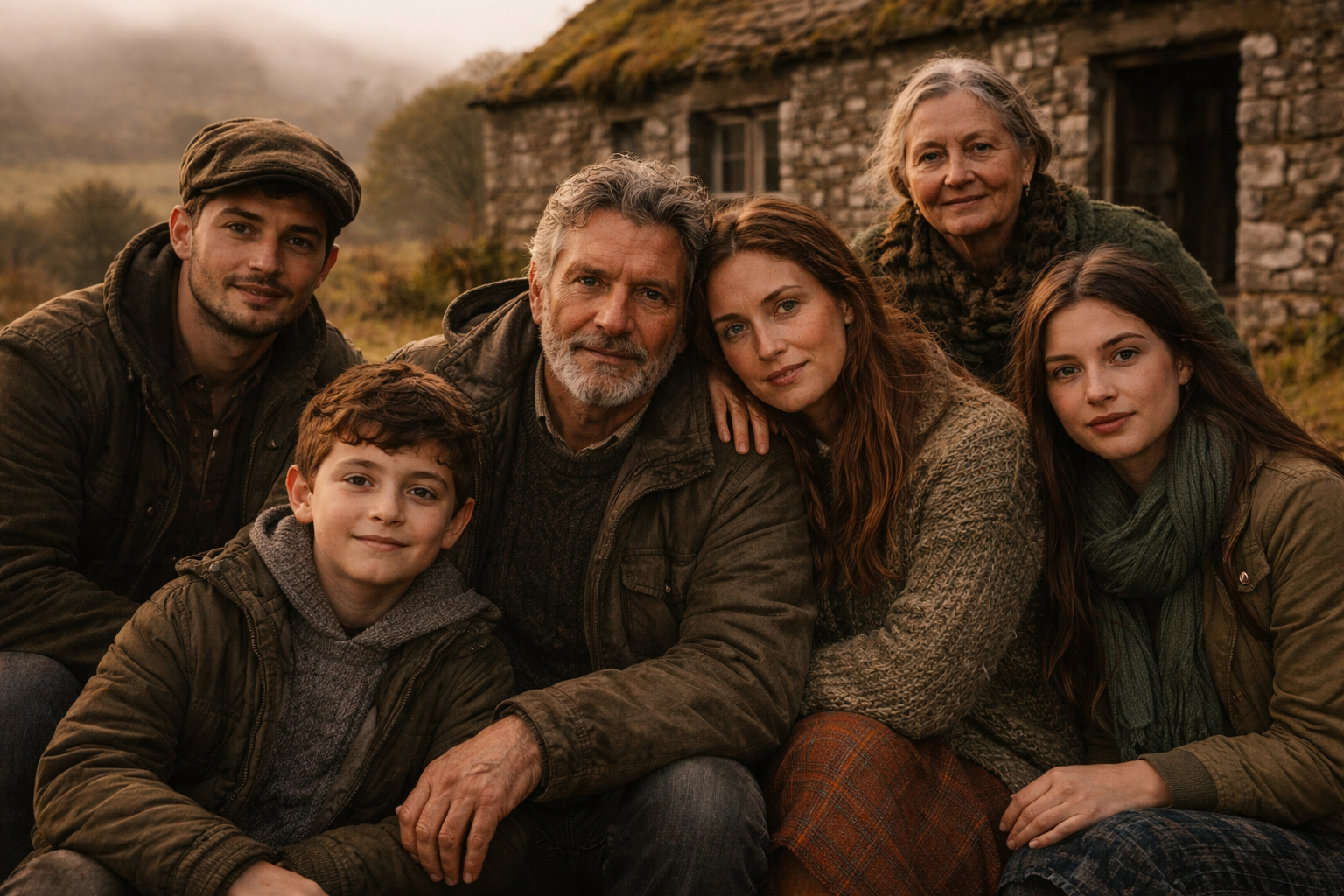
There is a series running on this blog, and if you are new here, the short version is this. A while back I was looking at some AI-generated images of the planets rendered as people, and something clicked. What if instead of abstract personifications of celestial bodies, you took the actual Roman gods those planets are named for and placed them in a contemporary family portrait with real economic and cultural grounding? The image that came back was not what I expected. Jersey Shore meets the Sopranos. That was not an accident. It was data.
So I started a series. Ten ancient pantheons, each one prompted into a contemporary family portrait, each one examined not just as art but as a kind of cultural mirror. The series also includes posts on Judaism, Christianity, and Buddhism. What does the AI reach for when you say Celtic? When you say Norse? When you say Hindu? The answers have been surprising, uncomfortable, and occasionally funny. The Roman post is a good place to start if you want the full context.
This one is the Celtic pantheon. And I have to be honest with you: it's the post I've been both looking forward to and dreading, because the image came back beautiful and completely boring.
What Came Back
Look at the image. Stone cottage with a moss-covered roof. Rolling misty hills. A multigenerational family bundled in earth tones, pressed close together, warm against the cold. Red hair. Green scarves. Everyone photogenic in that specific way that says ancient and wholesome simultaneously.
It is a lovely image. It is also exactly what you would expect. Every single element of it exists in a tourism ad somewhere. The AI reached into its training data and produced the most commercially successful, most exported, most thoroughly domesticated version of Celtic identity available. This is Ireland as a product. This is Scotland as a brand. This is the version that sells whiskey and genealogy tours and Outlander box sets.
There is nothing wrong with it, exactly. But there is nothing surprising in it either. And for a mythology that is genuinely one of the strangest bodies of sacred literature on the planet, that is a significant failure.
What Celtic Mythology Actually Is
Let me tell you about the Morrigan.
She is a goddess of war, fate, and sovereignty, and she is not the warm maternal figure you might expect from that last word. She shapeshifts into a crow. She appears on the battlefield not to fight but to unsettle, washing the armor of men about to die, hovering at the edges of the carnage with an intelligence that is neither cruel nor kind but something older and stranger than either. She propositions Cú Chulainn, Ireland's greatest hero, and when he rejects her she spends the rest of his life making things difficult for him, not out of spite exactly, but out of something that reads more like terrible interest. She is not evil. She is not good. She is a force with her own logic, and that logic does not care about your comfort.
Then there is the Dagda, a god of the earth and abundance who carries a club so large it has to be dragged on wheels. One end kills. The other end resurrects. He owns a cauldron from which no one ever leaves unsatisfied, and he plays a harp that controls the seasons. He is also frequently described as wearing a tunic too short for his enormous belly, wandering into situations that are essentially comic while also being cosmically powerful. Celtic mythology holds both of those things at once without embarrassment.
Cú Chulainn himself, in battle, undergoes something the texts call a riastrad, usually translated as warp spasm, in which his body literally distorts. One eye sinks into his skull, the other bulges out. His muscles rearrange. He rotates inside his own skin. It is terrifying and grotesque and the ancient Irish told this story as heroism, not horror.
The Otherworld, the Celtic realm of the supernatural, is not heaven. It is not the underworld. It exists sideways to this world, accessible through fairy mounds, through lakes, through certain kinds of fog. Time moves differently there. You go in for what feels like a night and come out to find a hundred years have passed. Or the reverse. The boundary between here and there is thin and unreliable, and the beings who cross it are not always doing you a favor when they invite you over.
None of this is in the image. Not one breath of it.
Why I Named My Son Finn
I have a son named Finn. When people hear it they usually think of a gentle Irish name, something soft and green, maybe a nod to heritage. That is not why I named him that.
I named him after Fionn Mac Cumhaill, known in English as Finn McCool, and the story that has stayed with me since I first encountered it is the one about the Salmon of Knowledge. The salmon has spent its whole life swimming in the Well of Segais, absorbing all the wisdom in the world. A druid named Finnegas has been trying to catch it for seven years. He finally does, and he gives it to the young Fionn to cook, with strict instructions not to eat any of it. Fionn burns his thumb on the skin, instinctively puts it in his mouth, and in that moment inherits everything. All the knowledge in the world, not because he sought it, not because he earned it through years of study, but because he touched the thing at the right moment and paid attention to the burn.
That is a myth about the nature of wisdom. It is also a myth about accident and readiness, about how understanding sometimes arrives sideways rather than through the front door. I find it more interesting as a piece of spiritual and psychological literature than most things written in the last two thousand years.
Fionn goes on to lead the Fianna, a band of warrior-poets, which is itself a concept worth sitting with. He loses the woman he loves to his most trusted companion in a story about desire and loyalty and the way those two things can destroy everything they touch. He is flawed in ways that matter. He carries his knowledge and it does not make him happy. That is not a tourist ad. That is a myth with genuine weight.
Why the AI Produced What It Produced
The image is not a failure of the technology. It is an accurate reflection of what the training data contains.
Celtic culture in the Western imagination has been processed, packaged, and sold for a long time. The raw material, the Morrigan's genuine menace, Cú Chulainn's body horror, the Otherworld's philosophical strangeness, got sanded off somewhere between the nineteenth century romantic revival and the modern heritage industry. What replaced it was something safer and more exportable. Mystical but not threatening. Ancient but approachable. Foggy enough to feel magical, domestic enough to sell.
The AI absorbed that version because that version dominates the data. It has seen a thousand stone cottages and a hundred Braveheart scenes and forty years of tourism photography. It has seen comparatively little of the actual texts, and even less of serious scholarly engagement with what those texts contain. So it gave us the cottage. It gave us the mist. It gave us warmth.
The Economic Picture the Image Also Missed
Contemporary Ireland is worth looking at here, because the image has no trace of it. Ireland is one of the wealthier nations in the European Union, driven heavily by the tech sector, with American multinationals using Dublin as a European base for decades. The GDP numbers are striking. The inequality underneath them is also striking. Housing costs in Dublin have become genuinely brutal. Young Irish people are leaving again, not for the reasons their great-grandparents left, but leaving. The country is navigating what prosperity means when it does not feel evenly distributed.
Scotland is working through its own set of questions, post-Brexit identity, independence politics that will not stay resolved, a Highland landscape that is genuinely gorgeous and also the result of clearances that were not gentle. Neither of these places is a stone cottage in the fog. Both of them are complicated in ways that actual mythology, the real stuff, tends to be.
The Gap Is the Story
The distance between what Celtic mythology actually contains and what the AI produced is not a technical error. It is a cultural record. It shows us which version of a tradition gets amplified, replicated, funded, and distributed, and which version gets left in the texts that most people never read.
The Morrigan does not sell whiskey tours. The warp spasm is not going on a greeting card. Fionn's grief is not Instagram content. So the AI does not know them well, and when asked to render the Celtic divine, it reaches for what it has the most data on, which is the comfortable, exportable, romantically misty version that the tourism industry and the film industry and a century of diaspora longing have produced together.
That version is not nothing. It carries real feeling. People connect with it genuinely. But it is a reduction, and reductions have costs. What gets lost when a tradition that spent centuries thinking seriously about fate, sovereignty, transformation, and the terrible logic of war gets turned into a pretty family on a hillside?
My son is named Finn. When people hear it they think of something gentle and Irish. I think of a man burning his thumb on a salmon and inheriting everything.
That is the version I wanted him to carry.
Series so far: Rome · Norse · Hindu · Egyptian.
Next in the series: the Japanese pantheon, which produced the most compositionally sophisticated image in the project and the one with the most to say about tradition, modernity, and the cost of holding both.