
The Japanese Pantheon: The Nail That Sticks Up
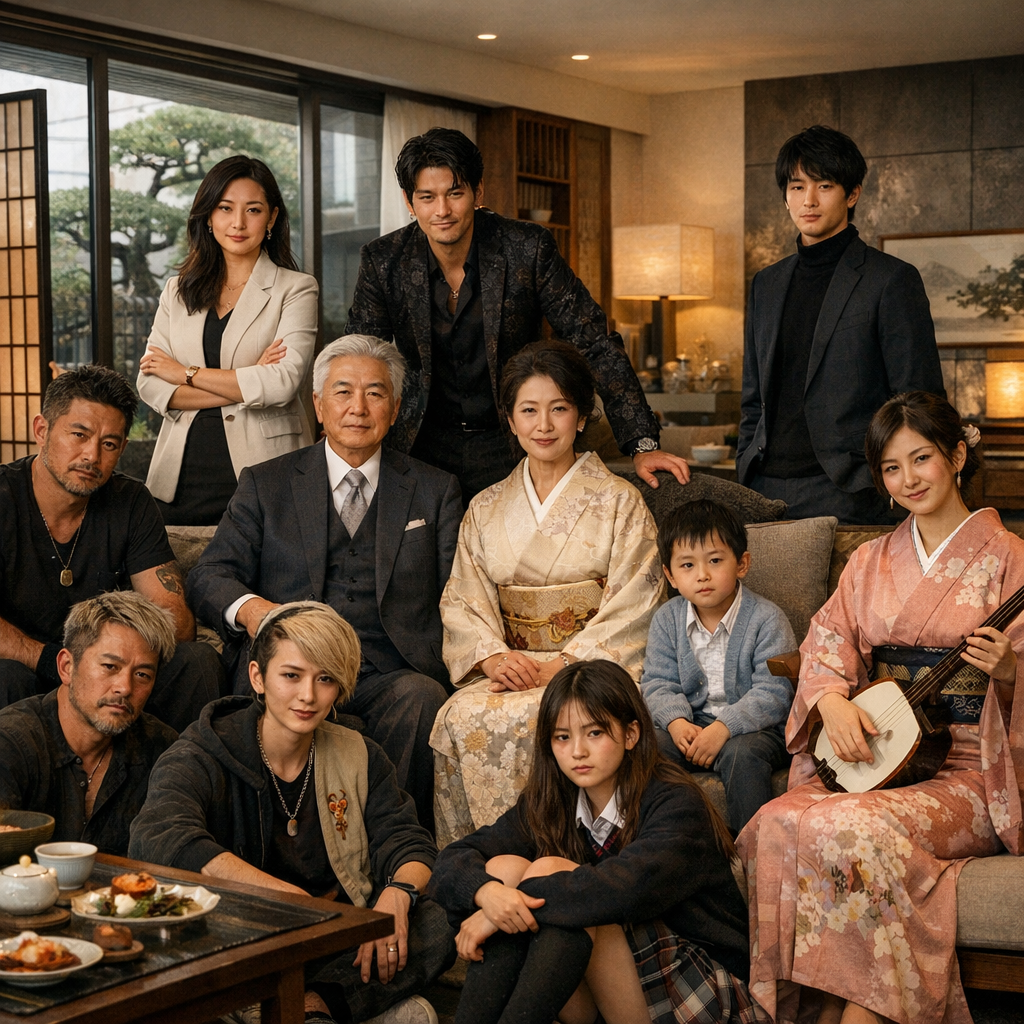
The Most Complicated Image in the Series
I have been thinking about this image longer than almost any of the others.
Not because it is the most dramatic. The Egyptian image hit harder on first contact, a family in visible hardship surrounded by crumbling walls, the gods of one of history's greatest civilizations rendered in poverty. That one landed like a punch.
This one is different. This one takes time.
Every other image in this series collapsed its subject into a single register. The Roman gods bought the room. The Norse gods came home for the holidays. The Celtic gods disappeared into the mist and memory. Each one gave the AI a culture and the AI found one true thing about it and built a picture around that thing.
The Japanese image didn't do that. The AI found the tension instead of resolving it. It put the old world and the new world in the same room, on the same couch, at the same low wooden table, and let them sit with each other. A woman in a formal kimono beside a man with tattoos. A girl playing a traditional stringed instrument beside a girl with bleached hair and streetwear. A patriarch in a suit at the center of all of it, composed, watching.
That is not a simple image. That is a family portrait of a culture negotiating with itself in real time.
To understand what the AI actually rendered here, you need some background you probably didn't get in school. I didn't either. What I knew about Japanese mythology when I was young came from sources that were thin at best and romanticized at worst. So before we walk through who is in this room, let me tell you what I've since learned about the stories these figures carry.
What Western Readers Need to Know About Shinto
Most Western readers arrive at Japanese mythology through anime, video games, or a vague awareness that Japan has a lot of shrines. That's not nothing, but it doesn't prepare you for the actual stories.
Shinto is Japan's indigenous spiritual tradition, and its mythology was first written down in the early 700s in two texts called the Kojiki and the Nihon Shoki. What those texts record is a creation story that begins not with order but with grief.
The two creator deities, Izanagi and Izanami, were brother and sister tasked with forming the Japanese islands. They stood on the floating bridge of heaven and stirred the primordial ocean with a jeweled spear until land emerged. They built a life together. They populated the world with gods. Then Izanami died giving birth to the fire deity, and everything changed.
Izanagi followed her into Yomi, the underworld, because he could not accept the loss. It is the same story as Orpheus and Eurydice, the same story as Persephone and Hades. The person you love is gone somewhere you cannot follow, and you follow anyway. And like those stories, it ends badly. He was told not to look at her. He looked. He found her body rotting, covered in maggots, already belonging to death. She chased him out in fury. He sealed the entrance to the underworld with a boulder and their union was over.
What he did next is the part that matters for this image.
He went to a river to purify himself, to wash off the contamination of death and grief. And as he bathed, gods were born from the act of cleansing. Amaterasu, the sun goddess, emerged when he washed his left eye. Tsukuyomi, the moon god, from his right eye. Susanoo, the storm god, from his nose. The three most important deities in the Shinto pantheon didn't come from an act of creation. They came from an act of grief being washed away.
That origin matters. Keep it in mind.
Amaterasu became the ruler of heaven, the ancestor of the Japanese imperial family, the source of order and light. She is the central deity of Shinto, the one everything else orbits. Her brother Susanoo was her opposite. He was expelled by their father for refusing his duties, for weeping and raging instead of governing the seas he was assigned. Before leaving he went to say goodbye to Amaterasu, and what followed was chaos. He destroyed her rice fields, killed one of her attendants, and drove her into a cave. When Amaterasu retreated, the world went dark.
What brought her out was not force or argument. It was a goddess named Ame-no-Uzume, who danced outside the cave with such wild joy that all the gods burst out laughing. Amaterasu, alone in the dark with the world in crisis, heard laughter and got curious. She opened the cave door to see what could possibly be funny, and light returned to the world. Ame-no-Uzume saved everything by being unruly at exactly the moment when decorum would have failed.
One more figure you need to know before we walk into the room. Near the right side of the image, a young woman in a pink floral kimono holds a stringed instrument. That instrument identifies her immediately to anyone familiar with Japanese tradition. Her name is Benzaiten, and she is one of the most interesting deities in any mythology.
Benzaiten is not originally Japanese. She arrived from India, filtered through China, carried by Buddhist texts sometime around the sixth century. She began as Sarasvati, the Hindu goddess of music, arts, and learning. By the time she settled into Japanese spiritual life she had accumulated new associations: water, dragons, wealth, fortune, eloquence. She became the only consistent female member of the Seven Lucky Gods, a beloved folk grouping of deities still celebrated across Japan today. She is almost always depicted holding a biwa, a traditional Japanese lute. The AI gave her a shamisen instead, close enough, and put her in the younger generation of the family, which is its own quiet observation about how tradition gets carried forward.
One last thing before the room. The Shinto pantheon is not like the Greek or Norse or Roman pantheons. Those are hierarchies, pyramids with a king at the top. Shinto operates more like an ecosystem. There is a concept called yaoyorozu no kami, which translates roughly as eight million gods. Not eight million exactly. It means countless, everywhere, in everything. Rivers have kami. Mountains have kami. Particular trees, particular rocks. There are more than 80,000 Shinto shrines across Japan, each one tending its own relationship with its own local divine presence.
That matters for how you read the image. The AI wasn't rendering a royal family with a king at the center. It was rendering something more like a whole world compressed into one room. Which, it turns out, is exactly what it did.
Who Is In This Room
Let me walk you through the figures the way you would if you were standing in front of this image with someone who knew the mythology.
At the center sits the patriarch. Silver hair, dark suit, silver tie. Composed in the way that powerful older Japanese men are composed in photographs, not stiff exactly, but settled. This is Izanagi, the father of the gods, the one who stirred the ocean and built the world and then lost everything and had to start again. He looks like he has absorbed a great deal and is not finished absorbing.
Beside him is the matriarch in the cream kimono. Floral embroidery, formal obi sash, hands folded in her lap. She is the most visually traditional figure in the image and her composure is serene in a way that reads, on the surface, as graceful. This is Izanami. Once you know her story, that serenity lands differently. This is the goddess who died, who was pursued into the underworld by a husband who couldn't let go, who was seen in her ruin and became the goddess of death. She is sitting at the center of a family portrait smiling quietly. There is something in that worth sitting with.
To the left, slightly apart from the formal grouping, sits a man with visible tattoos on his arms, weathered face, dark t-shirt, a pendant around his neck. He is the most visually dissonant figure in the room. In Japan, tattoos carry a specific cultural weight. They have long been associated with the yakuza, with people who have stepped outside the social contract. This is Susanoo, the storm god, the one who was expelled from heaven for refusing his duties, who destroyed his sister's rice fields and drove her into a cave. He is still at the table. The family kept a place for him. That is its own statement.
Seated to the right in a pink floral kimono, holding her instrument with easy familiarity, is Benzaiten. The goddess of music and arts, the one who crossed three religious traditions and kept her instrument the whole way. She is younger than the central figures, part of the next generation, which makes a certain kind of sense. Tradition in Japan is often carried forward by the young more consciously than by the old, who simply inhabit it.
At the front of the image, sitting on the floor slightly outside the main composition, is a young woman with bleached blonde hair, a hoodie, streetwear, looking directly at the camera with an expression that is neither hostile nor performing. She is the nail that sticks up. This is Ame-no-Uzume, the goddess who saved the world by dancing when everyone else was frozen in crisis. She doesn't fit the formal frame of this portrait. She may be the most important person in it.
And at the center, seated on the couch between the patriarch and the space where the family gathers, is a young girl in a school uniform. Dark hair, direct gaze, something in her expression that is watchful and serious in the way that children are serious when they understand more than the adults think they do. This is Amaterasu. The sun goddess. The ruler of heaven. The ancestor of emperors. Rendered as a child in a plaid skirt, waiting to inherit everything.
The Room Itself
The setting the AI chose is worth its own attention.
This is not a modest home. The recessed lighting, the clean architectural lines, the low wooden table with its careful arrangement of tea and small dishes, the art on the walls, the quality of the furniture. This is an affluent urban Japanese household, Tokyo or somewhere like it, upper middle class at minimum.
Look at what the AI placed in the background. A bonsai tree visible through the window, shaped and tended over years. Shoji screen panels, the traditional sliding dividers that have defined Japanese interior space for centuries. A landscape painting on the wall in the classical style. These are not decorative afterthoughts. They are the AI reaching into its training data and pulling out the visual markers that say: this family has not forgotten where it came from.
And then look at what surrounds those markers. Recessed lighting. A modern sofa. Fashion that ranges from business formal to streetwear. The traditional and the contemporary share the same room without apparent conflict, which is either a remarkable achievement or a careful performance depending on how you read it.
Compare this to the Egyptian image, which came earlier in this series. The contrast is direct and uncomfortable. The Egyptian gods were rendered in poverty, crumbling surroundings, visible hardship. The Japanese gods are rendered in comfort. Both images came from the same AI trained on the same internet. What that tells us is that the visual record of Japan available to that AI is a record of a prosperous, modern, aesthetically sophisticated society, while the visual record of Egypt available to the same AI is something very different. That is not a neutral observation. It is a map of whose stories get told and how.
The room says: these gods have made it. What the rest of the image asks is: made it to what, exactly, and at what cost.
The Economy Behind the Room
That comfortable room has a complicated history behind it.
Western audiences tend to think of Japan as a wealthy, technologically advanced nation, and that is not wrong. But the economic story of the last thirty years is more complicated than the image of prosperity suggests. When the asset bubble collapsed in the early 1990s, Japan entered what economists now call the Lost Decades, a prolonged period of stagnation that the country is only beginning to emerge from. From 1995 to 2023, Japan's GDP actually shrank in nominal terms, from 5.5 trillion dollars to 4.2 trillion, according to World Bank current-dollar GDP data. For a generation of Japanese workers, wages were essentially frozen. The expectation that hard work and loyalty to a company would produce a stable, comfortable life, the expectation the patriarch at the center of this image represents, quietly stopped being reliable.
Things are shifting. Wages have been rising for over two consecutive years now, and the 2025 spring labor negotiations produced the largest wage increases in thirty-four years. But inflation has outpaced those gains, meaning real purchasing power for most workers has actually declined over the past several years; Japan's own labor ministry has tracked that squeeze through its Monthly Labour Survey real wage data. The room looks like comfort. The economy behind the room looks like a long, slow squeeze that the furniture doesn't show.
There is also a gender dimension that belongs here. Japan has one of the highest gender pay gaps in the developed world, nearly double the OECD average. Women have entered the workforce in greater numbers, but the structure of work hasn't changed enough to meet them. Many women still face a choice between career and family that men are not asked to make in the same way. That choice, made by millions of individual women for entirely rational reasons, shows up directly in the birth rate numbers in the next section.
The room is real. The comfort is real. And it sits on top of thirty years of economic disappointment that the younger figures in this image inherited without being asked.
The Demographic Shadow
Now look at the composition again, but this time look at it like a demographer.
Two elderly figures at the center. A wide ring of adults in their thirties and forties surrounding them. Two children, one small boy at the edge of the couch, one school-age girl at the center. That ratio, many adults, very few children, is not just an artistic choice. It is an accidental portrait of Japan's actual population structure.
In 2024, Japan recorded 686,061 births, the lowest number since records began in 1899. In that same year, 1.6 million people died. Deaths outnumbered births by more than two to one. The median age of the Japanese population is now just under fifty, second highest in the world. Experts had predicted the birth numbers would not get this low until 2039. They arrived fifteen years early.
Children aged fourteen and under now make up just over eleven percent of Japan's population. In the United States the comparable figure is nearly double that. In the image, two children appear among ten figures. That is twenty percent, which is generous compared to the actual numbers.
The government has responded with urgency. Japan committed roughly twenty-three billion dollars over three years to encourage births, through child allowances, subsidized fertility treatments, and workplace reforms. The current prime minister has called the population crisis the biggest problem facing the country. A former prime minister described the window for reversing the trend as now or never, part of the same policy emergency summarized in AP's reporting on Japan's 2024 birth data.
The reasons young people are not having children are not mysterious. The cost of living is high. Housing in cities is expensive and small. The work culture is demanding in ways that leave little room for family life. Wages spent decades going nowhere. And for women in particular, the structural barriers between career and motherhood remain largely intact despite years of stated government intentions to address them.
The AI did not know any of this when it generated the image. It just reached into its training data and produced a family. But the family it produced, with its two children outnumbered by adults and its youngest figure sitting alone at the center carrying the weight of the whole composition, looks like a country that is running out of next generations.
The Nail That Sticks Up
Western readers encountering the Japanese proverb for the first time usually feel its weight immediately. The nail that sticks up gets hammered down. It describes a social operating system built around group cohesion, collective identity, and the suppression of individual deviation. In America the squeaky wheel gets the grease. In Japan it gets hammered down. Same wheel, opposite outcome.
This is the system the figures in the left side of this image are visibly negotiating with.
The tattooed man. The young woman with bleached hair sitting outside the formal composition. The man in the ornate dark blazer with jewelry, stylish in a way that is not quite corporate and not quite rebellious. These figures are not, in the Western sense, rebels. Japan has its own tradition of visible youth deviation, the gyaru aesthetic of the 1990s and 2000s with its bleached hair and rejection of traditional feminine ideals, the yankii subculture with its roots in resistance to academic pressure and the promise that obedience leads to stability. Both were visible, both were legible as deviation, and neither was quite the same thing as Western counterculture. They pushed against the frame without fully leaving it.
Researchers studying Japanese youth have identified what they call quiet mavericks, young people who find creative ways to negotiate conformist pressure rather than confronting it directly. They adapt. They find the edges of the acceptable and inhabit them with enough style that the hammer doesn't quite come down. The tattooed man in this image has held his ground long enough that his family still sets a place for him at the table. The blonde woman on the floor is present, accounted for, inside the frame even if she's sitting outside the formal arrangement of it.
But here is where the economic and demographic context changes the reading.
In previous generations, the pressure to conform came with a transaction attached. You subordinate your individual desires to the group, you follow the path, you work the hours, and in return you receive stability, a career, a family, a place in the social fabric. The nail stays down because staying down has rewards.
That transaction has been quietly breaking down for thirty years. The wages stagnated. The secure jobs became scarce for young people entering the market. The cost of raising children in a city became prohibitive. The hours demanded by employers remained punishing while the rewards diminished. A generation was asked to hammer itself down and found that the promised rewards were no longer reliably on the other side.
What looks like aesthetic rebellion in this image may be something more specific than that. It may be a generation opting out of a transaction that stopped being fair, expressing that choice in the only register available to them, which is how they dress and where they sit in the family portrait.
Susanoo in Slow Motion
Susanoo was given a domain. He was assigned the seas, told to govern them, told to perform his role in the cosmic order. He refused. He wept and raged and said he wanted to go to the underworld to be with his dead mother. His grief was real. His inability to take up his assigned place was real. And the consequence, in the mythology, was that the mountains withered and the rivers dried up. Not because he was evil. Because the role went unfilled.
I am not drawing a simple parallel between a generation of Japanese young people and a storm god who got expelled from heaven. People are not mythological figures and demographics are not divine punishment. But the oldest stories have a way of encoding something true about the shape of human situations, and this particular shape, the assigned role, the generation that cannot or will not fill it, the slow withering that follows, appears in the data with uncomfortable clarity.
Japan is not withering. It is one of the most remarkable human civilizations ever produced, with extraordinary depth in art, philosophy, cuisine, design, and spiritual practice. But its population is declining in ways that will reshape it fundamentally over the coming decades. The schools are emptying in rural areas. Some towns are already disappearing. The government is beginning to do what it resisted for decades, opening immigration, because the alternative arithmetic doesn't work.
The young people in this image did not choose this situation. They were born into an economic structure that asked everything of them and delivered less than it promised. They were born into a housing market and a work culture and a set of gender expectations that made the path the patriarch represents look less like a reward and more like a sentence. Their choices are rational. Their situation is genuinely hard.
Susanoo's grief was real too. The mythology doesn't present him as a villain. It presents him as someone whose pain made him unable to be where he was needed. That is a different kind of story, and a more honest one, than the stories we usually tell about demographic decline, which tend toward either blame or abstraction.
The mountains are not withering. But the birth registry numbers have been falling for forty-four consecutive years. The shape of the situation is the shape of the old story. That is worth naming even if it doesn't resolve into anything clean.
What the AI Saw
Every image in this series raises the same question at the end: what does it tell us that this is what the AI produced?
The AI that generated this image was not thinking about Japan. It has no thoughts. It was pattern-matching across an enormous archive of human visual and textual production, finding the shapes that recur most reliably when the words Japanese pantheon appear alongside the word family and the word contemporary and the other terms that shaped the prompt. It synthesized that archive into a single image.
And the archive it was working from is not neutral. It is the aggregate visual record of how Japan has been documented, photographed, reported on, dramatized, and represented by the global media ecosystem over the past several decades. That record has a very specific shape. It is saturated with a particular story: tradition versus modernity, old obligation versus new identity, the tension between what Japan was and what it is becoming. That story has been told in thousands of documentaries, news articles, fashion spreads, manga, anime, films, and academic papers. It is one of the most thoroughly documented cultural narratives of the twentieth and twenty-first centuries.
The AI absorbed all of that and put it in one room.
What is interesting is not that the AI got Japan wrong. What is interesting is the specific version of Japan it got right. It did not render poverty or chaos or a society in crisis. It rendered a prosperous family in a beautiful room, negotiating quietly with itself. That is the Japan that appears most frequently in the training data, the Japan that gets photographed for architecture magazines and profiled in travel writing and documented in sociological studies of modernization. It is a real Japan. It is also a selected Japan, the one the world has chosen to look at most.
The Egypt image rendered hardship because hardship is what the training data most consistently associated with Egypt. The Japan image rendered this particular tension because this particular tension is what the training data most consistently associated with Japan. Both are partial. Both are revealing. The mirror shows you what has been held up to it most often, and that is its own kind of data.
Amaterasu in a School Uniform
Come back to the girl in the center.
She is seated between the patriarch and the matriarch, which is compositionally the most significant position in the image. She is the youngest figure at the heart of the frame. She is wearing a school uniform, the most legible symbol in Japanese visual culture of the path that has been laid out, the expectations waiting to be fulfilled, the nail that will be asked to stay down.
Her expression is serious. Not unhappy, not defiant. Watchful. She looks like someone who understands that she is being looked at and has decided to look back.
In the mythology, Amaterasu is the sun goddess, the ruler of heaven, the source of order and light, the ancestor of emperors. She is the most important deity in the Shinto pantheon. She is also the one who retreated into a cave when the weight of what her brother had done became too much, and had to be coaxed back out by laughter.
The AI rendered her as a child.
That is either an accident of composition or the most honest thing in the image, depending on how you read it. The sun goddess is young. The light of this particular civilization is young. The one who will inherit the room, the economy behind the room, the demographic shadow, the negotiation between the tattooed man and the woman in the kimono, is sitting on the couch in a plaid skirt with her hands in her lap, watching.
What she inherits is not simple. It is a country of extraordinary beauty and depth and a birth registry that has been falling for forty-four consecutive years. It is a tradition that produced Benzaiten and Ame-no-Uzume and the cave story and the idea that laughter can restore the sun. It is a room full of people who are all, in their different ways, trying to figure out how to be in the world that was handed to them.
She is at the center of the frame. The light comes back when she decides to step out of the cave.
We are waiting to see what she does next.
Next in the series: The Mesopotamian Pantheon: The Oldest Story We Know.