
Ancient Pantheons in the AI Mirror: Postscript
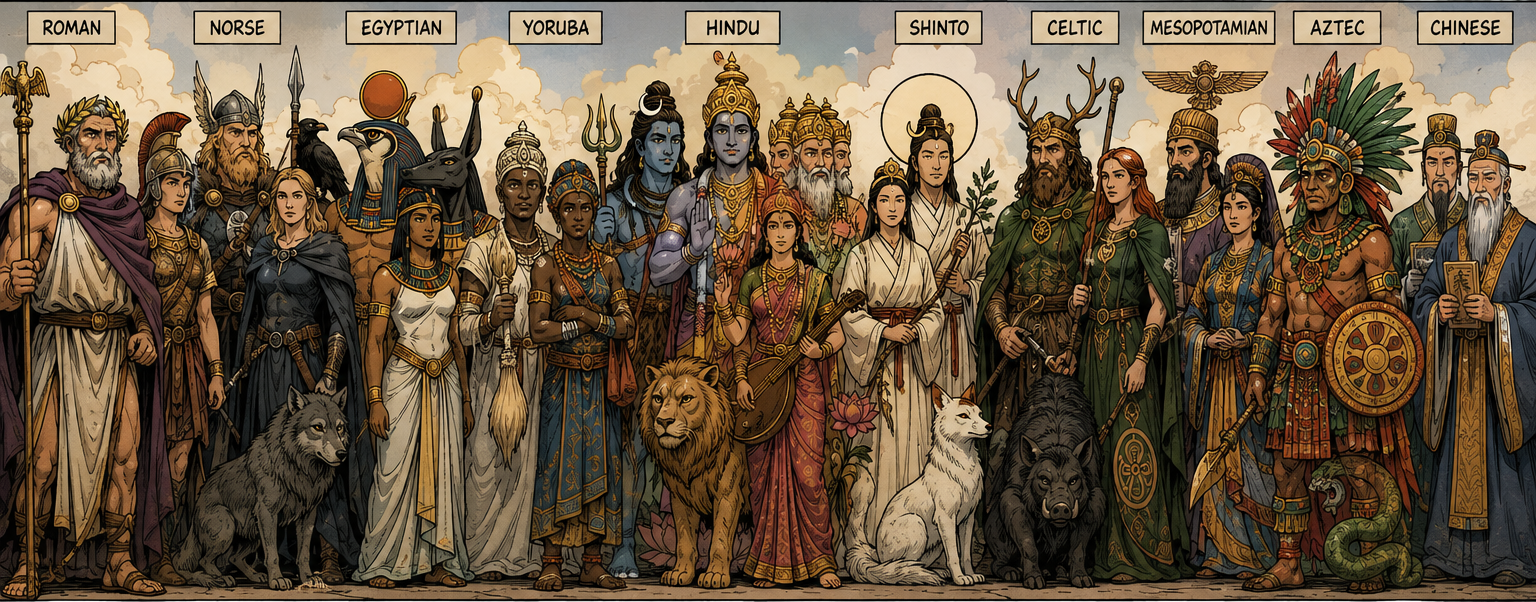
The Traditions Without Traditional Pantheons
Every entry in this series worked from the same premise: take a pantheon, a structured family of gods with distinct domains, relationships, rivalries, and cosmic jurisdictions, and ask the algorithm to render it as a contemporary family in the economic and cultural world of its living descendants.
The premise held for ten entries. It held for the Roman hierarchy of divine administrators, for the Norse gods of war and fate, for the Egyptian functions-made-flesh, for the Yoruba orishas, for the Hindu cosmic triad and its vast supporting cast, for the Shinto kami, for the Celtic pantheon, for the Mesopotamian assembly of heaven, for the Aztec deities of sun and rain and death, for the Chinese celestial bureaucracy.
Every one of those traditions has a pantheon in the structural sense: a populated divine world with internal relationships, competing interests, and differentiated roles. You can ask the algorithm to render them as a family because they already are one, or something close enough that the translation is possible, even when it fails.
The three traditions in this postscript are different for a specific reason.
They don't have pantheons.
Judaism, in its modern form, is rigorously monotheist. One God, no divine family, no cosmic hierarchy of competing personalities. This was not always the case. Early Israelite religion was considerably more populated, and the Hebrew Bible contains traces of that older world if you know where to look. But the monotheism that defines Judaism today was refined through exile and centuries of rabbinic interpretation, and it is that tradition the algorithm was working with.
Christianity has a Trinity and a vast communion of saints but not a pantheon in the sense the series has been using. Buddhism, depending on the tradition, has bodhisattvas and celestial figures, but its central concern is not divine personalities. It is the nature of mind and the structure of suffering and the mechanics of liberation.
When you ask the algorithm to render a pantheon from a tradition that doesn't have one, it has to reach for something else entirely. And what it reaches for, it turns out, is more revealing than anything the ten main entries produced.
This is not a postscript because these traditions are less important or less alive than the ones that preceded it. Hinduism has over a billion active practitioners. The Yoruba tradition is living and growing across three continents. And even the ancient traditions in this series have living practitioners of some kind, from serious reconstructionist communities like Asatru for the Norse, Kemetic Orthodoxy for the Egyptians, and Nova Roma for the Romans, who are working to recover what time and conquest interrupted. The postscript exists for one reason only: these three traditions resist the central premise of the series by definition.
What the algorithm did when the premise broke down is where this ends.
Judaism: The Family at the Table
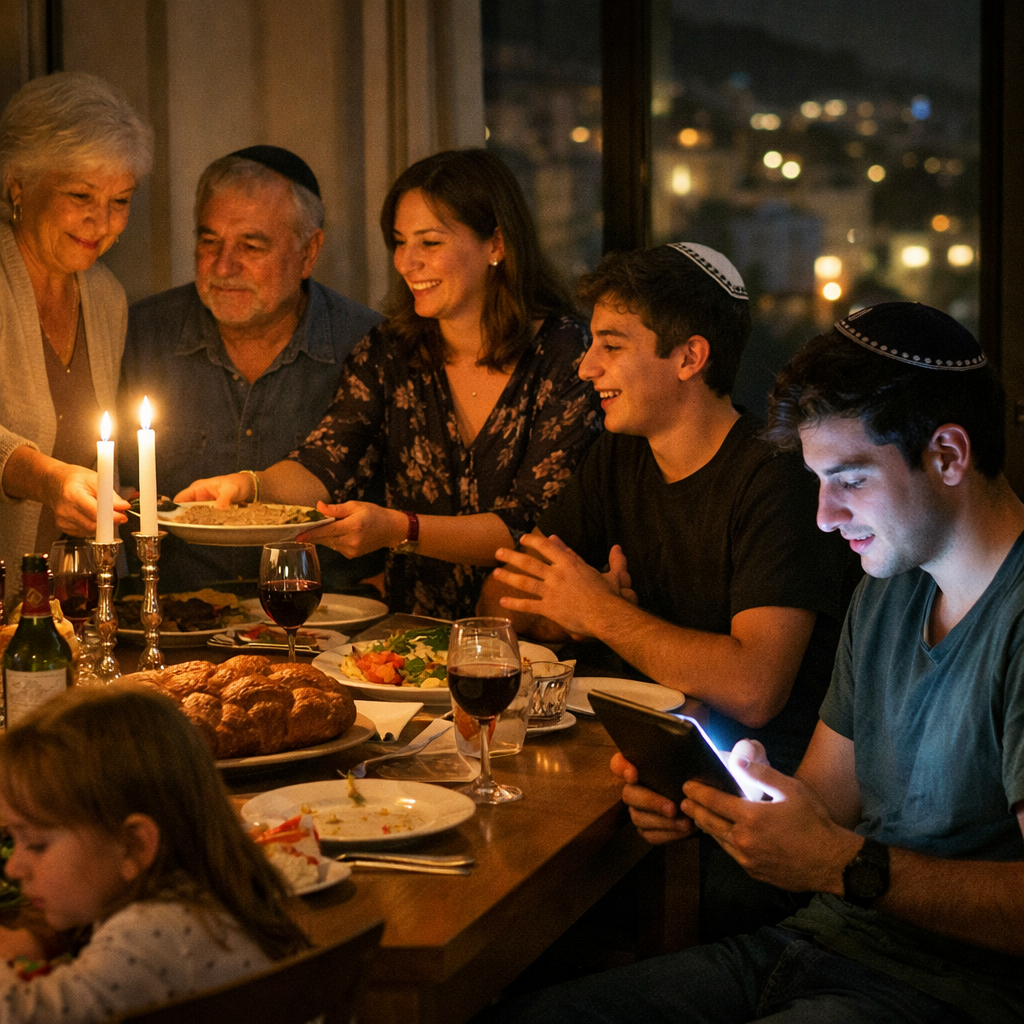
The Jewish image is the most domestic in the entire series, and I mean that as a precise observation rather than a casual one.
A family gathered around a table in the evening. Candles lit. Challah on the table. Wine poured. A grandmother passing a plate. A grandfather in a kippah, quiet authority, the weight of someone who has sat at this table for decades. A mother laughing. Two young men in conversation, one of them with a tablet glowing in his hands.
The algorithm gave Judaism its Shabbat table. That is not nothing. It is in fact a fairly specific and accurate rendering of something real: the tradition that has survived longer than almost any other on the planet did so in part because it located the sacred inside the domestic. The table is the altar. The meal is the ritual. The family gathered is the congregation.
But look closer at the figures.
The young man with the tablet is Moses. I am certain of this. Not because of the tablet itself, though the echo is not accidental, but because of the posture: slightly apart from the warmth of the table, oriented toward something the others aren't looking at yet, carrying information that hasn't been delivered. Moses is always slightly ahead of the room. The tablet glows the way the burning bush must have in a world before electricity.
The older man at the head of the table carries Abraham's particular quality of patriarchal weight, the founder's gravity, the sense of someone from whom everything in the room descends. The grandmother passing the plate reads as Sarah, matriarch, the one who keeps the household moving while the men negotiate with God.
The algorithm did something here it didn't fully do anywhere else in the series. It gave the tradition its domestic theology intact. The sacred is in the ordinary objects. The candles, the bread, the wine, the gathered generations. Judaism encoded that equation thousands of years ago and it survived every exile and every attempt at erasure because it could be practiced anywhere a family could sit down together.
The AI found that. Not the Temple, not the Torah scrolls, not the iconography of power and institution. The table.
Of all the images in this series, this one feels least like a failure.
Christianity: What I Saw First, and What I Missed
I have to be honest about what happened when I first looked at this image, because my first reading was wrong, and the way it was wrong is the point.
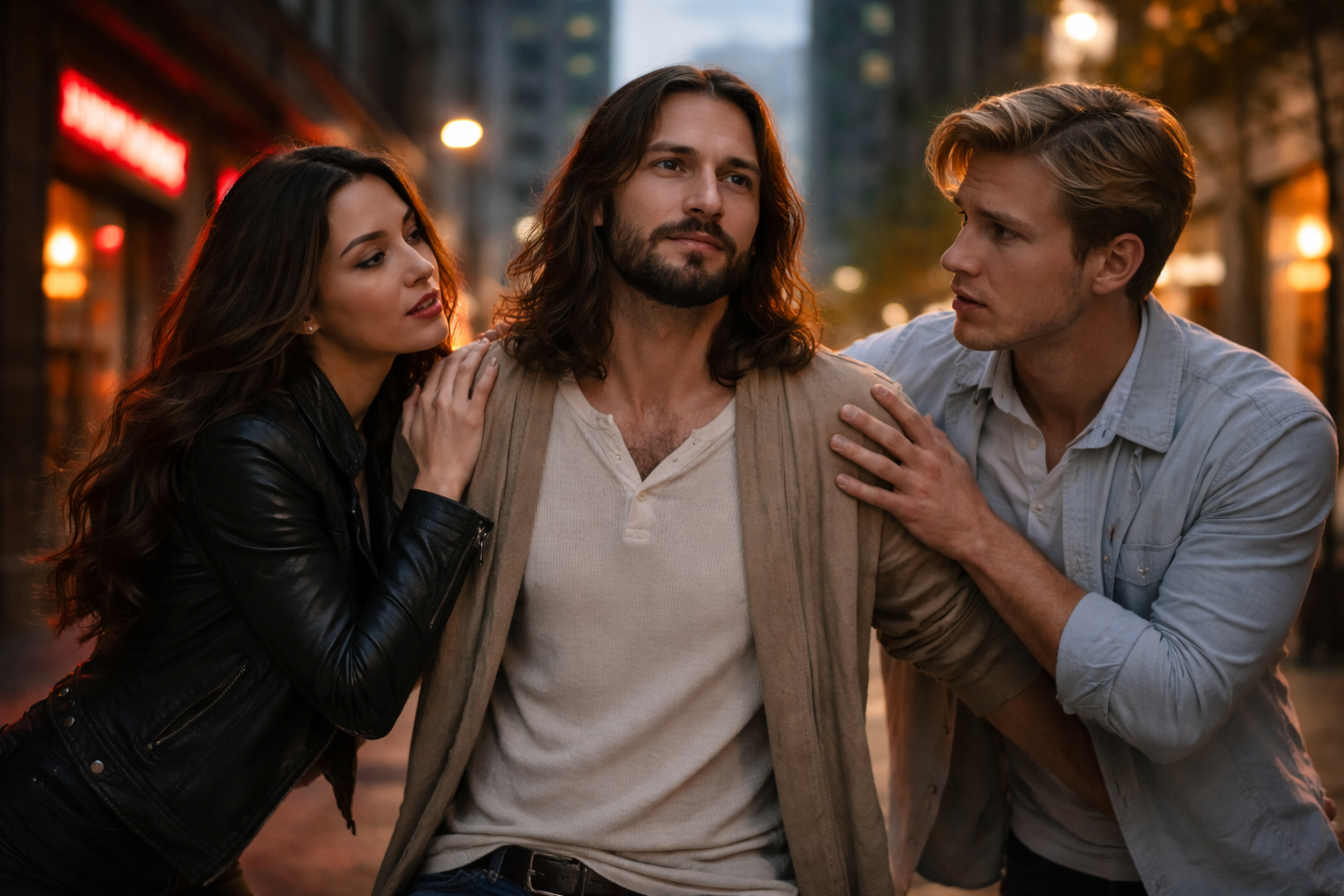
What I saw: a charismatic white man with long brown hair and a beard, standing on a city street at night between two younger figures, a dark-haired woman in a leather jacket leaning close on his left, a young blonde man reaching toward him on his right. Warm cinematic lighting. The composition of a prestige drama. I saw Jesus flanked by devotees. I saw the tradition rendering its central figure as a film protagonist, European and beautiful, the long-haired messiah of a thousand painted altarpieces updated for contemporary clothing and golden hour street lighting.
That reading felt right. It felt like the series argument made visual: Christianity gets its movie, its leading man, its romantic iconography, while other traditions get poverty and erasure and pleasant living rooms that don't know what they don't know.
Then I did something I had not done in any of the previous entries. I asked the algorithm to explain what it had rendered.
And what came back stopped me.
Look at the figures again. The woman leaning in on the left, pressing close, her posture not devotional but insistent, something being offered or demanded. She is Satan. Not the horned cartoon, not the medieval monster, but the original meaning of the word: the adversary, the one who whispers that there is another way, that the cost is too high, that you could have all of this. The dark hair, the leather jacket, the intimacy of the lean, the AI reached for the oldest visual grammar of temptation without knowing it was doing so.
The young man on the right is the other shoulder. Urgent, reaching, his expression carrying something between plea and warning. An angel, or the part of God that stays close to the human, the still small voice that Elijah heard after the wind and the earthquake and the fire. He is losing. You can see it in the posture. He knows he is losing.
And Jesus stands between them, eyes forward, existing in a register neither of them can quite reach. The city lights blur behind him. This is the temptation in the wilderness relocated to a city street, which is theologically appropriate, because the wilderness was never really about geography. It was about the space between who you were and who you were about to become. The crisis is happening right now, to Jesus, on a street that could be anywhere, because it has always been everywhere.
And in a tradition that has no pantheon, this is the closest thing to one: three figures, three forces, three roles that have organized the Western moral imagination for two thousand years. Not a family of gods with competing jurisdictions. Jesus and the two forces pulling at him from either side.
The algorithm couldn't give Christianity a pantheon because Christianity doesn't have one. So it gave Christianity its trinity of moral drama instead. And it did it on a city street at night because that is exactly where that drama has always actually lived.
And he is still white. That matters and cannot be passed over. The historical Jesus was a first-century Jewish man from the Galilee. The AI reached for the version that Western painting produced over twenty centuries of deliberate aesthetic choices, and rendered it without hesitation as the default. The tradition's central figure has been European in the training data for so long that the algorithm doesn't know there is another option.
But the scene itself, once you see it, is more theologically precise than my first reading gave it credit for.
I saw the surface. I stopped there. I called it a movie.
It took looking closer to see what was actually in the frame.
Buddhism: Three Looks at One Photograph
I want to walk you through what happened when I first saw this image, because I think you probably saw the same thing I did, and I think we were both wrong in the same way, and that wrongness is the most important thing the series produced.
The first look
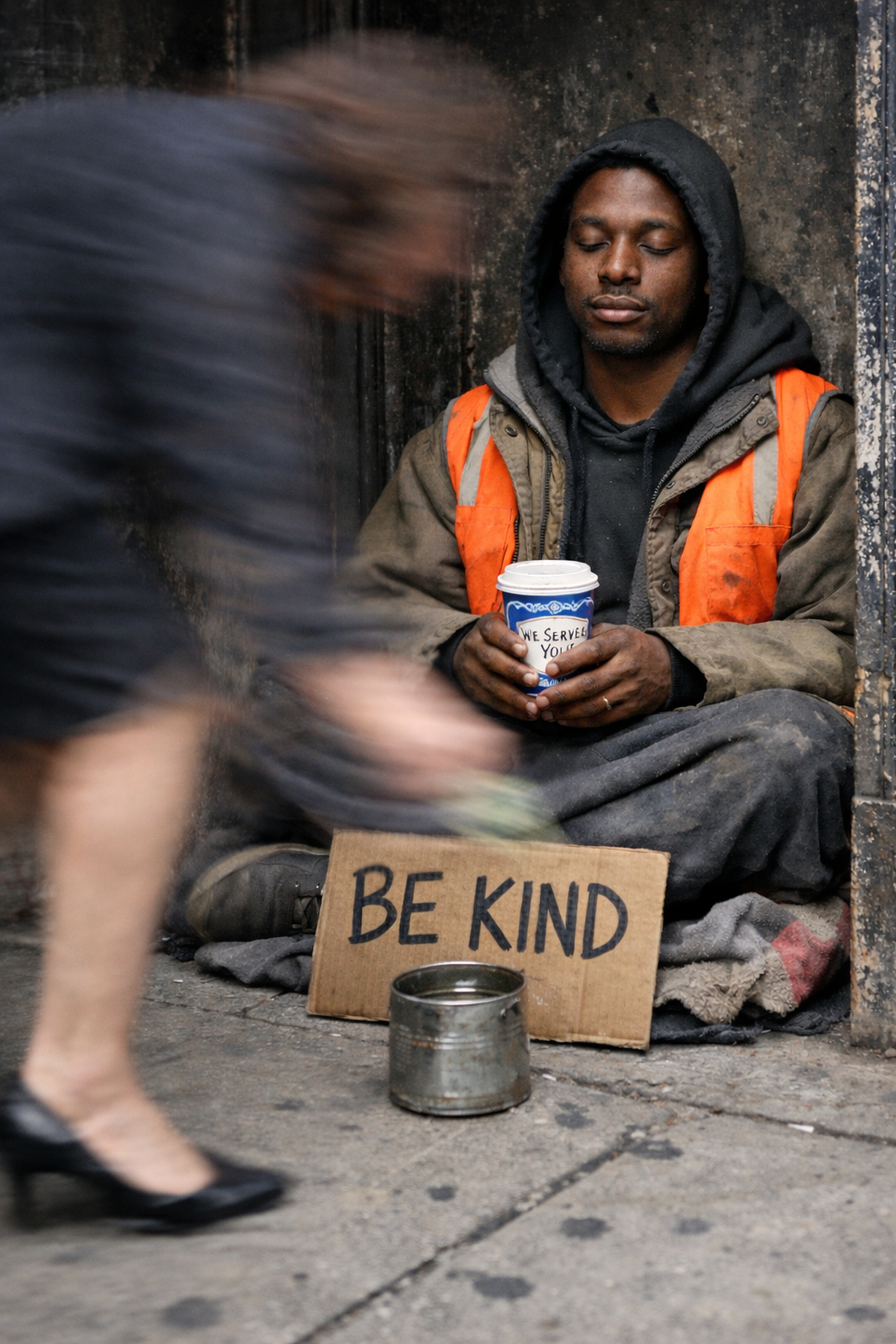
A Black man on a city sidewalk. Worn work clothes, orange safety vest, hooded jacket. Sitting against a wall with a paper cup in his hands and a cardboard sign in front of him. A woman in heels and a pencil skirt moving past, blurred by motion.
The sign says BE KIND.
I saw a poverty photograph. I saw the algorithm reaching into its training data for "contemporary Buddhism in New York" and returning an image of urban hardship and indifference. I saw a Black man being ignored. I saw three simultaneous failures: the reduction of a 2,500-year philosophical tradition to a social welfare aesthetic, the casting of marginalization as enlightenment, the woman as a symbol of the city that doesn't stop.
I wrote that down. I was confident about it.
The second look
Then I looked at his face.
His eyes are closed. Not in exhaustion. Not in despair. In practice. I've seen that look a thousand times. He is somewhere the sidewalk is not. The cup in his hands, the city moving past, the sign, none of it has broken the surface of wherever he is. He has gone somewhere interior and the exterior world is continuing without him, which is more or less the description of every serious meditation practice that has ever existed.
The sign says BE KIND. In that context it is not a plea. It is instruction. It is dharma on cardboard, which is the most New York possible delivery mechanism for a teaching that has been circulating for two and a half millennia.
The cup says WE SERVE YOU.
The bodhisattva vow is precisely that: the commitment to remain in the world of suffering, not to exit into personal liberation, but to stay until all beings are free. You don't leave. You serve. The cup is not incidental.
The third look
Then I decided I probably should look even closer.
She is not ignoring him. She is giving him money. It's hard to see. In motion, anonymous, without breaking stride, without waiting for acknowledgment, without needing him to receive her. She will never know if he noticed. He didn't notice. The exchange is complete on her side and irrelevant on his.
That is dana, the Buddhist practice of giving without attachment to outcome or reciprocity. She is practicing it on a sidewalk in New York while the man she is giving to practices something else entirely, and neither of them is performing it for an audience.
The algorithm generated an image of two simultaneous Buddhist practices and didn't know what it had done.
By accident, reaching for "contemporary Buddhism in New York" and finding the dominant visual vocabulary of urban poverty and indifference, it assembled something that is actually about what Buddhism asks of people in the world. Not the iconography of monks and temples and bells. The actual practice, lived in ordinary clothes on an ordinary sidewalk.
You have to look closer. The tradition that has always taught that the deepest things are hidden in plain sight hid itself in plain sight inside an image that looks like a failure until you look closer.
What the Mirror Actually Was
When I started this series I called it Ancient Pantheons in the AI Mirror. I meant it as a description of method. I was using the AI as a tool to reflect mythological pantheons back at the viewer, a lighthearted attempt to see what happened when you pointed the algorithm at the world's great mythologies and asked it to make them contemporary. I was not trying to prove anything. I was curious, and I thought it might be entertaining.
I thought the mirror was passive. I thought I was the one doing the looking.
I was wrong about that in ways that took ten entries and a postscript to fully understand.
The mirror is not passive. It is a record. Everything that went into the training data, every painting and photograph and film still and news image and album cover and advertisement that human culture produced and distributed and rewarded and repeated, is in there, compressed into weights and probabilities, ready to be retrieved. The mirror holds all of it. Every hierarchy. Every erasure. Every romanticization. Every reduction. Every choice about whose face is the default and whose story gets told at full resolution and whose gets compressed into something easier to render.
The AI didn't make any of those choices. We did. Over centuries, across media, through institutional power and market incentives and the accumulated weight of who got to tell stories about whom. The algorithm arrived at the end of that process and learned from it, which means it learned everything we put in, including everything we would prefer not to have put in.
That is what I didn't understand when I started.
I thought I was examining what AI does to these mythologies. The series kept showing me something else. It kept showing me what we did to them, and how thoroughly we did it, and how the AI's only real contribution was to remove the filters that usually let us avoid looking directly at the results. It began to make me angry around the Egyptian image. The poverty overwhelming the frame, the gods of one of the longest continuous civilizations in human history reduced to the weight of current economic data. Then the Celtic image, pretty and vapid, all misty countryside and red hair, the tradition that produced some of the most complex mythological literature in the ancient world flattened into a tourism photograph. Then the Yoruba, and I realized I knew almost nothing about it, that my own ignorance was part of the problem, that the tradition had been so thoroughly marginalized in the Western cultural record that I had arrived at it nearly empty-handed.
The anger kept building. Entry by entry. The whitewashing, the erasure, the romanticization, the reduction. The consistent pattern of whose story gets told at full resolution and whose gets compressed into something easier to render or easier to ignore.
And then the postscript. And the Buddhist image. And the three looks it took to actually see what was in the frame.
That is where the anger turned around.
Because I had done exactly what I was angry about. I looked at the image and I saw the most available interpretation. Pattern recognition did what it always does: it found the familiar shape and stopped. The Black man, the sidewalk, the cardboard sign, the woman walking past. I assembled a narrative from those elements and called it a reading. I didn't look at his face. I didn't look at the woman's hand. I didn't ask what was actually happening in the frame.
I did to that image exactly what the AI does to every tradition. I found the pattern and I called it the content.
What started as a lighthearted examination of AI image generation became, entry by entry, something I didn't plan and couldn't have planned. A cultural journey that ended up being less about what the algorithm sees and more about what I was willing to look at, and how many times I had to look again and again before I actually saw what was there.
The description I chose at the beginning turns out to have been more accurate than I knew.
Ancient pantheons in the AI mirror.
The mirror was never looking at the pantheons.
It was looking at us.